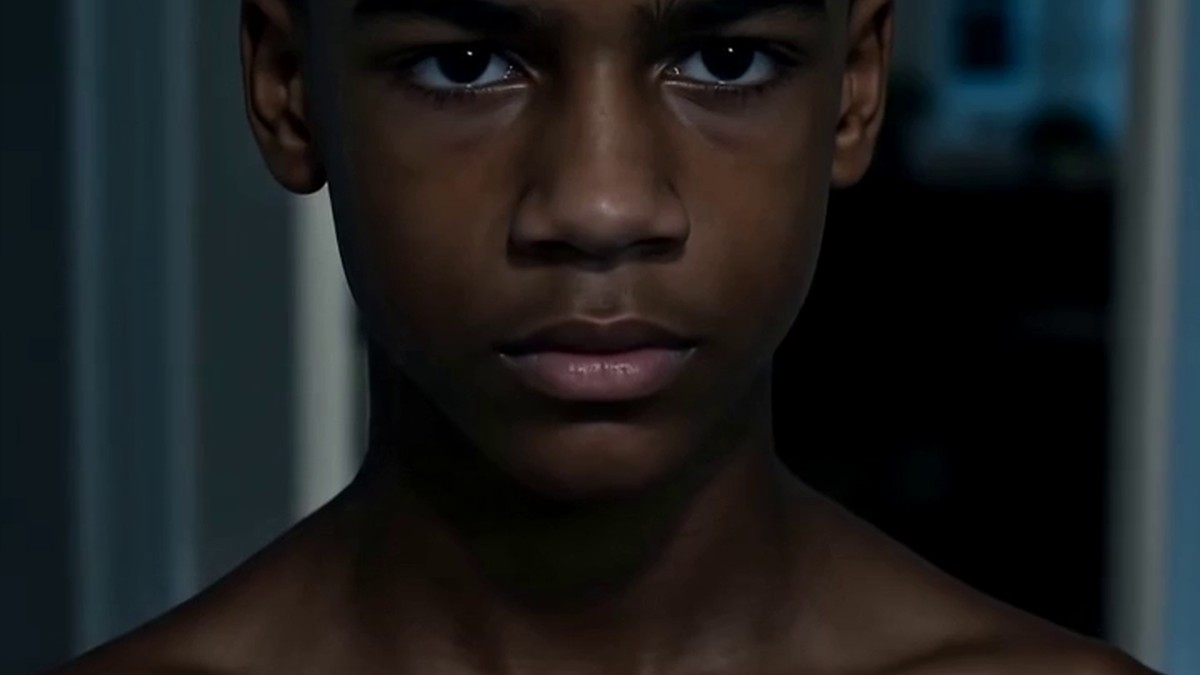
My Husband Left Me for a Fitness Trainer and Our Ten Kids, but Our 13-Year-Old Son’s Words on the Doorstep Made Him Drop His Head
David said it at dinner, right while baby Chloe was squishing oatmeal in her fist on my lap and the twins were fighting over the last piece of cornbread. The whole kitchen smelled like simmering beans, cheap shampoo, and the deep exhaustion that lives in a house with ten children. Someone was always crying about a broken crayon, someone was always looking for a missing shoe, and someone always needed help with math exactly when the rice was about to burn. I thought he was kidding.
“What?”
He was already standing by the door in his dark jacket, a big black suitcase at his feet. Not a gym bag. Not an overnight duffel. It was the same suitcase we’d bought ten years earlier for a Disney trip we never saved enough to take. The whole table froze. Hannah, our sixteen-year-old, clutched her mug. Twelve-year-old Lily stopped chopping cucumbers. The twins, Mason and Maxwell, exchanged a look. Little Owen crawled under the table like he always did when grown-up voices got sharp. And our thirteen-year-old Ethan sat straight across from his father, watching him with an intensity that scared me. Ethan rarely cried. He was the kind of child who learned too early how to hold silence inside his chest.
“David, the kids can hear you,” I said.
“Good,” he answered. “Let them. I’m done being an ATM, a chauffeur, a handyman, and a dad to a whole football squad. I want a normal life.”
Chloe grabbed my shirt. “Daddy, where you going?”
He didn’t even look down. “To Brittany.”
Something cold dropped through me. Brittany. His twenty-seven-year-old fitness trainer. Smooth tan, perfect abs, a social media page full of captions about “raising your vibration,” “detoxing toxic people,” and “a man’s right to choose himself.” I’d glimpsed her photo once by accident, and David had snatched his phone back so fast I didn’t need to ask questions.
“You’re leaving ten kids?” Hannah’s voice wobbled but she didn’t break eye contact.
David grimaced. “Don’t be dramatic. I’m not disappearing. I’ll still help out.”
“How?” Ethan asked quietly.
David turned to him. “What?”
“How exactly are you going to help? With money? Groceries? Diapers for Chloe? Or will you show up on Sundays for a photo so everyone thinks you’re a good dad?”
The room went so silent I could hear the water bubbling over on the stove. David’s face flushed. “Don’t talk to me in that tone.”
Ethan didn’t blink. “Then don’t leave this way.”
I wanted to stop my son but couldn’t find my voice. He was saying everything I was too afraid to let out. I was still gripping a thread of hope that David would set the suitcase down, wrap his arms around the children, and tell us he was exhausted but we’d be okay. He didn’t. He picked up the bag.
“Sarah, I transferred some money. It’ll cover a month. We’ll figure out the rest later.”
“Some?” I repeated. “David, we have the mortgage, school fees, Jacob’s asthma medicine, preschool, groceries—”
“I said we’ll figure it out.”
“Who’s ‘we’? You and your trainer?”
He finally looked at me without love, without guilt—only irritation. “If you ever looked in a mirror once in a while, maybe I wouldn’t have to find a woman who still remembers she is one.”
He said it in front of our daughters. In front of our sons. In front of baby Chloe, who couldn’t understand the words but felt me flinch. I didn’t answer back. How do you answer a man who held your hand during labor, ate at your table for twenty years, and then tried to erase everything you were with a single sentence?
The door closed behind him.
That night, all ten kids slept in the living room together, even the older ones. Nobody wanted to be alone. I sat on the floor between mattresses, stroking one child’s hair, then another’s cold fingers, then someone’s tear-wet cheek. Lily asked, “Mommy, are we poor now?”
“No.” I lied because sometimes mothers lie so children can fall asleep.
The truth was we were worse than poor. We were abandoned.
Within a week, the money stopped. Within a month, the bank called to say we were past due on the mortgage. Within two months, I discovered David had cleaned out nearly all our joint savings for a “fresh start.” Within three months, Brittany posted a photo of them by the ocean with the caption: “When a man finally chooses to live, not just fulfill obligations.”
I stared at that caption from the kitchen table, surrounded by bills, homework sheets, half a loaf of bread, and a grocery list I couldn’t afford to buy. I didn’t feel jealousy. Just a hollow emptiness.
That same night, Ethan came to me with a notebook. “Mom, I did the math.”
“What math?”
He laid a page in front of me. In careful, childish handwriting, he’d listed every expense—bread, milk, electricity, Jacob’s inhalers, the preschool fee, bus fare. With amounts. Where we could cut. Where we couldn’t.
“I can help Uncle Pete at his shop after school. He said he’d give me a little cash.”
“No, Ethan. You’re a kid.”
He looked at me with eyes that had already lost too much childhood. “I’m your son.”
That answer broke something in me. Not because he wanted to help, but because my thirteen-year-old boy already understood that somebody in this house had to become the man who walked out the door.
I didn’t let him trade childhood for a paycheck. But we all changed. Hannah started baking custom cakes with me. Lily watched the little ones after school. Mason and Maxwell hauled firewood for neighbors for a few dollars, even when I scolded them. Owen taught Chloe how to put toys away like a game. And Ethan spent weekends repairing old bikes and selling them online, but only under my supervision.
I sewed late into the night, baked before dawn, cleaned two other houses, and taught myself not to collapse even when my body begged to lie down on the floor and never get up.
A year passed. The house stood. So did we.
Then one rainy evening, as I was hanging little jackets by the heater, the doorbell rang. Ethan answered.
David stood on the porch, thinner, unshaven, wet hair plastered to his forehead, gripping that same black suitcase. Brittany was right behind him, her expensive coat soaked, her eyes cold and irritated.
“Hey, buddy,” David said, forcing a smile. “I came home.”
Ethan didn’t move an inch. “Home?”
David nodded, confused. “Yeah. I want to talk to your mom. To all of you. We’re family.”
Our thirteen-year-old son looked his father in the eye and said, as steady as stone, “No, Dad. Family are the ones who stay when things get hard. You’re just someone who knows our address.”
David stood there like he’d been punched. Then he shifted his gaze past Ethan to me. “Sarah, you’re going to let a child talk to his father like that?”
I dried my hands on a dish towel. “Child? That’s the same child who calculated our budget while you were spending our savings at the beach.”
Brittany’s lips thinned. “David, I told you this was a bad idea.”
“Shut up,” he muttered at her.
The kids were already gathering. Hannah came from the kitchen with flour on her sleeve. The twins appeared behind her. Owen held Chloe’s hand. Jacob, Ava, Ella—all of them filled the hallway behind me like a wall we’d built painstakingly across twelve months.
“I made a mistake,” David said. “A huge one. But I’m still your father.”
Ethan answered first. “’Father’ is a verb, not just a name on a birth certificate.”
David’s jaw tightened. “Who taught you to talk like that?”
“Your silence.”
Brittany snapped, “I’m not standing here while your kids lecture me.”
Hannah’s voice was ice. “Our kids? You wrote that we were an ‘obligation’ he freed himself from.”
Brittany paled. “I never—”
Hannah pulled out her phone, turned it around with a screenshot glowing on the screen. “Right here. ‘When a man finally chooses to live, not just fulfill obligations.’ That’s about us, isn’t it?”
Brittany didn’t answer.
David shifted his weight. “I didn’t come here to fight. I want to come back. I’m in a rough patch.”
“A rough patch?” The words tasted bitter. “When Chloe had bronchitis and I didn’t sleep for three nights, what was that? When the bank threatened to take the house, what was that? When Mason gave his lunch money to his sister for bus fare and came home hungry, what was that?”
David looked away. “I didn’t know.”
Ethan let out a short, joyless laugh. “You didn’t know because you never asked.”
I started to close the door, but David suddenly said, “I still have a right to my share of the house.”
Brittany’s head came up. Now everything clicked. He hadn’t come back only with regret. He’d brought a need.
“What?” I whispered.
David squared his shoulders. “The house was bought during our marriage. I can claim a portion. I don’t want a legal battle, Sarah. But if you won’t let me return, we’ll have to settle it in court.”
Hannah breathed, “Are you serious?”
Lily started crying silently. And Ethan, still standing in the doorway, suddenly said, “Come in.”
Everyone stared at him. Even me.
“Ethan…”
He didn’t turn around. “No, Mom. Let him come in. He wants to do this legally.”
David took it as victory. He stepped across the threshold, set his suitcase in the hall, and looked around. He probably expected ruin—a broken woman, children ready to throw themselves at him, chaos and poverty that would prove he’d been right: we couldn’t survive without him.
But the house smelled like fresh bread. Drawings hung on the walls. Jars of homemade preserves we sold to the neighbors lined a shelf. In the corner stood boxes of Hannah’s custom cake orders. Near the door were two bikes Ethan had refurbished, tagged for shipping. It wasn’t a home without a man. It was a home that had learned to stand without the person who called himself its pillar.
Ethan walked to the cabinet, pulled out a blue folder, and laid it on the table.
“Here.”
David frowned. “What’s this?”
“Your transfers. Or their absence. Bank notices. Screenshots of your posts and Brittany’s. A copy of Mom’s child support filing. A letter from the enforcement office. And one more document you’ll find interesting.”
I froze. I knew about the first papers. Not the last one.
Ethan slid out a sheet in a plastic sleeve. “This is a bank record showing you tried to take out a loan against the house three months after you left. Mom didn’t know anything. But the bank called the home phone, and I took down the message.”
My breath stopped. “Ethan…”
He finally looked at me. “I wanted to tell you, but you were crying in the kitchen that night and I got scared. Then I showed Aunt Anne. She said to save everything.”
Anne, my sister, a family law attorney. I knew she’d helped with the child support case, but I hadn’t known she and Ethan had spent a whole year gathering evidence while I was just trying to survive.
David snatched the paper. “This is nonsense.”
Ethan pulled out his phone. “Want to hear the recording?”
Without waiting, he hit play. The voice of a loan officer filled the hallway: “Mr. David, to process the application we’ll need your wife’s consent, since the property is jointly owned. Without Mrs. Sarah’s signature, we can’t proceed.”
Then David’s voice, sharp and impatient: “She doesn’t understand these things. I’ll get her signature. Just have everything ready fast.”
The silence that followed was absolute.
Brittany took a step backward. “You said the house was practically yours.”
I turned to her slowly. “So that’s why you came.”
She couldn’t hold my gaze. David started talking fast. “I wasn’t going to steal anything. I needed a loan to cover debts. I would’ve paid it all back.”
“Even your excuses make you a thief,” Hannah said.
He spun toward her. “You shut up!”
Ethan stepped between his father and his sister. He was still skinny, still a boy who should have been worrying about video games and first crushes. But he stood straight, chin up, facing the man who’d given him life and then taken away his childhood.
“Don’t yell at her. You’re a guest here. An unwanted one.”
David raised his hand—maybe not to hit, maybe just a gesture. We all flinched. I surged forward, but Ethan didn’t back up.
“Try it,” he said quietly. “And tomorrow this recording won’t just be with the enforcement office. It’ll be with the police.”
David’s arm fell. For the first time, I saw fear on his face. Not shame. Fear. He finally understood that the family in front of him could not be shattered by shouting. We’d already been broken. That was exactly why we’d glued ourselves back together, stronger.
There was a knock at the door. Hannah opened it. My sister Anne stood there with her husband and a court mediator she’d arranged to have present, just in case David tried to pressure us without paying what he owed.
“Good evening,” Anne said, stepping inside. “Looks like we’re right on time.”
David went pale. “Is this an ambush?”
Ethan answered, “No. It’s what grown-ups do when they need to protect their kids.”
Anne placed another folder on the table. “David, as of today your child support arrears are officially documented. The attempted loan without co-owner consent will be filed separately. If you’ve come to voluntarily set up a repayment plan, have a seat. If you’ve come to demand the house, you can leave now and we’ll see you in court.”
Brittany murmured, “You said she wouldn’t do anything. That she was weak.”
I looked at her—young, pretty, furious. A year ago I’d hated her like she’d stolen my husband. Now I understood: a man who can be stolen from ten children isn’t stolen. He runs, looking for someone who’ll believe his lies.
“He told you we destroyed him, right?” I asked. “That I stopped being a woman. That the kids weighed him down. That he carried everything alone.”
Her lips quivered. “He said you never let him live.”
I smiled tiredly. “I gave him dinner, clean shirts, children who loved him, and a home to come back to. But some people mistake responsibility for a cage.”
David sank onto a chair as if his legs had given out. “Sarah, I got lost.”
Once, those words might have broken me. I would have rushed to make tea, to find excuses, to ask what we could do to fix things. But now I saw not the man of my life, only a person who only came back when he lost his comfort.
“No, David. You didn’t get lost. You made a choice. You just didn’t like how it ended.”
Chloe peeked out from behind Hannah and asked, “Is Daddy going away again?”
No one breathed. David looked at her, maybe truly seeing for the first time how much she’d grown in a year. Her hair was longer. She didn’t clutch a spoon in her fist anymore. And she gazed at him not as a hero, but as a strange man who brought fear into the house.
“Chloe…” he whispered.
She hid behind her sister. Ethan laid a hand on her shoulder.
“Yes,” he said for all of us. “He’s leaving. But this time we’re not the ones left abandoned. This time he’s going because we won’t let him break us again.”
I memorized those words. They felt harsh coming from a child. But they were the truth adults are often too afraid to speak.
That evening, David signed a preliminary repayment agreement. Not out of remorse. Under the weight of evidence. And that was okay. Justice doesn’t always start with a repentant heart. Sometimes it starts with a form, a stamp, and the fear of real consequences.
Brittany left first. At the threshold, she paused and said quietly to me, “I thought he was the victim.”
I answered, “He always thinks that about himself.”
She nodded and walked out into the rain.
David lingered a moment in the hallway, his black suitcase beside him—the same one that had once looked like a symbol of his freedom and now only looked like proof of his emptiness.
“Ethan,” he said.
My son didn’t move closer. “What?”
“I… I didn’t want you to grow up so fast.”
Ethan was quiet for a long beat. “Then you should have stayed a dad.”
David dropped his head. It was the first time he couldn’t lift his gaze to us, the first time shame—or maybe something close to it—settled in his shoulders.
It wasn’t a victory. Victory tastes sweeter, lighter. We all had a knot in our throats, because even when justice arrives, it doesn’t give a child back the year without a father, doesn’t give a mother back the nights without sleep, doesn’t restore the smallest ones’ feeling of safety.
But that night, for the first time, we didn’t ask him to stay. He walked out, and the door shut behind him not like a wound, but like a boundary.
There was more after that—court hearings, official child support orders, the divorce decree, a legal block preventing him from touching the house without my consent. Bank inquiries were reviewed. David tried threats, then half-hearted reconciliations, then long messages to the kids about how “Mom turned you against me.”
But the children had already seen enough.
I never forbade them from talking to him. I only stopped forcing them to pretend they weren’t hurt. Hannah messaged him first: “Dad, if you want to be in our lives, start by paying for them instead of asking for a piece of them.” Mason wrote shorter: “Come to my game. No Brittany. No lies.” He didn’t show. Maxwell blocked him for a month after that. Lily was silent for a long time, then sent a photo of Chloe’s drawing—our whole family standing by the house. David wasn’t in it.
He texted, “Where am I?” Lily wrote back, “Where you put yourself.”
Ethan didn’t write at all. Only six months later, when David started paying regularly, he agreed to meet at a diner. I sat at a booth nearby because Ethan had asked, “Don’t interfere, but stay close.”
They talked for almost an hour. Afterward, Ethan slid back into my booth.
“How are you?” I asked.
He shrugged. “He said he regrets it.”
“And you?”
“I told him regret doesn’t fix a bike if you never pick up the tools.”
That was my son. Thirteen then, soon fourteen. A child who spoke in repair-shop metaphors because that was where he’d learned to survive.
I hugged him. “You don’t have to be the grown-up instead of me.”
“I know, Mom.”
“Really?”
He smiled just a little. “I’m learning.”
We were all learning. Learning to live not as the abandoned, but as the ones who stayed together. Our tiny homemade business grew. Hannah enrolled in culinary school. Ethan built a page for his refurbished bikes and named it “Second Gear,” because, he said, even broken things can ride again when someone has the patience to fix them. The twins started helping elderly neighbors with grocery deliveries. Lily drew custom notecards for cake orders. The little ones placed stickers on boxes, often crooked, but with the pride of a royal seal.
A year after David’s return, we took a new family photo. Not to prove anything to anyone. For us. We stood in the same living room where the kids had slept on mattresses the night he left. I was in the center with Chloe on my hip, my ten children around me. The older ones were taller than me. The younger ones were laughing. Ethan stood off to the side, serious but without that frozen adulthood in his eyes anymore—just a cautious calm.
The photographer asked, “Will Dad be in the picture?”
Everyone hesitated. Before I could answer, Chloe said, “We have a mom.”
The kids laughed. So did I. Not because a father doesn’t matter, but because for the first time that sentence didn’t sound like a lack. It sounded like a foundation.
Later, David saw the photo online. He texted me: “You erased me from this family.”
I looked at the message for a long time. Then I wrote back: “No. I just stopped holding a place you walked away from.”
He didn’t reply that day.
Years passed. Ethan grew into a young man who wasn’t hardened the way I’d feared. He was attentive to other people’s pain, but he’d learned not to let it become a rope around his own neck. When his little brother Owen once said, “I don’t want to be like Dad,” Ethan answered, “You don’t have to spend your whole life running from what you don’t want to be. Just do something every day you won’t be ashamed of.”
I listened from the kitchen and let myself cry quietly so no one would see.
David stayed somewhere at the edges of our life. He showed up for some birthdays, missed others. The kids learned not to build a house on his promises. Those who wanted contact had it; those who didn’t were given permission to draw their own boundaries. I stopped being the bridge between his guilt and their hearts.
Once, after Chloe’s school play, he approached me in the parking lot. “Sarah, you were stronger than I thought.”
I looked at him without rancor. “No. I was just stronger than you allowed me to be when I was with you.”
He took it in silence. Maybe he understood. Maybe not. It no longer was the center of my life. The center was a long table that never had enough chairs, spilled juice, burned pancakes, school certificates, wet mittens on the radiator, and a chorus of children who drove me to the edge of my sanity but never again felt like a burden.
My husband left me and our ten kids for a fitness trainer. Back then, I thought he’d taken our family with him. But the truth turned out differently. He only took the illusion that we couldn’t stand without him.
A year later, he came back to our doorstep with a suitcase, debts, and a version of rights he’d invented. He thought he’d find a abandoned woman still waiting. He thought the children would rush to him because blood is louder than memory. He thought the word “dad” would open every door.
But our thirteen-year-old son said to him, “Family are the ones who stay when things get hard. You’re just someone who knows our address.”
And that was the moment I understood: we didn’t lose a father that evening. We found a boundary. And sometimes a boundary is the first real roof over your head.