He announced it over dinner.
"I can't keep living in this daycare." Andrei said it flatly, like he'd been rehearsing it in the car. Like he'd been carrying it in his chest for months, just waiting for the right terrible moment to set it down on the table in front of everyone.
The smallest one, Solomiya, was still on my lap with a spoonful of porridge gripped in her tiny fist. The twins were fighting over the last heel of bread. The kitchen smelled like braised cabbage, children's shampoo, and the particular kind of exhaustion that never quite lifts — the kind that comes from always searching for someone's lost sock, from someone always crying over a broken pencil, from someone always needing math help right when the dinner starts to burn.
I thought he was making a joke.
"What?"
Andrei was standing by the door in his dark jacket. At his feet sat a suitcase. Not a duffel bag. Not a backpack. A large black suitcase — the one we'd bought ten years ago for the family beach trip we'd never managed to afford.
The whole table went still.
Marichka, our oldest at sixteen, pressed her mug to her chest with both hands. Twelve-year-old Katrusia stopped mid-slice on a cucumber. The twins, Nazar and Matviy, looked at each other. Little Petryk crawled under the table, the way he always did when the adults started talking in sharp voices. And our thirteen-year-old, Danylo, sat directly across from his father and stared at him with a focus so absolute it frightened me.
Danylo rarely cried. He was the kind of son who learned too early how to go silent.
"Andrei, the children are listening," I said.
"Good," he replied. "Let them. I'm tired of being an ATM, a taxi, a repairman, a father to an entire soccer team. I want a real life."
Solomiya clutched my cardigan.
"Daddy, where are you going?"
He didn't look at her.
"To Vika."
Something cold dropped inside me.
Vika. His fitness trainer. Twenty-seven years old, tanned, flexible, with an Instagram page full of posts about "the energy of a new life," "detoxing from toxic people," and "a man's right to choose himself." I'd seen her photos by accident once. Andrei had snatched his phone back so fast I didn't need to ask anything.
"You're leaving ten children?" Marichka said. Her voice trembled, but she didn't look away.
Andrei grimaced. "Don't be dramatic. I'm not disappearing. I'll help."
"How?" Danylo asked quietly.
Andrei turned to him. "What?"
"How, exactly, will you help? With money? With food? With diapers for Solomiya? Or will you stop by on Sundays to take pictures so everyone thinks you're a good dad?"
The kitchen went so quiet I could hear the water bubbling in the pot on the stove.
Andrei's face flushed. "Don't talk to me in that tone."
Danylo didn't blink. "Then don't leave in that way."
I wanted to stop my son. I couldn't. His voice carried everything I was too afraid to say myself — because I was still clinging to one last thread of hope: that Andrei would catch himself, put the suitcase back, hug the children, tell us he'd snapped, that he was exhausted, that everything would be okay.
He didn't catch himself.
He picked up the suitcase.
"Olena, I transferred some money. It'll cover a month. We'll figure the rest out."
"Some money? Andrei, there's the mortgage, school expenses, Ostap's medication, daycare, groceries—"
"I said we'll figure it out."
"Who is 'we'? You and your trainer?"
He finally looked at me then. Not with love. Not with guilt. With irritation.
"If you ever bothered to look at yourself in a mirror, maybe I wouldn't have had to find a woman who still remembers she's a woman."
He said this in front of our children. In front of my daughters. In front of my sons. In front of little Solomiya, who didn't yet understand the words but felt, immediately, the way my whole body flinched.
I didn't answer. Because what do you say to a man who ate at your table for twenty years, slept beside you, held your hand through every labor — and then tried to erase everything you were with a single sentence?
The door closed.
That night, all the children slept in the living room together. Even the older ones. No one wanted to be alone. I sat on the floor between the mattresses, stroking someone's hair, someone's cold fingers, someone's face wet with tears.
"Mom, are we poor now?" Katrusia asked.
"No."
I lied. Because mothers sometimes lie so their children can fall asleep.
The truth was we weren't just poor. We were abandoned.
A week later, Andrei stopped sending money. A month in, the bank called about the overdue mortgage. Two months in, I learned he had drained nearly all our shared savings for his "fresh start." Three months in, Vika posted a photo of the two of them at the beach. The caption read: *When a man finally chooses life over obligation.*
I was sitting at the kitchen table, staring at that caption, surrounded by bills, children's notebooks, half a loaf of bread, and a grocery list I had no money to fill. I didn't feel jealous. I felt hollow.
That same night, Danylo came to me with a notebook.
"Mom. I did the math."
"What math?"
He put a sheet of paper in front of me. Written in careful, boyish handwriting: bread, milk, grains, electricity, medication, daycare, transportation. Amounts next to each one. Notes on where we could cut, where we couldn't.
"I can help Uncle Serhiy at his repair shop after school. He said he'd pay me something."
"No, Danylo. You're a child."
He looked at me with eyes that had almost no childhood left in them.
"I'm a son."
That answer broke something in me. Not because he wanted to help. But because my thirteen-year-old had already understood: someone in this house had to become the man of it, because the one who was supposed to be had walked out and closed the door behind him.
I didn't let him give up his childhood to work. But we all changed.
Marichka started baking custom cakes with me. Katrusia looked after the younger ones after school. The twins carried firewood for neighbors in exchange for a few coins, even when I scolded them for it. Petryk taught Solomiya to put her toys away. Danylo repaired old bikes and sold them online — only on weekends, only under my watch.
I sewed at night. I baked. I cleaned houses. I learned how not to fall, even when my body begged me to just lie down on the floor and never get up again.
A year passed.
The house stood. So did we.
And then, one rainy evening, while I was hanging children's jackets near the stove, someone knocked at the door.
Danylo opened it.
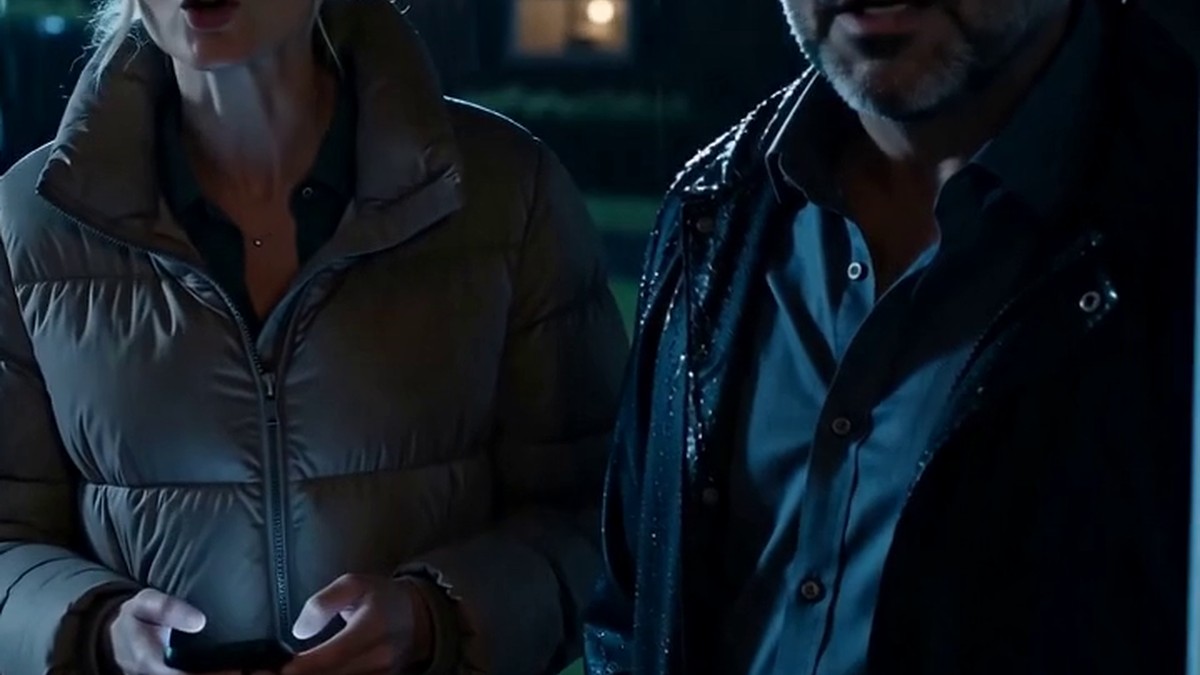
Andrei stood on the porch. Thinner. Unshaven. Hair wet from the rain. The same black suitcase at his side. And behind him — Vika. She no longer looked like the woman from the "new life" photos. She wore an expensive jacket, but her eyes were cold and impatient.
"Hey, son," Andrei said, trying to smile. "I've come home."
Danylo didn't move an inch from the doorway.
"Home?"
Andrei gave an uncertain nod. "Yeah. I want to talk to your mom. And to all of you. We're family."
Our thirteen-year-old son looked at his father and said, in a voice so calm it made my hands go cold:
"No, Dad. Family is the people who stayed when things got hard. You're just someone who knows our address."
Andrei stood there as though the words had hit him physically. He slowly shifted his gaze from Danylo to me. In his eyes I saw something I had spent a year waiting for and no longer needed: the bewilderment of a man who assumed the door would open on its own because he once had a key to it.
"Olena," he said. "Are you going to let a child speak to his father like that?"
I dried my hands on a dish towel.
"A child? This is the same child who was calculating our expenses while you were spending our savings on a beach vacation."
Behind him, Vika pressed her lips together. "Andrei, I told you this was a bad idea."
"Shut up," he said to her, quietly.
Quiet, but we all heard it. The children heard it.
Marichka stepped out of the kitchen with flour still on her sleeve. The twins appeared in the hallway. Little Ostap held Solomiya's hand. Nela, Irynka, Katrusia, Petryk — all of them materialized in doorways, on the stairs, at my back, like a small wall built over a year by grief.
"I made a mistake," Andrei said. "A big one. But I'm still your father."
Danylo answered first. "Father is a verb, not just a word on a birth certificate."
Andrei clenched his fists. "Who taught you to talk like that?"
"Your silence did."
Vika exhaled sharply and looked at Andrei. "I'm not standing here while your kids lecture me."
Marichka said, without warmth: "Our kids? You wrote that we were the 'obligation' he freed himself from."
Vika went pale. "I never—"
Marichka pulled out her phone, opened a screenshot, and turned the screen toward her.
"Here. 'When a man finally chooses life over obligation.' That's us, right?"
Vika had no answer.
Andrei shifted his weight from foot to foot. "I didn't come here to fight. I want to come back. I'm going through a difficult period right now."
It landed so pathetically that even the youngest ones stopped whispering.
"A difficult period?" I repeated. "When Solomiya had bronchitis and I didn't sleep for three nights — what period was that? When the bank threatened to take the house — what period was that? When Nazar came home from school without lunch because he'd given his money to his sister for the bus — what period was that?"
Andrei looked away. "I didn't know."
Danylo let out a short, mirthless laugh. "You didn't know because you didn't ask."
The words hung in the air between us like a verdict.
I was about to close the door. Then Andrei said something that tightened everything inside me.
"I still have legal rights to my share of this house."
Vika lifted her head sharply. Now everything made sense. He hadn't come back with only regret. He'd come back with an agenda.
"What?" I asked quietly.
Andrei straightened his shoulders, as though remembering he had once been the man of this house.
"The house was purchased during our marriage. I'm entitled to a share. I don't want a war, Olena. But if you won't let me back in, we'll have to settle this legally."
Marichka whispered, "Are you serious?"
Katrusia began to cry without sound.
And then Danylo — who had been standing motionless in the doorway — said:
"Come in."
Everyone looked at him. Including me.
"Danylo—"
He didn't turn around. "No, Mom. Let him in. He wants to go legal. Fine."
Andrei took this as a victory. He stepped across the threshold, set the suitcase down in the hallway, and looked around. He was probably expecting ruin. A broken woman. Children racing to throw their arms around him. Disorder, poverty, failure — proof that without him we couldn't survive.
Instead, the house smelled like fresh bread.
Children's drawings lined the wall. Jars of jam we sold to neighbors filled the shelves. Marichka's custom cake orders sat boxed in the corner. Near the door, Danylo's repaired bikes stood ready for their buyers.
This wasn't a house without a man. This was a house that had learned to stand without the man who used to call himself its foundation.
Danylo walked to the cabinet, pulled out a blue folder, and set it on the table.
"What's this?" Andrei asked.
"Your wire transfers. Or rather, their absence. Bank notifications. Screenshots of your posts and Vika's posts. A copy of Mom's alimony filing. A letter from the enforcement office." He paused. "And one more document you'll want to see."
I went still. I knew about the other papers. Not this one.
Danylo slid out a sheet in a clear plastic sleeve.
"This is a bank notice confirming that you tried to take out a loan using our house as collateral — three months after you left. Mom didn't know. But the bank called the home line, and I recorded the message."
I couldn't breathe.
"Danylo—"
He finally looked at me.
"I wanted to tell you. But you were crying at the kitchen table and I got scared. Then I showed Aunt Oksana. She said to keep everything."
Oksana was my sister — a lawyer at a small community organization. I knew she'd been helping me with the alimony case. I hadn't known that she and Danylo had spent an entire year quietly building a case while I was simply trying to survive.
Andrei grabbed the document.
"This is nonsense."
Danylo calmly picked up his phone. "Want to hear the recording?"
Without waiting for an answer, he pressed play.
A bank employee's voice filled the room: *"Mr. Andrei, to process the application, we'll need your wife's consent, as the property is jointly owned. Without Ms. Olena's confirmation, we cannot proceed."*
Then Andrei's voice — crisp, impatient: *"She doesn't understand these things. I'll bring her signature. Just make sure everything's ready quickly."*
The room went dead silent.
Vika took a step back.
"You told me the house was practically already yours."
I turned slowly toward her.
"So that's why you came."
Vika couldn't hold my eyes.
Andrei started talking fast. "I wasn't going to steal anything. I needed the loan to cover debts. I would have paid it all back."
"Even your excuses are theft," Marichka said.
He spun toward her. "You stay out of this."
And then Danylo stepped between his father and his sister.
He was lean, still a teenager, still a boy who should have been thinking about soccer and first crushes and midterm exams. But he stood straight, head up, looking at the man who had given him life and taken from him his childhood.
"Don't raise your voice at her. You're a guest here. An unwelcome one."
Andrei raised his hand. Not to strike, maybe. Perhaps just a gesture. But every one of us flinched.
I stepped forward. Danylo didn't move.
"Go ahead," he said, very quietly. "And tomorrow this recording goes not just to the enforcement office, but to the police."
Andrei's hand dropped.
For the first time all evening, I saw something new on his face. Not shame. Fear. He understood that the family standing in front of him was not one that could be broken with a raised voice. We had already been broken. That's exactly why we'd fused back together stronger.
A knock at the door.
Marichka went to answer it. My sister Oksana walked in with her husband and two social services workers — not to take the children, as I had once feared during my darkest nights, but to serve as official witnesses to a conversation about the alimony debt. Oksana had anticipated this. She'd known Andrei might show up and try to pressure us.
"Good evening," she said, stepping inside. "Looks like we're right on time."
Andrei went pale. "Is this a setup?"
Danylo answered: "No. This is what adults do when they need to protect children."
Oksana laid another folder on the table.
"Andrei, your alimony arrears have been officially documented as of today. The attempted loan application without your co-owner's consent will be filed separately. If you came here voluntarily to arrange a repayment schedule — sit down. If you came to claim the house — you can leave right now. We'll see each other in court."
Vika whispered: "You told me she'd never do anything. You said she was weak."
I looked at her. Young, beautiful, furious. A year ago I had hated her as though she had stolen my husband. Now I understood: a man who can be stolen away from ten children isn't stolen. He runs — looking for someone who'll believe his version of himself.
"Did he tell you we destroyed him?" I asked.
Vika said nothing.
"That I stopped being a woman? That the children were a millstone around his neck? That he carried everything alone?"
Her lips began to tremble.
"He said you suffocated him. That you didn't let him live."
I gave a tired smile.
"I gave him dinner, clean shirts, children who loved him, and a home he could always come back to. But some people experience even love as a cage — when love comes with accountability attached."
Andrei sat down heavily on a chair. His legs seemed to give out beneath him.
"Olena. I got lost."
Once, those words would have undone me. I would have rushed to make him tea, to find excuses, to ask how we could save the family.
Now I looked at him and saw not the man of my life, but a person who had returned only after losing his comfort.
"No, Andrei. You didn't get lost. You made a choice. You just didn't like where it ended up."
Solomiya, who had been hiding behind Marichka, spoke up suddenly.
"Is Daddy going to leave again?"
No one breathed.
Andrei raised his eyes to her. Maybe only then — truly then — he saw how much she had grown in a year. How her hair had gotten longer. How she no longer gripped a spoon in her little fist. How she was looking at him not as a hero, but as a stranger whose presence made the house feel unsafe.
"Solomiya," he whispered.
She pressed closer to her sister.
Danylo put his hand on her shoulder.
"Yes," he said, for all of us. "He's going to leave. But this time we're not the ones being left behind. This time he leaves because we're not letting him break us again."
I will remember those words for the rest of my life. They were too hard for a child to have to say. But they were the truth that grown-ups are usually too afraid to speak.
That evening, Andrei signed a preliminary repayment schedule for the alimony. Not out of remorse. Under the weight of evidence. And that was fine. Justice doesn't always begin with a contrite heart. Sometimes it begins with paper, a stamp, and the fear of what the law can do.
Vika left first. At the door she stopped and said to me, quietly:
"I thought he was the victim."
"He always thinks that about himself," I answered.
She nodded and walked out into the rain.
Andrei lingered another minute in the hallway. The black suitcase stood beside him — the same one. A year ago it had looked like a symbol of his freedom. Now it looked like evidence of his emptiness.
"Danylo," he said.
His son didn't come any closer. "What."
"I… I never wanted you to have to grow up this fast."
Danylo was quiet for a long time.
"Then you should have stayed his dad."
Andrei lowered his head.
This was not a victory. Victory tastes different. Lighter. More joyful. What we all felt in our throats was a knot — because even when justice finally arrives, it doesn't give a child back the year without his father. It doesn't return to a mother the sleepless nights. It doesn't restore to the youngest ones their sense of safety.
But that evening, for the first time, none of us asked him to stay.
He left.
And the door closed behind him — not like a wound, but like a boundary.
After that, there was still a great deal to get through. The court proceedings. The official alimony order. The divorce. An injunction preventing him from encumbering the house without my consent. An audit of the loan applications. Andrei oscillated between threats and peace offerings, sending the children long messages about how "Mom turned them against him."
But the children had seen enough.
I never forbade them from talking to him. I simply stopped making them pretend it didn't hurt.
Marichka replied to him first: *"Dad, if you want to be in our lives, start by paying for them, instead of asking for a cut of them."*
Nazar kept it shorter: *"Come to my game. Without Vika. Without the lies."*
He didn't come. Matviy blocked him for a month after that.
Katrusia said nothing for a long time. Then she sent him a photo — Solomiya's drawing of the whole family standing in front of the house. Andrei was not in the picture. He wrote back: *"Where am I?"*
Katrusia replied: *"Where you put yourself."*
Danylo never messaged him at all. Only after six months — when Andrei finally started sending money consistently — did the boy agree to meet him at a café. I sat at the table next to them, because Danylo had asked: *"Don't get involved, but be close."*
They talked for almost an hour. Then Danylo came back to me.
"How are you?" I asked.
He shrugged. "He said he regrets it."
"And you?"
"I told him that regret doesn't fix a bicycle if you never pick up the tools."
That was my son. Thirteen when it all began. Fourteen by the time we came through it. A child who spoke in workshop metaphors because the workshop was where he'd learned to survive.
I held him.
"You don't have to be the adult. That's not your job."
"I know, Mom."
"You sure?"
He smiled, just slightly, at the corner of his mouth.
"I'm learning."
We were all learning. Learning to live not as people who had been abandoned, but as people who had stayed — together.
Our small home bakery grew. Marichka enrolled in culinary school. Danylo built a page for his refurbished bikes and named it *Second Wheel*, because, he said, even broken things can ride again if someone has the patience to fix them. The twins started helping elderly neighbors with grocery deliveries. Katrusia made hand-lettered cards for our orders. The littlest ones stuck labels on the boxes — crooked, always a little sideways, but with the kind of pride you'd expect from a royal seal.
A year after Andrei's return, we took a new family photo. Not to prove anything to anyone. For ourselves.
We stood in the same living room where the children had once slept on mattresses on the floor after he walked out. Me in the center, with Solomiya in my arms. My ten surrounding me. The older ones already taller than me. The younger ones laughing.
Danylo stood slightly off to the side — serious, as always — but the frozen, icy adulthood that had lived behind his eyes that night on the porch was gone. In its place: a careful, watchful calm.
The photographer asked, "Will Dad be in the shot?"
Everyone went still.
Before I could answer, Solomiya said:
"We have Mom."
The children laughed. And so did I. Not because a father doesn't matter. But because it was the first time that sentence sounded not like a lack, but like a foundation.
Later, Andrei saw the photo online. He sent me a message: *"You erased me from the family."*
I stared at it for a long time.
Then I wrote back: *"No. I just stopped saving your seat at a table you chose to walk away from."*
He didn't write again that day.
Several more years went by. Danylo grew up. He didn't become hard, the way I had feared. He became the opposite — attentive to other people's pain, but no longer willing to let that pain become a rope someone could tie around his neck.
When his younger brother Petryk said once, "I don't want to be like Dad," Danylo answered:
"You don't have to spend your whole life running from who you don't want to be. Just do something every day that you're not ashamed of."
I heard it from the kitchen and cried quietly, so no one would see.
Andrei remained somewhere at the edge of our lives. He came to some birthdays. Not others. The children learned not to build houses on his promises. Those who wanted contact had it. Those who didn't had that right. I was no longer the middleman between his guilt and their hearts.
Once, he found me after Solomiya's school recital.
"Olena," he said, "you were stronger than I thought."
I looked at him.
"No. I was stronger than you ever let me be when I was standing next to you."
He received that in silence. Maybe he understood it. Maybe not. It was no longer the center of my life.
The center of my life was in our house: a long table that was never big enough, laughter and arguments and spilled juice and burned pancakes, school certificates and wet mittens left by the radiator, children's voices that sometimes drove me to the edge of my sanity but never again felt like a burden.
My husband left me and our ten children for a fitness trainer.
I believed, at the time, that he'd taken our family with him when he walked out that door.
The truth turned out to be different. He had only taken the illusion that we couldn't survive without him.
A year later he came back to our door with a suitcase, a pile of debts, and a legal claim he had invented for himself. He expected to find a waiting woman. He expected children who would fall into his arms because blood is always louder than memory. He expected the word *daddy* to open any door.
Instead, our thirteen-year-old son looked him in the eye and said: *"Family is the people who stayed when things got hard. You're just someone who knows our address."*
And in that moment I understood: we hadn't lost a father the night he left.
We had found a boundary.
And sometimes a boundary is the first real roof you've ever had over your head.