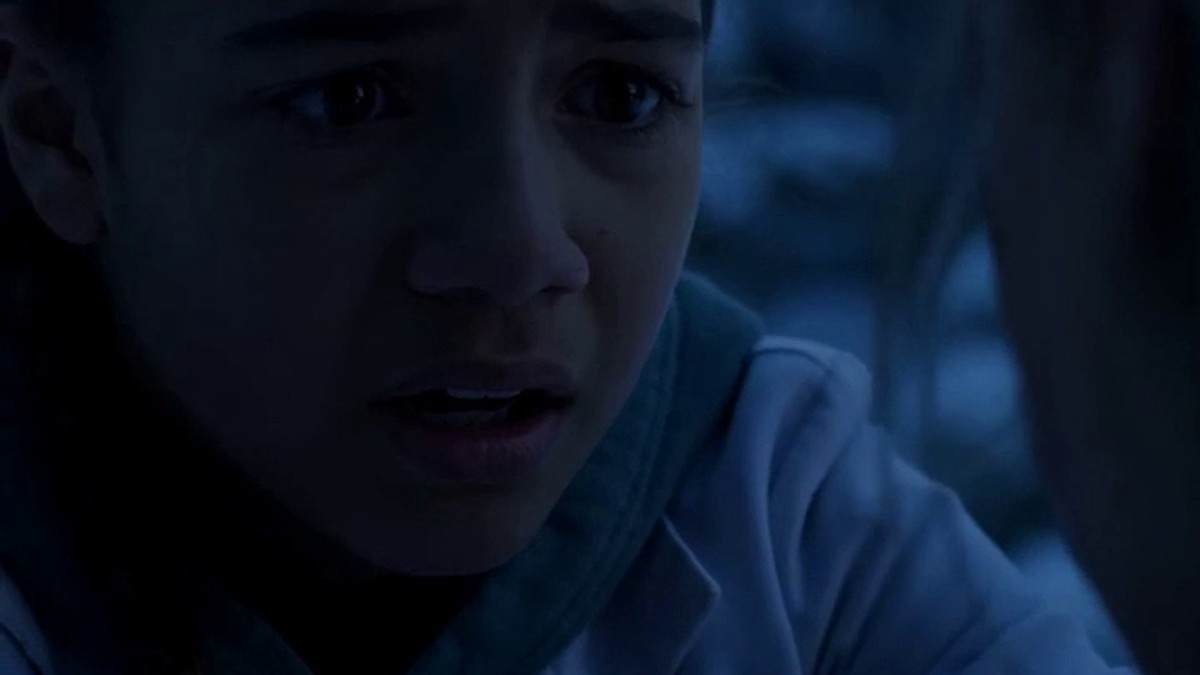
The November wind came off the mountains with a bite that had nothing to do with the calendar. It cut through Maya’s hoodie, through her jeans, straight into her knees as she took the shortcut behind the school. The ground was a soup of dead leaves and half-frozen mud, and every step made a sound like tearing paper. She had her earbuds in but no music playing — she just wanted the world to stay a little farther away for a few more minutes.
Her brother Cody had been coughing through the night again. Not the ordinary cold kind. The kind that makes a ten-year-old’s chest rattle like a cracked fan belt. Their mom had sat on the edge of his bed until three a.m., staring at the wall, and when Maya got up for water, she saw two full cups of untouched tea on the nightstand. Nobody said what they were afraid of.
So she took the long way home. Not the road, but the thin deer trail that dropped behind the Dollar General, past the old pump station, and through a stand of ponderosa pines before it came out at Mapleton Road. She could walk it blindfolded. She had, once, on a dare.
Halfway down the slope, she stopped.
Under a big pine, maybe ten yards off the trail, something white caught the last light. It looked like a bundle of trash, the kind people throw out of car windows — a rolled-up tarp, maybe, or a garbage bag snagged on a root. But the shape was too long. Too still.
Maya pulled out her earbuds.
The forest went quiet. Not peaceful quiet — the kind where you notice your own heartbeat in your ears. A crow called somewhere up the ridge, one short and ugly note, like a door slamming shut.
She took a step closer. Then another.
It was a woman.
She sat slumped against the trunk, her legs folded under her, the white of her medical coat muddied into a sour brown. The coat was stained all the way up, except for one clean sliver at the collar where a laminated badge still hung. Her blonde hair had come loose and mixed with the wet leaves around her shoulders. Her wrists were pulled behind her back, cinched tight with a length of yellow polypropylene rope — the kind sold at the hardware store for tie-downs, for hay bales, for anything but this.
Maya’s fingers went to her own wrist. The skin there felt suddenly thin.
She knew the face.
Doctor Angela Marsh. The woman who had come to the elementary school last spring with a blood pressure cuff and a box of pencils that said “Your Health Matters” in bubble letters. The one who had sat cross-legged on the gym floor when Maya refused to let anyone touch her, and showed her the little silver bell of her stethoscope, and let her tap it with one finger until she giggled.
Angela’s eyelids twitched.
Her lips parted, dry and cracked at the corners. Her eyes moved, fuzzy at first, trying to focus. When she saw Maya, something in her face shifted — not relief, but panic.
“Hey,” she rasped. Her voice sounded like the bottom of a drawer. “Hey, kid.”
Maya didn’t move.
“You need to find Miss Ruth,” Angela said. Each word came out separate, like she was picking them up off the floor. “The church lady. Ruth Ellison. You know her?”
Maya knew her. Ruth ran the food pantry out of the basement of First Lutheran, the one with the crooked “JESUS IS LORD” sign out front. She also answered the phone for the clinic on Wednesdays.
“Do not call 911 from the house,” Angela went on. “Do not tell any man. Not a deputy. Not a doctor. Not anyone from the clinic. Promise me.”
“Why?” Maya’s voice came out smaller than she’d expected.
Angela’s head lolled forward. Her mouth worked, no sound. Then she forced it out: “Because one of them did this to me.”
The wind picked up. It rattled the dead branches overhead, and somewhere far off a truck geared down on the highway. Maya counted the seconds. Three. Four. Five. The woman’s breath was getting shallow and quick, like a sparrow in a shoebox.
Sunset came fast in those hills. It was already pooling orange between the ridges. Thirty more minutes, maybe forty, and the temperature would drop below freezing. Maya had seen what that did. Her uncle’s dog had gone missing in November two winters back. They found it in March, curled under the porch, stiff as firewood.
She dropped to her knees in the wet leaves. The rope was tied with a double knot, then wrapped again around the trunk. Whoever had done it hadn’t wanted Angela to move. Or hadn’t wanted her to be found moving.
Maya’s thumbs went to work on the knot. The rope was slick with mud and something dark. Her nails bent back. She cursed under her breath, first time she’d ever done that out loud, and the word hung there in the cold like smoke.
“I said go,” Angela breathed.
“I will,” Maya said. “Soon as I get your hands free.”
The knot gave with a wet snap. Angela’s arms fell forward. She moaned, a sound that didn’t sound human, and her fingers curled into claws. Maya pulled the rope away and flung it hard into the brush. It caught on a branch and swung there, yellow against the dark.
Angela tried to stand. Her legs buckled. Maya got an arm around her waist, and together they half- crawled, half-walked up the trail. The woman weighed almost nothing. Maya counted the steps to keep her own legs moving. She made it to forty-one before Angela’s knees gave out again.
“I can’t do the hill,” Angela said.
“You don’t have to.” Maya set her against a fallen log. She pulled off her own hoodie, heavy with the smell of school and woodsmoke, and tucked it around Angela’s shoulders. It wasn’t much. It was all she had.
“When I come back,” Maya said, “I’ll whistle. Two short. Like this.” She demonstrated. “If I don’t whistle, it’s not me.”
The woman looked up at her. Her face was beaten and pale, but her eyes were clear now. She didn’t say anything. She just gave one small nod.
Maya ran.
She took the trail at a full sprint, jumping roots, sliding on pine needles, her lungs burning with the frozen air. She burst onto Mapleton Road just as the streetlights flickered on, one by one, like witnesses turning to watch her. Ruth’s house was a pale green trailer at the end of a gravel drive. The lights were on in the kitchen. A thin curl of smoke rose from the stovepipe.
Maya didn’t knock. She hit the screen door with both hands, and when Ruth opened it, the old woman had a dishtowel in one fist and a phone in the other.
“Angela Marsh is in the woods,” Maya said. “She’s been tied up. Don’t call the clinic. Don’t call no man.”
Ruth stared at her for one long second. Then she turned and pulled a thick wool blanket from a hook by the door, and said: “Get in the truck.”
They drove back down Mapleton Road with the headlights on bright, the old Ford Ranger rattling over the potholes. Ruth said nothing. Her knuckles were white on the wheel. Maya sat in the passenger seat, her lungs still screaming, and she caught her own reflection in the side window — her face streaked with dirt, her lips blue, her eyes too wide. She didn’t recognize herself.
They found Angela exactly where Maya had left her. She’d managed to get the hoodie around her shoulders in a way that actually helped. Ruth pulled the truck onto the shoulder, and the two of them loaded Angela into the back seat, as gentle as they could. The blanket went over her. Ruth cranked the heat. Then she reached into the glove box and pulled out a first aid kit, the kind for horses, and handed Maya a pair of scissors.
“Cut the rest of that rope off her,” Ruth said. “Then we’re going to my house. And we’re not telling a soul until Angela says different.”
They stayed at Ruth’s trailer that night. Ruth made tea. She made soup. She sat by the door with her dead husband’s hunting rifle across her lap, not loaded but somehow more serious that way. Maya sat on the floor beside the fold-out couch where Angela slept, wrapped in blankets, and watched the woman breathe.
At two in the morning, Angela woke up. She blinked at the ceiling. Then she said, very quietly: “They were going to leave me there.”
Ruth turned from the door. “Who?”
Angela closed her eyes. “The man I work for. The one who runs the clinic. He came out to the house last week and asked me to sign over my patient list. Said it would be good for both of us. I said no.” She opened her eyes. “Two days ago, someone hit me from behind in the parking lot after my shift. I woke up tied to that tree.”
Maya’s stomach dropped. She thought of the man at the clinic who always handed out lollipops to kids. The one with the bright orange watch and the crisp white coat. He had smiled at her once, right after the school visit, and she had smiled back.
“Why didn’t you call the deputies?” Ruth asked.
Angela shook her head. “He’s on the town board. His cousin’s a deputy. The whole county goes through him for job references. If I call, and they don’t believe me, I’m just a woman who got drunk and wandered off. And then he knows I’m alive.”
Ruth was quiet for a long moment. Then she picked up the phone and dialed a number from memory.
“I know a journalist in Helena,” she said. “And I know the county attorney’s office hours. Tomorrow morning, we’re going to make some noise.”
The next day, they did.
Maya stayed with Ruth while Angela made the calls. She heard fragments through the thin trailer wall: “kidnapping,” “false imprisonment,” “patient list,” “financial pressure.” The journalist from Helena drove down that afternoon and did an interview in Ruth’s kitchen. Angela showed her the rope burns on her wrists. She showed her the bruises. She gave her copies of three letters she’d saved, all signed by the clinic director, offering to “streamline” her practice. The third one had a number written at the bottom: $275,000.
“That’s what my practice is worth to him,” Angela said. “That’s the number he put on my life.”
By Thursday, the story was on the news. By Friday, the clinic director was on administrative leave. By the following Monday, he was arrested on multiple charges, including attempted murder. His cousin the deputy resigned two days later. The whole town went quiet in a way that felt like a held breath, and then the talking started — at the diner, at the gas station, at the church potluck. People looked at Maya differently now. Not everyone liked it.
Angela came by Maya’s house the next week. She pulled up in a white Subaru with a new set of keys in her hand. The old keys, she explained, had been taken from her when she was jumped. The locks at her office had been changed the same day the story broke. She had driven straight to the clinic that afternoon with a manila folder in her lap.
“I revoked every access code,” she said. “His, the office manager’s, the answering service’s. Then I walked into the billing office and froze the account. The full amount sitting there — $275,000 — got flagged for fraud review. It won’t move.”
Maya sat on the front steps, pulling at a loose thread on her jeans. “Did he see it?”
Angela nodded. “He showed up at the clinic about twenty minutes later. His keycard wouldn’t work. The door locked from the inside. He stood there in the parking lot, holding his work badge like a kid holding a blank report card. Then he looked at me through the glass. I held up the folder. He knew what it was.”
“Did he say anything?” Maya asked.
“He didn’t have to.”
Angela reached into her bag and pulled out a small box. Inside was the stethoscope from the school gym. The same silver bell. The same black tube.
“I want you to have this,” she said.
Maya stared at it. “Why?”
“Because you didn’t run.” Angela put the stethoscope down on the step between them. “And because I want you to know what a heartbeat sounds like when it’s finally safe.”
Maya picked it up. The metal was cold and smooth. She pressed the bell to her own chest and listened. It sounded like rain on a tin roof, like footsteps running, like something that had been waiting to be heard.
That evening, Maya walked back to the shortcut behind the school. She stood at the top of the hill and looked down into the pines. The yellow rope was gone. The mud had dried into a map of tire tracks and boots. The crow called again, somewhere deeper in the hush.
She whistled two short notes. Then she turned and went home, with the stethoscope still around her neck, the stethoscope cold against her collarbone, and the sound of her own heart steady in her ears.