The brown dog showed up at the county road turnoff in late September, right before the oaks above the lake started going copper. Ethan first saw him from the school bus window, sitting in the gravel like he'd been poured there and left to set.
By October, people in the lake subdivision had started leaving food. A Styrofoam tray with the remains of a pulled-pork sandwich. A plastic bowl that still smelled like coleslaw. The dog would eat when no one stood too close, gulping every scrap like the bowl might vanish if he lifted his head.
Ethan biked down to the turnoff every afternoon. His house was the fourth one past the boat ramp, a blue-paneled ranch with a basketball hoop over the garage and a mailbox his dad had taken out twice with the lawn tractor. The dog stopped backing away from Ethan around the third week, though he still wouldn't let the kid touch him.
"Hey, buddy." Ethan would sit on the shoulder with his bike laid flat in the weeds and talk about school, about the history teacher who gave pop quizzes on Mondays, about how his mom said they might get a Costco membership if his dad's overtime held through winter. The dog would tilt his head, one ear up and one flopped sideways, and not move.
The dog was big, shepherd-sized, with a coat the color of burnt sugar and a tail that curled up over his back in a tight loop. A question mark, Ethan's sister called him. Every car that passed got the same inspection: head lifting, nostrils working, then the drop back to roadside dust.
Winter came hard that December. County plows shoved snow up over the shoulder and buried the food bowls. Ethan's dad, a man who spent weekends rebuilding a '72 Ford Bronco in the driveway, dragged out a doghouse he'd thrown together from plywood and two-by-fours. Insulated with old moving blankets and a tarp folded over the roof. He dropped it fifty feet from the turnoff with a note taped to the side: "For the dog. Please leave alone."
Ethan shoveled a path from the doghouse to the road after every snowfall. The dog would curl up inside, nose hidden under his tail, but whenever a truck or a car approached, he'd come out and stand at the edge of the gravel, watching the headlights sweep past.
Then spring. The ice went out of the lake the third week of March, and red-winged blackbirds came back to the cattails. Daffodils pushed up around the Millers' mailbox, and someone put a "Firewood for Sale" sign back out on the highway.
Ethan was there the Tuesday afternoon the dark SUV made the turn too fast, tires throwing loose stone. The dog went from lying in the weeds to running full-out, cutting across the road so hard his back legs kicked out sideways. The SUV braked with a lurch, and the driver's door swung open.
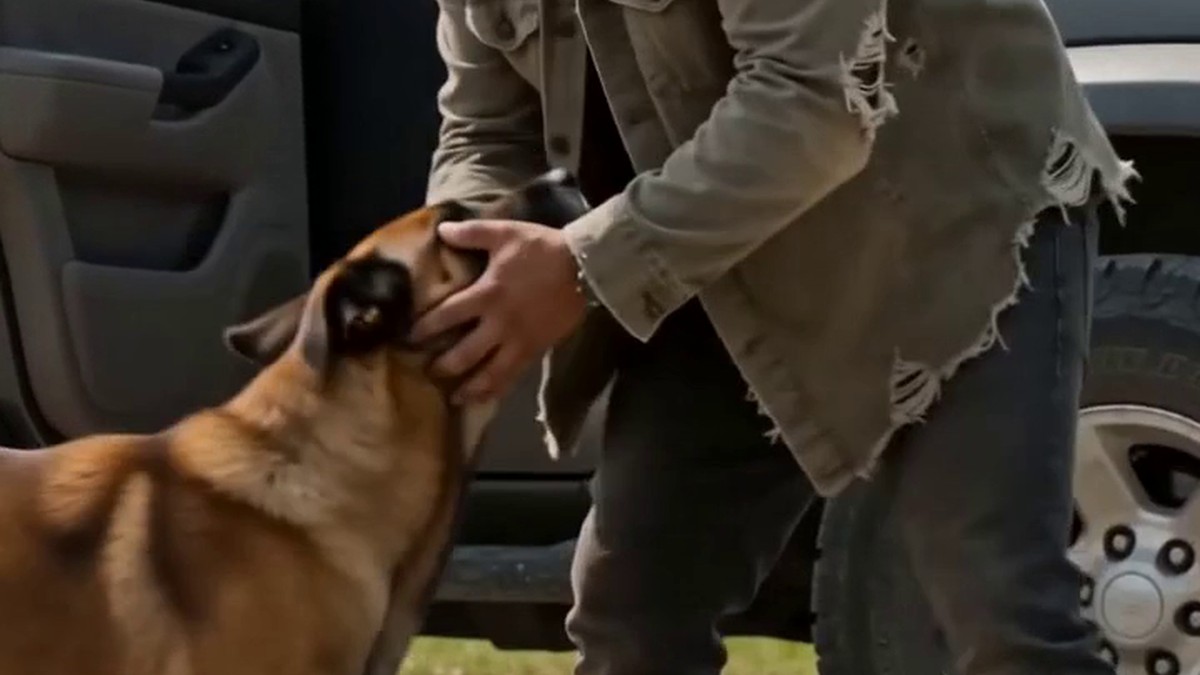
A stocky man got out, maybe thirty, gray Timberland boots and a canvas jacket with a tear in the left sleeve. The dog was all over him, whimpering, jumping up, paws scrabbling at the man's chest. The man shoved him off and the dog circled back, tail in a blur, making sounds Ethan had never heard from him.
"Dwayne? Son of a—" The man grabbed the dog's head with both hands and tilted it back. "Hanna, look at this. It's Brewer! I swear I thought he'd run off or gotten hit. Damn dog's still alive."
A woman stayed in the passenger seat, window down, phone in her hand. She didn't get out.
Ethan walked up, bike left in the gravel. "Sir? Is this your dog?"
The man turned. "Was. Bought him off some guy near Crossville for forty dollars. Said he was a shepherd mix. Look at that tail." He pointed. "Get him home and the guys at the kennel club would've laughed me off the property. I wanted a dog for field trials, not a—" He waved at the air.
"He's been waiting here for you." Ethan's voice came out tighter than he meant. "Since Thanksgiving. Six, seven months. People feed him. My dad built him a house."
"Six months?" The man blinked, looked at the dog, back at Ethan. Then he laughed, a short burst through his nose. "Well, he's a tough one. Hey." He crouched, scratched the dog behind the ears. The dog pressed into his knee, eyes half-closed, making a sound like a leaky radiator. "I got a real German Shepherd now. Bite-trained, papers from a breeder in Nashville. Paid two thousand for him. Wanna see?"
He went to the back of the SUV and came out holding a leggy black-and-tan puppy by the collar. The puppy's paws were enormous, his head too big for his frame. The man lifted him like a trophy.
"This is Ruger. Pure German working line. See the pasterns? Look at the bone on this dog. He's gonna top ninety pounds. You know what a dog like this does to a field trial judge?"
The brown dog sat down in the road. He looked at the man, then at the puppy, then at the ground. His tail went flat and still.
"Look, buddy." The man stepped closer to his old dog, not close enough to touch. "Two dogs is one too many. And you're doing fine here, from the looks of it. People leave you food. You got a house. You're better off than most." He pushed the puppy back into the car, the little dog's legs dangling. "Anyway, you're not—" He didn't finish.
Ethan wanted to say something, wanted to find the words that would make this man see what he was throwing away. But the man was already in the driver's seat, and the SUV was already backing up, and the dog was already running after it, legs pumping hard through the dust, and the SUV was accelerating toward the highway, and the dog ran until the road curved and the car was a dark speck, then gone.
The dog stopped.
He stood in the middle of the county road, chest heaving, looking in the direction the taillights had vanished. Around him, the day went on: a mourning dove called from the power line, someone's lawn mower coughed to life up in the subdivision.
Then the dog turned around. He walked back past Ethan, head dropped low enough to almost touch the gravel, and went to the doghouse. He lay down inside with his head on his front paws, looking out through the opening at nothing.
Ethan stood in the road. His hands were shaking, and he pressed them against his jeans. He'd been telling himself for months that the owner would come back, that there was a story, a reason. But there was a reason, all right. The reason was sitting in an SUV with a fresh puppy in the back and two thousand dollars of pedigree in the passenger seat.
He walked over and kneeled by the doghouse. His reflection was in the water bowl, warped by the rim of the plastic.
"You know what?" he said. His voice cracked at the end, but he kept going. "I don't have papers. I don't have a field trial. But I'll come here every day. I already do." He took off his sweatshirt, a gray one with a ripped cuff, and laid it inside the doghouse, next to the dog's head. "I'm not leaving. Not ever."
The dog shifted. His nose twitched against the fabric, and then, after a long minute, he crawled out and stood in front of Ethan. Not wagging. Just watching, with that one ear up and one ear flopped, like he was trying to decide if a fourteen-year-old kid in jeans and a t-shirt could make good on a promise.
Ethan stood up and started toward home. He didn't look back, not right away. He made it maybe twenty steps before he heard the click of claws on the road behind him.
He turned. The dog was a few yards back, stopped, tail doing a small uncertain circle.
"Come on," Ethan said. "I'll make you a real house. With a real blanket. And you can sleep in the garage until my mom gets over it."
The dog walked to him and pushed his nose into Ethan's hand.
They went up the gravel together, past the boat ramp and the Millers' mailbox and the basketball hoop, and into the yard where the Bronco sat with its hood up and a socket set spread out on a towel. Ethan's dad looked up from the engine block, saw the dog, and wiped his hands on a rag.
"That the turnoff dog?"
"His name's Brewer," Ethan said. "But I'm calling him something else."
He went inside, found his mother in the kitchen slicing tomatoes for dinner, and told her this dog was staying. Not asking. Telling. When he came back out with a bag of dog food from the pantry, the dog was drinking from the garden hose his dad had left dribbling by the tomatoes.
His mother came to the screen door and stood there for a while, arms crossed, watching her son pour kibble into a bowl. Then she said, "He's got to go to the vet. And I'm not paying for it until you've mowed the lawn twice."
"Deal," Ethan said.
That night, he clipped the old collar off the dog—the ragged nylon one with a broken buckle that had been on him since the day he showed up—and put a new red one in its place. On the tag, his dad had engraved two lines with the label maker from the garage:
BREWER
Home: the blue house past the boat ramp.
Phone: 555-0147.
The dog sat on the porch step next to Ethan, pressing against his leg, and together they watched the last of the light go orange over the lake. Down at the turnoff, the empty doghouse stood in the dusk, and on its floor lay the old broken collar, next to the gray sweatshirt Ethan had left behind.
The dog didn't look that way once.