The first time I heard the story, Diane Whitfield was stirring cream into coffee that had already gone cold, watching it swirl without drinking any of it. She told it slowly, the way you'd handle something you weren't sure was still sharp.
It happened on a Tuesday in March, the kind of gray Ohio afternoon when the snowbanks along the curb have turned to gritty slush and everyone's sick of winter but it won't let go. Diane had come home early from her shift at the dental office in Westerville — a patient canceled, and she figured she'd surprise her husband Craig with dinner started before he got back from the insurance agency.
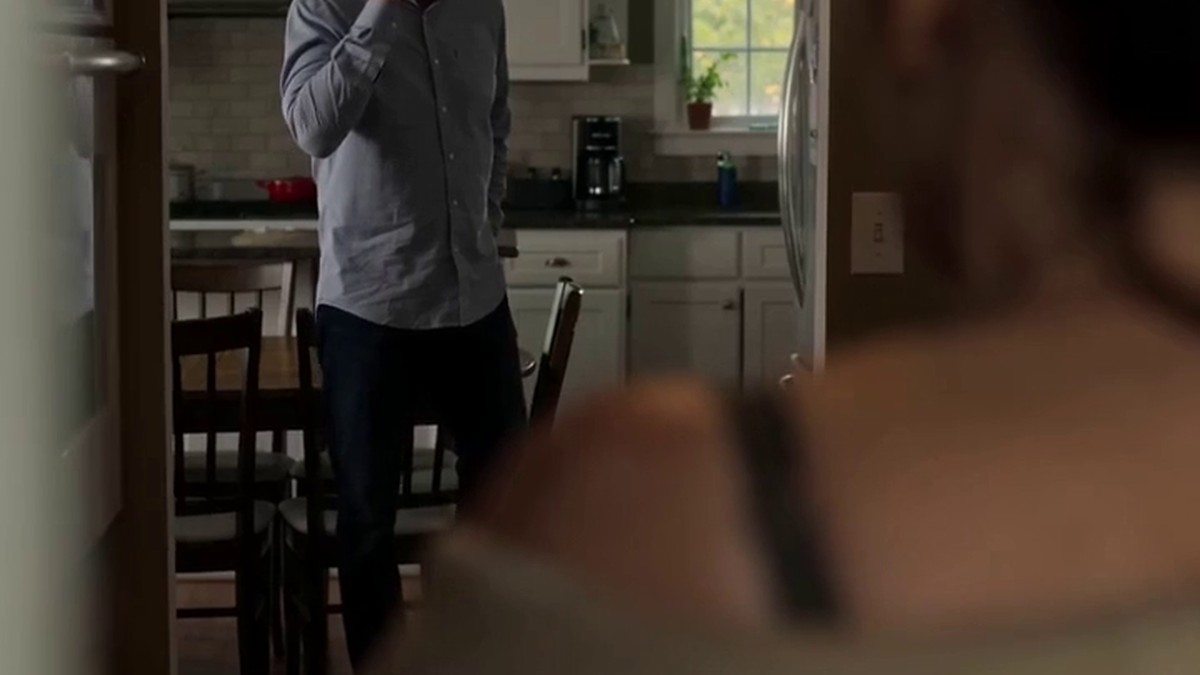
She'd let herself in through the garage, dropped her keys in the bowl by the door, and was hanging up her coat when she heard his voice from the kitchen. He didn't know she was home yet.
"I can't tonight — she'll be here." A pause. "Yeah, I know. I miss you too."
Diane stood in the mudroom with her coat half on one shoulder. The dryer was running down the hall, and the smell of fabric softener drifted past her — Downy, the same one she'd bought for eighteen years. Ordinary smell. Ordinary Tuesday. And Craig's voice sounding like something she hadn't heard directed at her in years.
She knew his voice the way you know the creak of your own stairs. The clipped tone when a client canceled a policy. The particular silence before he told her something she wouldn't like. But this — this softness — she didn't recognize it as belonging to her anymore.
She didn't walk in. She didn't demand anything. She stood very still, the coat sleeve slipping down her arm, and felt something inside her come loose the way a shelf bracket gives way — not all at once, just enough that everything on it tilts.
She backed out through the garage the way she'd come, got back in her Honda CR-V, and sat in the driveway for eleven minutes before she could make herself turn the key.
She went back to work. Finished her half-day. Chatted with the front desk girl, Kayla, who was complaining about her boyfriend's fantasy football habit. Diane nodded along and didn't hear a word of it.
"Why didn't you just stay and confront him right there?" I asked her, weeks later, in the café on High Street where we always met.
She turned her cup in slow circles on the saucer. "Because if I stayed, I'd have to know it for sure. And I wasn't ready to know it."
She never used the word *affair*. Not once, in all the months she told me pieces of this. It sat between us like something too heavy to name out loud.
For the next few weeks, Diane lived like a stand-in for herself. She made Craig's lunch — turkey on wheat, the mustard he liked, an apple. She asked about his day. She helped their son Tyler study for his driver's permit test, quizzing him on stopping distances at the kitchen table while Craig sat two feet away scrolling his phone, which — she noticed now — never left his hand anymore. It used to sit face-down on the counter for hours. Now his thumb moved over it even during commercials.
He started taking calls out on the back porch, in February, with no coat on. "Work stuff," he'd say, coming back in with his ears red from the cold.
He stopped meeting her eyes when he said it.
Six months went by before Diane brought me back into it fully. We were at the same café, and outside the window a plow was scraping down High Street throwing up a wall of dirty snow.
"You know what got me the most?" she said. "I always figured if this ever happened, I'd be the type to scream. Throw something. Demand names."
She managed a small, tired laugh.
"Instead I just realized the man I'd been married to for eighteen years had turned into someone I didn't know how to read anymore."
She didn't tell me how it ended. Not that day.
She called me at six the next morning. I picked up before the second ring — you learn to, with a friend like Diane, who never calls early unless something's happened. Her voice was steady, almost too steady.
"Can you meet me? Don't ask me anything yet."
We sat at our usual table. She wrapped both hands around a mug of coffee that had gone cold before she touched it.
"I asked him something last night," she said. "Not about her. I asked, 'Are you happy with me?'"
I waited.
"He said, 'Why are you asking that?'"
She set the cup down carefully, like it might crack.
"Not yes. Not no. Not even 'what's going on.' Just — why are you asking."
They sat at the kitchen table until almost one in the morning, she told me — the same table where they'd argued over paint swatches for the dining room, where Tyler had done ten years of homework, where they used to split a bag of Doritos watching the Bengals lose on Sunday afternoons. The table hadn't changed. The people sitting at it had.
He told her it wasn't what she thought.
"Is that true?" I asked.
"I don't know," she said, and something in her face had shifted from pain to plain exhaustion.
Later she learned the woman's name: Renee. And the strange part was, Diane already knew her — not well, but from Tyler's travel soccer league, where Renee's daughter played midfield. Quiet woman. Kept to herself at the sidelines, arms crossed, watching more than talking.
"You know what surprised me?" Diane said. "I couldn't hate her. I tried. I'd lie in bed and try to build her into somebody I could hate, and all I could come up with was a woman who brought orange slices for the team on Saturdays and always forgot her own folding chair."
A few days later, cleaning out a closet, Diane found an old photo album shoved behind a box of Tyler's baby clothes. A picture from a trip to the Outer Banks, twelve years back — Craig's arm around her, both of them squinting into the sun, young and sunburned and laughing at something neither of them could remember now.
She sat on the closet floor with the album open on her knees for a long time. Then she closed it and put it back exactly where she'd found it, behind the box of baby clothes.
A month later, Diane made her decision — not to leave immediately, not to stay out of fear either. She told Craig: "I'm done living off guesses."
They actually started talking, for maybe the first time in a decade — not as two people defending a marriage, but as two people finally looking at each other without the usual armor on. He admitted his own version of loneliness, the resentments he'd swallowed for years instead of saying out loud. It didn't excuse anything. It explained some of it.
"That phone call didn't wreck my life," Diane told me once, then stopped and pushed a napkin around the table with one finger. "It just showed me the life I'd already stopped having."
Two months after that, she showed up at my place unannounced on a Sunday evening, a small paper bag in her hand, her face wearing a calm I hadn't seen on her in a year.
Inside the bag was an old flip phone — not the one she'd almost caught him with that first day, a different one, a backup he must've kept in his truck.
"I found it by accident," she said, setting it on my kitchen table.
She didn't turn it on right away. She turned it over once in her hand, thumb running along the seam where the case had cracked, and set it back down.
There was nothing. No texts. No pictures. Just a couple of old notes and one voice memo, something he'd apparently recorded for no one but himself.
She played it. A few seconds of static, then his voice, tired in a way she'd never heard.
"I don't know when things started going different—"
She stopped it there. "I couldn't finish listening."
I didn't say anything. Some moments don't call for advice. They call for somebody willing to sit in the wreckage with you until it settles.
"I spent all this time thinking he chose somebody else," she said. She picked the flip phone back up, closed it, and dropped it in her purse like she was done carrying it in her hand. "I don't know what he chose. I don't think he knew either."
A week later, Renee texted her out of nowhere. Four words: *We should talk.*
Diane almost deleted it. Instead she put the phone down, walked the length of the house and back, picked it up again, and typed: *Okay.*
They met at Antrim Park on a flat gray afternoon, the bare tree branches drawn thin against the sky like something sketched in a hurry. Renee was already there when Diane arrived, sitting on a bench with her coat collar up, looking nothing like the person Diane's imagination had built — not sharp-eyed, not smug, just a tired woman with her shoulders caved in.
Diane sat down at the other end of the bench. The wood was cold enough that she could feel it through her jeans.
"I don't really know why I asked you here," Renee said. She was picking at a loose thread on her coat sleeve, winding it around one finger and letting it go, winding it again.
"Then why'd you text?"
Renee didn't answer that directly. "My daughter has a game Saturday. Regional semis. I keep thinking about whether I'm even going to be able to sit in the bleachers without everybody looking at me."
"They won't," Diane said, though she wasn't sure that was true.
They sat without talking for a while, watching a man throw a tennis ball for a dog that kept losing interest halfway there. Renee cleared her throat like she might say something else, then didn't. Diane didn't push her.
When Diane finally stood to leave, Renee said, "For what it's worth. I'm sorry it was messy. I didn't want it to be messy."
"It's already messy," Diane said. "That part's not up to either of us anymore."
They didn't hug. They didn't cry. Diane walked back to her car, got in, and sat there for a minute before starting the engine, the same way she had in the driveway back in March.
Three weeks later, Diane sat me down at that same café on High Street and pulled a manila folder out of her tote bag. Inside was a printed listing for a duplex on Dublin Road, and underneath it, a signed lease with her name only.
"I put down first, last, and a security deposit," she said. "Nineteen hundred a month. I start moving Tyler's room in on the fifteenth."
She'd already been to the bank that morning — closed the joint checking account they'd shared since 2008, moved her half, eleven thousand three hundred dollars, into an account with only her name on it. She had the printed confirmation folded inside the same folder, next to the lease.
"Craig doesn't know yet," she said. "He will tonight."
She told me she wasn't angry when she said it to him — she described it later as almost gentle, the way you'd tell someone a decision that had already been made rather than one still up for negotiation. She laid the lease on the kitchen table, the same table where he'd once dodged her question with a question of his own, and told him she and Tyler would be out by the end of the month.
He asked her to wait, to talk it through, to give it more time. She told him they'd had eighteen years of time.
The last thing she told me about it: two weeks after she moved, Craig showed up at the duplex on a Thursday evening, unannounced, standing on the little concrete stoop in the rain without an umbrella, asking if they could just talk for five minutes. She opened the door partway, told him Tyler had a chemistry test in the morning and it wasn't a good night, and shut it — not hard, not for effect, just enough that the latch caught.
She told me she stood in the hallway afterward and listened to his truck pull out of the lot. Then she went and checked on Tyler, who was at the kitchen table with his chemistry notes spread out, and asked him if he wanted a grilled cheese before bed.