I pulled into Susan’s driveway at ten after six on a Wednesday, balancing a key lime pie and a list of grievances. The divorce had been final for eight months, and my big sister was still in that stage where she bought throw pillows she didn’t need and talked to the mailman like he was her therapist. The plan was simple: get her a nice kitten, something fluffy that the grandkids could Instagram, and maybe it would snap her out of it. Instead, I walked in and saw that thing.
She’d already named him. Edgar.
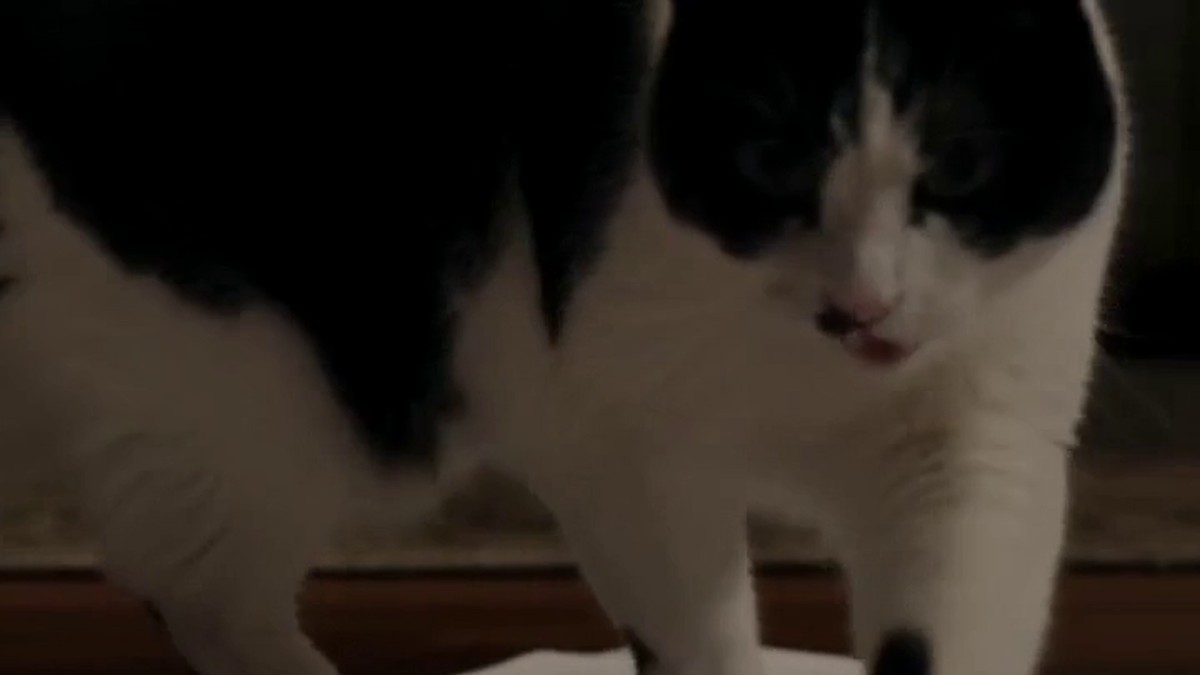
He sat in the middle of her living room like a retired boxer who’d lost every fight but still expected a towel and a bucket. Black-and-white coat, patchy. One ear bent sideways like a straw someone had folded wrong. His tongue hung out permanently, pink and dry, because half his lower jaw was gone—birth defect, the shelter had said. A small, frayed red bow tie was clipped to the collar some volunteer had tried to make festive. He was twelve years old. The shelter had him listed for a forty-dollar adoption fee, down from ninety-five, because, as the intake form noted, he’d been returned twice for being “disconcerting to guests” and requiring a prescription diet that cost more per month than my cell phone bill.
“You took the discount cat,” I said, setting the pie on the coffee table. The words came out before I could catch them, but I wasn’t wrong. Susan had gone looking for a cute kitten for the grandkids and came home with a geriatric hospice case with dental problems, a crooked face, and a tongue that couldn’t stay in his mouth. The thing looked at me with one eye squinted shut and I swear to God he was judging my purse.
Susan knelt down and scratched behind his good ear. The divorce papers were still on the floor by the sofa, a stack of manila folders and legal forms she’d had for a week and never filed away. I’d told her to at least put them in a drawer. She said she didn’t have a drawer that felt right. I’d told her that was nonsense.
Edgar ambled over to those papers, his back legs slightly off-kilter, and I watched him sniff the top sheet—the page with the dissolution clause and my sister’s maiden name typed out like an afterthought. Then he did something I still can’t explain. He turned, looked me dead in the face, and settled his whole weight right on the signature block. Just sat there, tongue out, bow tie crooked, like he’d signed the damn thing himself.
“He does that,” Susan said. “Every night. Sits right there until I go to bed.”
I didn’t have a joke for that.
I left at seven-thirty with a Tupperware of leftover pie and a headache. All the way home down Route 41 I kept seeing that cat’s face, the way he’d planted himself on the one stack of paper my sister couldn’t throw away. A forty-dollar animal nobody wanted, sitting on a marriage nobody wanted anymore, looking at me like I was the one who needed to be put out on the curb.
Here’s the thing nobody tells you about being the practical sister: you spend years feeling like the one holding the house together, and you mistake that for being right. Susan married a man who wore loafers without socks and ordered appetizers like he was hosting a business lunch. I never liked him, but I also never liked how easily Susan forgave people who didn’t show up. She’d give second chances to furniture salesmen. So when the divorce hit, I told her to be smart. Get the lawyer. Split the 401(k). Don’t adopt a dying cat just because it’s on clearance and reminds you of your own reflection.
I went to bed that night and couldn’t sleep. At two in the morning I pulled up the shelter’s website on my phone. Edgar’s profile was still up—they hadn’t taken it down yet. The photo was terrible: him mid-yawn, the bent ear, the off-center face. Under “Special Needs” it said: prescription kibble ($62.40 per bag, three bags a month), quarterly blood panels, likely full-mouth extraction within twelve months. Estimated annual cost: somewhere around $2,100. They’d highlighted it in yellow. The notes from the previous adopters were polite but firm. “Sweet cat, but not a good fit for our home.” “Returned after three weeks—children found him unsettling.” “Too much maintenance for our lifestyle.”
I thought about Susan picking him up from the shelter in that blue PetSmart carrier, driving home, and setting him on the floor next to the one pile of paper she couldn’t throw away. She wasn’t keeping the cat. The cat was keeping her.
The next morning I called Dr. Yablonski’s office in Northbrook. I’d taken my own dog there for years, so the receptionist knew my voice. I asked for an estimate on a full-mouth extraction for an older cat with possible complications. They said baseline for a procedure like that, with pre-op bloodwork, anesthesia, and three days of pain management, started at $1,875 and could go higher. I said book it. Put the whole amount on my card. Then I called the pet supply place on Waukegan Road and set up a recurring delivery of the prescription kibble Susan would need—three bags every four weeks, billed to my account, no end date.
That Friday, the vet’s office called Susan to confirm Edgar’s surgery appointment. She phoned me in a panic, her voice high and confused. “They said it’s been paid for. They said a Caroline Halstead put it on a Visa ending in 4409. That’s you. That’s your card. What did you do?”
I was sitting in my car in the Jewel-Osco parking lot. The air conditioning was blowing hot because I’d never fixed the compressor. I watched a woman push a cart full of bottled water and thought about every time I’d told my sister to be less foolish with her heart.
“I paid for his mouth,” I said. “All of it. The surgery, the follow-up, the food. It’s done.”
There was a long pause. I heard the cat in the background—a low, rattly purr that sounded like a lawnmower with a loose belt. Susan didn’t say thank you. She didn’t ask why. She just let the purr fill the phone for maybe twenty seconds, and then she said, “He’s sitting on the papers again.”
I drove home, walked into my kitchen, and wrote a check for $2,400 made out to the veterinary clinic, even though I’d already paid, because I wanted to see it in my own handwriting. Then I put on coffee and pulled up the shelter website one more time. The forty-dollar cat was offline now, his profile gone, and in its place was a banner that said “Adoption success stories—send us your photos.”
I didn’t send a photo. I just sat at my kitchen table with the check in front of me, the pen still in my hand, and listened to the silence of a house I’d never had to share with anyone.