Leo found the cat on a Tuesday morning in February, wedged behind a rusted-out boiler in the basement of his apartment building on Quincy Street. The super, a guy named Marty who talked more to his lunch than to people, had finally let him down there after the third noise complaint about a “scratching” sound. Leo had stood in the hallway at 6 a.m., holding a flashlight and a can of tuna, while Marty fumbled with a ring of keys the size of a dinner plate.
The basement was a museum of forgotten junk. A headless mannequin. A crate of mildewed hardcovers. The air tasted like damp concrete and nickel. Leo swept the beam past all of it, his heart doing that thing where it hammered once, hard, against his ribs, then went quiet. He’d learned to ignore that feeling. Five months of false alarms will do that to you.
“Diego?” His voice was a croak.
A sound. Not a meow, exactly. More like a puff of dust given a voice. It came from the dark slot between the boiler's belly and the cinderblock wall. Leo got down on his hands and knees, not caring about the grit digging into his palms. He clicked the flashlight off. Waited.
Two eyes, the color of old pennies, blinked slowly from the black.
He’d been a block away the whole time.
—
The flyers had gone up the week after Labor Day, when the Brooklyn heat was still a wet blanket you couldn’t kick off. “Lost Cat. Answers to Diego. Very shy.” The photo was terrible—a blurry shot of a grey tabby loafed on a windowsill, one ear slightly crumpled like a potato chip. Leo had made two hundred copies at the FedEx on Fulton and spent every morning before his shift at the warehouse taping them to light poles. The tape would sweat in the humidity, peeling off by noon. He’d just circle back the next day and do it again.
His sister, Val, called it a lost cause by week three. “He’s a cat, Leo. They do this. He’s probably living his best life in some old lady’s penthouse in Manhattan.”
“He’s scared of the elevator,” Leo said, not looking up from his phone. He was scrolling through a grainy feed of animal shelter intake photos for the third time that night. “He wouldn’t go to Manhattan.”
Val sighed the sigh of someone who’d already had this conversation six times. “Mom’s worried about you. You’re not sleeping.”
“I sleep.”
“Sitting on the fire escape with an open can of sardines at 3 a.m. isn’t sleeping.”
Leo had no rebuttal for that. He just kept scrolling. Diego had slipped out the window during a thunderstorm. A window Leo had left cracked because the AC in his pre-war shoebox was either broken or trying to freeze the entire history of Bed-Stuy. The guilt sat in his stomach like a stone he’d swallowed by accident.
The first month, the calls came in a flood. A tuxedo cat on Classon. A fat orange tabby on Lafayette. A woman on Greene Avenue who was adamant she had Diego, but when Leo raced over, it was a Ragdoll with blue eyes that stared at him like he was the intruder. Leo apologized to the cat and left.
By November, the calls had dried to a trickle. The flyers were buried under layers of ads for furniture flips and mayoral candidates nobody voted for. Leo started a spreadsheet. It felt less crazy than the notebook he’d filled in October. He logged dates, cross-streets, a taxonomy of sightings—“grey tabby (wrong ear),” “grey tabby (too friendly),” “maybe, but ran.”
His co-worker, Jamal, found him staring at it one day during lunch break. “Bro. You’re data-mapping a cat.”
“I’m close,” Leo said, pointing to a cluster of pins around a vacant lot on Throop. “The sightings are tightening up. He’s circling back to the neighborhood.”
Jamal put a hand on his shoulder, heavy and warm. “It’s been three months. The coyotes in Prospect Park—”
“He’s not in the park.” Leo shut the laptop. “He’s close.”
—
The woman in 3B, a retired social worker named Mrs. Garrity, cornered him in the vestibule on a raw December morning. She was holding his latest flyer, now printed on neon green paper so it would pop against the grey slush.
“Leo, honey,” she said, her voice soft with the kind of pity that made him want to crawl out of his skin. “It’s time. The shelter on Linden has some beautiful kittens. I saw a little grey one…”
“Thanks, Mrs. Garrity.” He took the flyer from her hand, smoothed a crease, and stuck it back on the bulletin board. “I’m good.”
She watched him walk out into the cold, her coat pulled tight around her. She told Marty the super later that the boy had a look on his face, like a door that had been locked from the inside.
The break came on a frozen Tuesday in early February. The boiler in the basement coughed and died, and Marty, swearing a blue streak about the management company, had gone down to fix it. When he came back up, he was scratching his bald head. “Somethin’ down there,” he muttered. “Sounded like a ghost with a hairball.”
Leo, who had been coming home from a double shift, stopped dead on the stairs. “Let me down there.”
“No way. Insurance nightmare. You slip on a pipe, I’m fired.”
“Marty.” Leo’s voice wasn’t loud. But it had a weight to it that made the older man blink. “Please.”
The basement was a labyrinth. Leo moved through it with a kind of desperate reverence, calling Diego’s name into the dripping dark. He’d been down here before, months ago, but only a cursory sweep. Marty had rushed him out. Now, he went slow, running his hand along the greasy pipes, checking behind a stack of water-stained ceiling tiles.
And then, the sound. Not a ghost. A paper-thin, rusty little croak of a meow, from behind the boiler.
He didn’t rush. He sat down on the freezing floor, his back against an old steamer trunk, and waited. He talked. He told Diego about the new flyer design he was working on. About how he’d bought a new cat tree, the deluxe one with the hammock. About how he’d left the window closed, even on the nice nights, because the apartment didn’t smell right without him.
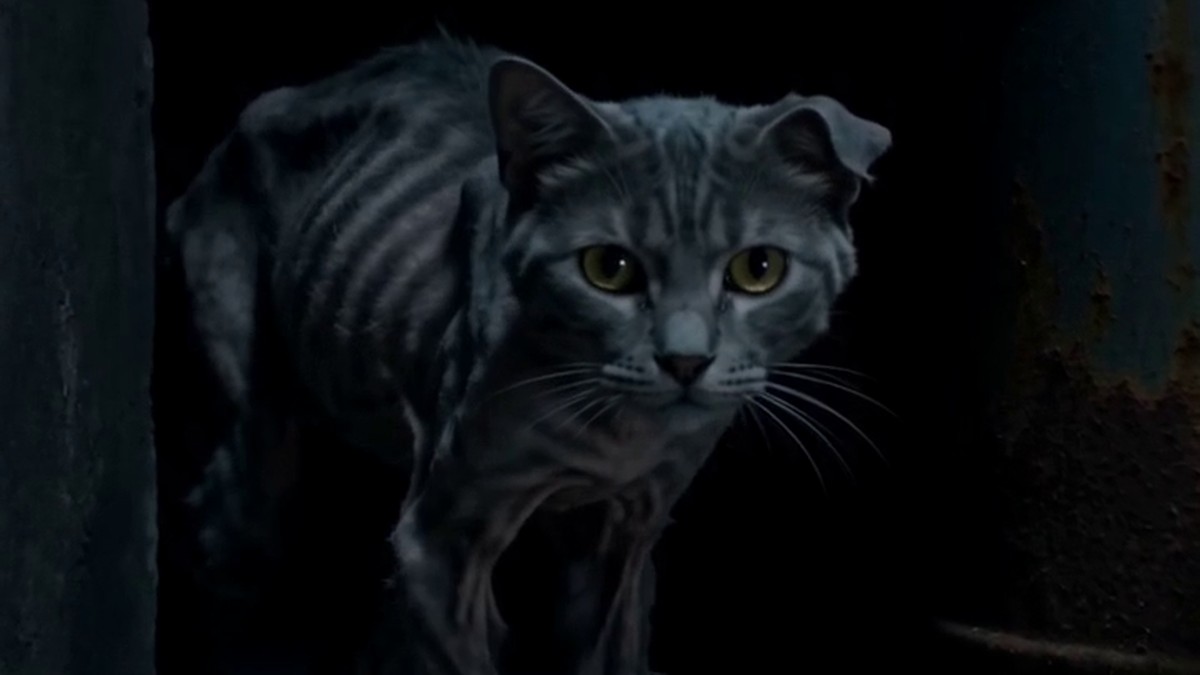
After forty minutes, a shape emerged. It wasn’t the sleek, muscular cat that had launched himself at a moth five months ago. This creature was a sketch of that cat, drawn from memory. Ribs visible beneath matted grey fur. A missing patch of hair on his flank, the skin underneath pale and scarred. One crumpled ear twitching, listening for the trap.
When Diego’s nose finally touched Leo’s outstretched knuckles, Leo didn’t grab him. He just let his hand rest there, a point of contact in the pitch black. He felt the cold, dry little nose twitch against his skin. He felt the hesitant start of a purr, so faint it was more of a vibration in the air between them. Leo’s eyes burned, but he didn’t cry. He was past crying.
He carried Diego up the stairs, cradled against his chest inside his parka. The cat weighed nothing at all. When he pushed open the door to the lobby, Mrs. Garrity was there, struggling with her mail.
She stopped. Stared. The junk mail slipped from her fingers and fanned across the tile floor.
“Lord have mercy,” she whispered. “You found him.”
Leo looked down at the grey head poking out of his coat. “He was in the basement,” he said, his voice cracking on the last word. “The whole time. He was right here.”
Upstairs, he set Diego on the worn kitchen linoleum. The cat didn’t run or hide. He wobbled slightly, then began a slow, methodical patrol of the apartment. He touched his nose to the leg of the couch, the edge of the bookcase, the baseboard. He was reading the story of his absence, smelling the months.
Leo put a bowl of shredded rotisserie chicken on the floor. Diego looked at it, then up at Leo. He took a step toward the food, then stopped, turned, and rubbed his bony cheek hard against Leo’s shin. One long, claiming stroke. Then he ate, daintily, as if he hadn’t been surviving on God-knows-what in the dark.
Later, Leo lay on the couch, unable to even think about sleep. The adrenaline was a live wire humming under his skin. Diego walked up the length of his body, his claws catching slightly in the fleece blanket, and settled his fragile weight right in the center of Leo’s chest. The purr was louder now. A steady, rattling hum, like a broken engine finally turning over. Leo felt the vibration travel through his sternum, into the hollow space where the stone of guilt used to be.
Outside, the Brooklyn night was silent and frozen solid. A siren wailed in the distance. Diego shifted, tucking his head under Leo’s chin, his one crumpled ear folded flat. Leo closed his eyes and placed a hand on the cat’s back, feeling every knob of his spine, the papery thinness of his skin. They had a vet appointment at 8 a.m. sharp. There would be antibiotics, probably fluids, a lecture from a stern woman in scrubs. All of that was for tomorrow.
For now, in the blue glow of a streetlamp filtering through the blinds, they just breathed together. One heart hammering a steady, grateful rhythm. The other heart, small and impossibly fast, answering it from the inside.