I still remember the exact sound of my mother’s hands shaking as she tried to zip the old bag.
Not the sound of fabric.
Not the rustle of things.
But the silence between her breaths—broken, uneven, like she had been holding pain inside her chest for too long.
And I stood there in the doorway.
Frozen.
Not because I didn’t understand what I was seeing… but because a part of me refused to accept it.
“Clara,” I said quietly.
My voice didn’t come out angry.
It came out empty.
She turned slowly.
No shock. No fear. Just a calm, practiced expression—like she had been waiting for this moment, rehearsing it in her mind.
“David,” she replied. “You’re home early.”
My mother looked up at me.
Just for a second.
Then she looked away again, as if she was ashamed of being seen like this.
That broke something in me I didn’t even know could break.
I stepped forward.
“Mom… what is going on?”
Her lips trembled.
“I didn’t want to disturb anything,” she whispered. “It’s fine, David. I’ll go. I don’t want trouble in your marriage.”
Her voice was soft.
Too soft.
The kind of softness people use when they’ve been pushed into silence for too long.
I turned to Clara again.
“This is my mother.”
Three words.
Simple.
But the air in the room changed.
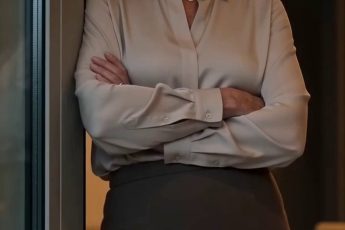
Clara crossed her arms.
“She understands boundaries now,” she said. “This house is not—”
“Stop,” I interrupted.
Not loudly.
But firmly enough that even the walls seemed to listen.
For the first time, I saw something flicker in her expression.
Not guilt.
Not regret.
Annoyance.
As if I had interrupted a plan she had carefully built.
I walked to my mother.
Kneeling beside her, I took the bag from her shaking hands and placed it on the floor.
“No,” I said quietly.
“You are not leaving this house.”
Her eyes filled immediately.
“David, please don’t fight because of me—”
“I’m not fighting,” I said, holding her hands. “I’m correcting something I should have seen earlier.”
There was a long silence.
Behind me, Clara spoke again—but her voice had changed now.
Lower.
Careful.
“You don’t understand what she’s been doing—”
I turned my head slowly.
“I understand enough.”
And for the first time since I walked into that hallway, she had nothing to say.
That night, I didn’t raise my voice again.
I didn’t argue.
I simply sat with my mother in the kitchen while she drank tea she barely touched.
Her hands finally stopped shaking after a while.
But mine didn’t.
Because I kept thinking:
How long had she been living like this… in my house… while I was away building a life I thought was safe?
At some point, she reached out and touched my wrist.
“It’s okay, David,” she whispered. “You didn’t know.”
But that wasn’t what hurt.
What hurt was realizing she had learned to expect less… so I wouldn’t feel guilty.
The next morning, the house felt different.
Not bigger.
Not smaller.
Just… honest.
Clara was gone.
No dramatic scene.
No shouting.
Just silence where something false used to live.
And my mother was sitting by the window, slowly watering a plant she always said was “too stubborn to die.”
She smiled at me faintly.
“I like this corner,” she said.
“You can have the whole house,” I replied.
She shook her head.
“I don’t need the whole house. Just a place where I’m not in the way.”
That sentence stayed with me longer than anything else.
Weeks passed.
Then months.
And slowly, something changed in me too.
Not my success.
Not my work.
But the way I measured life.
Because I realized something I should have known long ago:
A home is not built with money, or walls, or status.
It is built with who feels safe inside it.
One evening, I found my mother in the garden, watching the sunset.
The light was soft.
Golden.
She didn’t turn when I came beside her.
She just said quietly:
“You came home at the right time that day.”
I didn’t answer immediately.
Because I knew the truth.
I didn’t come home early.
I came home just in time to finally see what had been there all along.
If you were in my place… would you have had the courage to believe your eyes the first time?