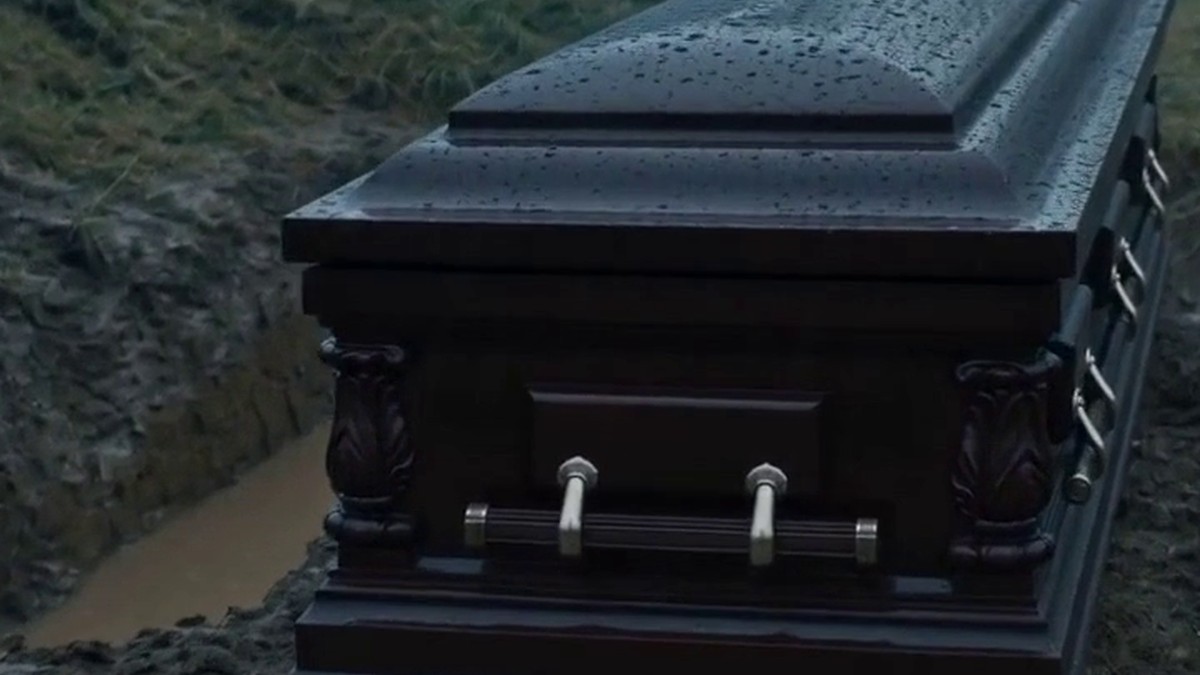
The gravediggers at Riverbend hadn't even finished when the sky opened up over Cedar Falls, Ohio, and I remember thinking my stepfather Walter would've laughed at that — rain ruining a funeral he'd have called "overpriced theater with a bad sound system." He was like that. A busted air conditioner in July wasn't a disaster, it was "character building." A flat tire on I-71 was "the car asking for a coffee break."
Even now, soaked through my navy trench coat, my flats sinking into mud by the fourth hole from the maple tree, I couldn't stop hearing his voice cracking jokes about his own funeral.
That's what broke me. Not the casket. The jokes I imagined he'd make about it.
Derek stood to my left, arms crossed so tight his knuckles had gone pale. Priya kept wiping her nose with the same soggy tissue. Jonah just stood there, staring at the hole like if he looked hard enough it would give something back.
I'd written something to read graveside, folded twice in my coat pocket, but I never got it out. Something about thank-you notes tucked into our backpacks. About the time he tried to braid my hair for school picture day and turned half of it into what looked like a fishing knot. About sitting up with me through chicken pox and a broken engagement and a car wreck of my own, years later, that scared him more than it scared me.
Walter Pruitt was never my biological father. In that house on Larchmont Street, it never once felt like it mattered.
I was five when I met him. He showed up to my mother's apartment holding a stuffed rabbit missing one ear, and said, "Your mom tells me you're particular about things. This rabbit's particular too. Figured you two might get along." I named it Waffles. I still have it in a box in my closet.
Two years of the three of us being an ordinary, boring, wonderful family. Then my mother went through a red light on Route 9 during an ice storm and didn't come home.
My grandparents drove down from Toledo to collect me, already talking about which of them would take me, assuming Walter — a man with no blood tie to me at all — would quietly step aside now that his wife was gone.
He was sitting on the living room floor with me when they said it out loud. I had Waffles in my lap. Walter looked at my grandfather and said, "She's staying with me." My grandfather started to argue. Walter said it again, slower, like he was reading it into a court record.
When I was eight, Walter adopted twins, Derek and Priya, who'd bounced through four different foster placements in six years. Two years after that came Jonah and his younger sister Marisol — siblings the county placed with us and Walter made permanent the second the paperwork allowed.
Five kids yelling "Dad" from five different rooms of a three-bedroom rambler that should've been too small for all of us. It never felt small.
At the cemetery, Derek leaned toward me and murmured that he half expected Marisol not to show. I'd spent two years bracing for her to show up furious, if she showed up at all.
She was twenty-two but looked like she hadn't slept through a full night in a year. I'd called her the morning Walter died. I hadn't expected an answer, let alone a person standing at the edge of the grave in a rented black dress.
"He kept the porch light on for you," Derek told her. "Every single night. He used to check the bulb before bed like it was a chore, like brushing his teeth."
I remembered the actual night she left — nine days after her eighteenth birthday, a duffel bag, a note on the kitchen table she didn't sign. Walter sat on the porch steps that whole night holding the bulb he'd bought to replace the one that had blown, waiting for a knock that didn't come.
She'd written once, months later, something about needing to build her own life away from all of us. When I finally got her on the phone, two years ago now, she said, "You don't know him the way I do," and hung up before I could ask what that meant.
Those seven words sat in my chest for two years like a stone I couldn't cough up.
After the service, a man in a gray overcoat that looked too expensive for the weather introduced himself as Arthur Kessler, Walter's attorney. He said Walter had left instructions — specific ones. All five of us, together, in his office on Fourth Street, before the week was out.
Tuesday afternoon, we sat around a conference table with a small cedar box in the middle, brass clasp, no lock. Inside was a letter in Walter's handwriting, plus five sealed envelopes, one for each of us — but the main letter he'd addressed to all of us together.
"There's something about Marisol's mother you all deserve to know," it started. "Something I should've told you years ago, and didn't, because I wanted you kids to find your own way to your history instead of me handing it to you like a verdict."
He wrote that Marisol had found an old locket in the back of his desk drawer the summer before she left — a photograph inside of Walter, maybe twenty-five, standing next to a young woman with the same sharp chin as Marisol.
I found Marisol out by the parking lot, sitting on the curb, crying into her sleeve.
"Read the rest," she said. "I can't say it out loud."
The woman in the locket was Renata — Marisol and Jonah's biological mother. Walter's letter explained they'd grown up two houses apart in Dayton, best friends since grade school, practically siblings themselves, until Renata ran off at seventeen after a fight with her own father. Walter didn't hear from her again for over a decade.
By the time he tracked down what happened to her, she was already sick — cancer, fast-moving — and her two kids were already in the county system. He didn't adopt Jonah and Marisol out of guilt. He adopted them because Renata had been the closest thing to a sister he ever had, and he wasn't going to let her children disappear into a filing cabinet.
He never told them the full story because he wanted them to come to their mother's memory on their own terms, not as an assignment from him.
Marisol had found the locket and assumed the worst — an affair, an old flame, a man who'd owed a debt and paid it off by taking in her and her brother like a tax write-off. When she confronted him at eighteen, furious and half-packed already, he tried to explain. She didn't stay long enough to hear it.
"Come back to the house," I told her, sitting down next to her on the curb, ruining my one good pair of trousers on wet asphalt. "He'd be furious if we found out the truth about our own family and then scattered into a parking lot over it."
That evening, all five of us walked through the chain-link gate on Larchmont together for the first time in two years.
The porch light was on. Walter had replaced that bulb every time it burned out, right up until the week he went into hospice — made Derek promise to keep doing it if he couldn't.
Marisol stood on the front walk, chin tipped up at that one yellow bulb, and didn't move for a long moment.
Inside, the house still smelled like him — Folgers, cedar shavings from his workshop, Tide, and the cinnamon Altoids he kept in every jacket pocket he owned. Priya found a Polaroid stuck in a drawer: all five of us in matching plaid pajamas one Christmas, laughing at Walter's insistence that flannel onesies were "authentic Bavarian sleepwear," a claim none of us ever fact-checked and never will.
The man who snored through every movie and swore up and down he didn't. The man who never missed a single school play, band concert, or parent-teacher conference, split five ways across two decades. The man who kept a spare pair of work gloves in the trunk of his Ford Ranger in case one of us needed them.
Around eleven, Marisol picked at the edge of the Polaroid with her thumbnail and asked, "Do you think he knew I still loved him? Even after everything I said?"
"He forgave you before you were even out the driveway," Derek said.
"Of course he did," Jonah said. "Man would've forgiven you for stealing his truck if you brought it back with an apology and a full tank of gas."
Marisol laughed — cracked, almost a sob, but real, the first time I'd heard that sound out of her in two years.
Three days later we drove back out to Riverbend together. Marisol knelt first, pressed her palm flat against the granite where his name was cut, and traced the letters of his name once with two fingers before she spoke.
"I'm sorry, Dad," she said. "I'm so sorry I stayed away."
I'd brought a small solar lantern from the hardware store on Ninth — the kind you stake into the ground, no batteries to replace. I set it next to the headstone and switched it on.
Marisol stayed crouched there a while longer, one hand still flat on the stone, watching the little light gather itself against the gray afternoon.
The following spring, I drove out to Kessler's office one more time, this time with a folder of my own — the paperwork to formally add all five of our names, side by side, to Walter's headstone as next of kin, something he'd never gotten around to filing himself. Marisol signed her copy first, no hesitation, and asked if she could keep the pen.