The bike was the first thing I noticed. Not the girl, not the men in suits—the bike. A faded blue Huffy with a rust spot on the chain guard and one broken reflector, leaning against the iron fence of Maplewood Park. The child beside it looked about ten, swallowed by a beige coat three sizes too big, with wet sneakers that had no business being out in Rochester in February. She kept flipping a piece of cardboard against the handlebars every time the wind flattened it. BICYCLE FOR SALE. PLEASE.
I had been waiting for the 23 bus for eleven minutes, reading the stub of a Wegmans receipt someone had left on the bench. The bank sign across Lake Avenue said 17 degrees. My name is Corinne Vance. I spent twenty-seven years as a fraud examiner for the New York State Comptroller’s Office. I retired because my knees stopped trusting me, not because I lost the ability to notice when something wasn’t actually for sale.
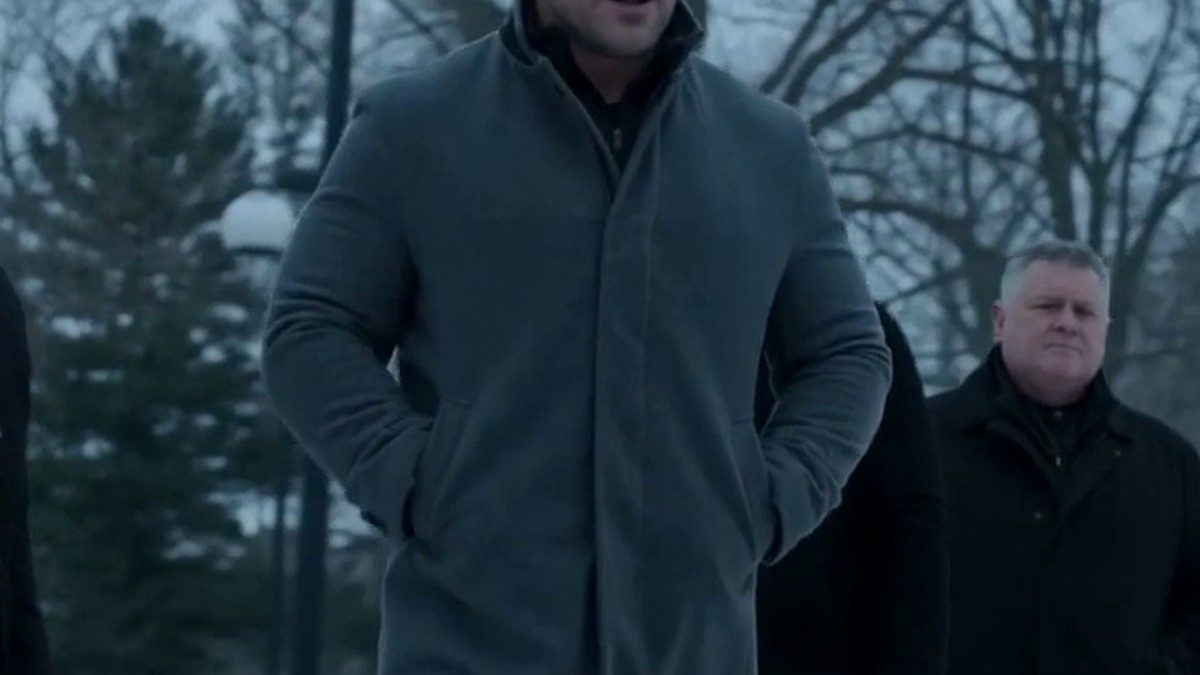
The four men were the second thing I noticed. They stood by the closed bandstand, all black wool coats and polished shoes, too clean for an afternoon after a snow squall. One had a lion lapel pin. Another kept tugging his left cuff. They weren’t talking. They weren’t smoking. They were watching the girl the way repo men watch a car that’s about to roll.
She walked up to me when the bus still hadn’t come.
“Excuse me. Would you like to buy my bike?”
I asked what it cost.
“Twenty dollars.”
I told her a Huffy like that, even rusted, was worth at least seventy.
“No.” The word came out sharp. “Twenty is enough.”
I didn’t like the way she said it. Her voice sounded memorized, not dishonest. I looked at the bike again. The card was lopsided. Under the seat there was a thin strip of white cloth tied around the frame. Too neat for a child, too hidden to be a decoration.
The girl caught me looking. She stepped closer, so close I could see a round scar on her chin. “Please,” she breathed. “Buy it before they ask what’s taped underneath.”
I didn’t look under the seat. I kept my eyes on her face. “Where’s your mother?”
“Home.” Her lips shook. “They think she has it.”
“What’s under the seat?”
Her face crumpled, then came back hard. “Proof about my dad.”
One of the men started toward us. I asked the girl her name. Mina. I told her to walk to the bench behind me when I said so, not run.
The man in the lion lapel pin reached us first. “Afternoon. Everything okay?”
“Perfect,” I said. “I just bought a bicycle.”
“Afraid that bike isn’t the girl’s to sell. It’s family property.”
He set his hand on the handlebar. I grabbed his wrist. My grip wasn’t much, but it was enough to make him stop.
“Touch it again, Collin, and you can explain to the Attorney General’s office why four grown men are standing around a ten-year-old in the cold.”
His pupils changed. He knew my face then. “Vance. I thought you retired.”
“Retired doesn’t mean dead. I still have every file I ever built on you. The car wash in Henrietta. The casino receipts from Batavia Downs. You want to test my memory?”
He lifted his hand off the handlebar. That was my card. The one thing he hadn’t expected.
“You don’t know what you’re interrupting,” he said.
“I know exactly. A little girl selling evidence, and you’re doing crowd control.”
He stepped forward. I pressed the side button on my phone five times. The emergency call connected inside my coat. I raised my voice. “Maplewood Park. Four adult men are threatening a child. North entrance by the bandstand.”
The man lunged. I shoved the bike into him. The chain guard clanged against his shin. He stumbled. I yanked the package from under the saddle and ran to Mina. We crouched behind the bench. One of the other men threw a chunk of ice. It cracked against the concrete near us. Mina’s hands went over her mouth.
I opened the package with cold fingers. A microSD card. A folded photograph. A silver key.
“Your father didn’t come home?”
She shook her head. “He drove for Mr. Toomey. One night he heard something. He recorded it on his phone. He told Mom if something happened, give it to someone honest.”
Her voice nearly disappeared. “He never came home.”
I inserted the card into a tiny reader on my keychain. My phone lit up. I opened an email, typed the address of the state Attorney General’s office, then added a reporter from the Democrat and Chronicle. The four men were moving to the sides, circling. Then a black SUV rolled down the service drive with blue lights on the dash. Not marked. The men stepped back.
A silver-haired man in a blue overcoat got out of the back seat. He carried a cane and looked like the boardroom photo on every charity billboard from Albany to Syracuse. Orrin Toomey. Bright Futures Foundation. The man who got his name on a children’s hospital wing while the city council looked the other way.
I’d seen his face my whole career, but never this close.
He said, “Oh, Mina. You’ve caused so much trouble.”
She shrank against my side.
Toomey looked at my phone. “That belongs to me.”
“Not anymore,” I said. “I already pressed send.”
His mouth twitched. “You’re retired. You have nothing.”
“I have a memory card, a photo of a safety deposit box number, a key, and your voice offering two hundred forty thousand dollars to a county inspector. I also have an email in my outbox with the subject line Toomey_BrightFutures_ledger, sent to the state Attorney General’s office and a reporter at the Democrat and Chronicle. It went out at 4:58.”
I turned the phone toward him. The screen said 100% sent. Recipients listed. He took one step forward, then stopped.
I took a small manila coin envelope from my coat pocket and folded the memory card inside. I licked the flap, pressed it shut, and wrote my initials and the time across the seal with a green pen from my purse. I raised the envelope.
“This is now evidence,” I said. “It doesn’t disappear because you ask nicely.”
Toomey’s phone rang. He ignored it. It rang again. A voice from the driver’s window said, “Real police at the north gate.”
The black SUV’s fake lights looked shabby under the park floodlights. A Rochester police patrol car came down the service road, lights strobing. Toomey turned toward it. The four men drifted backward toward the SUV. Collin kept his hands visible.
A young officer with mitten clips on her duty belt stepped out of the patrol car. I raised the envelope to her.
“This package was taped under the seat of a child’s bicycle. She says her father disappeared after recording a bribe. Her name is Mina. She needs protective custody, and this needs to go to a detective, not a patrol officer.”
The officer took the envelope with both hands and set it on the hood of her car to photograph it. Toomey didn’t leave. He stood frozen near the open door, one hand on his cane.
The officer spoke into her shoulder mic. Then Toomey’s driver started the SUV, but the patrol car blocked the service road. Toomey got back in and sat behind the windshield. The car didn’t move.
I put my arm around Mina. Her wet sneakers squeaked on the path.
“Is my mom okay?” she asked.
“She will be.”
The Number 23 bus came around the corner, its bell ringing. The driver slowed at the stop and looked at us through the salt-flecked glass. I waved him on. The doors closed. The bus rolled away down Lake Avenue, and Mina and I stayed on the bench with the rusty Huffy between us until a detective arrived.