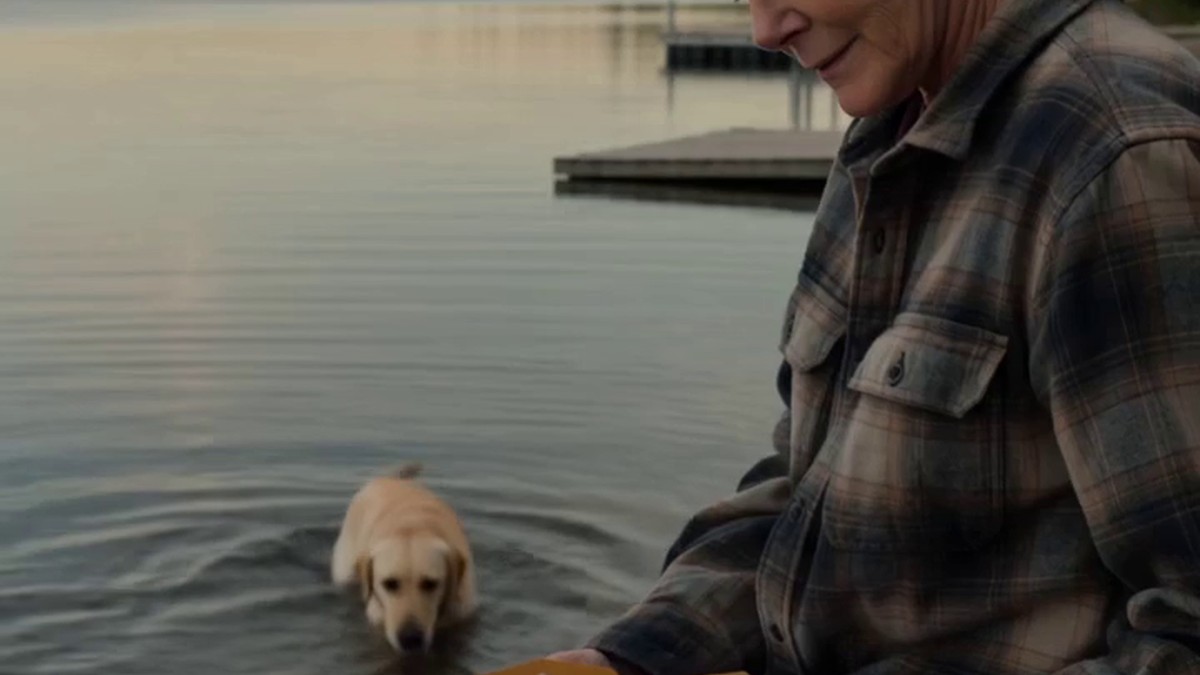
I've lived on Loon Lake Road for eleven years now, since my divorce from a man who taught me what it felt like to disappear inside my own home. The road is gravel, two ruts and a crown of weeds, and it doesn't lead anywhere except to the lake and the boat landing. Six year-round houses on the east shore. The rest are summer cabins, cedar siding and pontoon lifts. I know every mailbox, every dock, every dog that barks when I walk past. I'm the only person out here on foot at seven in the morning. Me and Rosie, my black lab mix.
My therapist said walking would be good for me after the paperwork went through. Better than drinking wine at noon, she said. I started walking and never stopped. Eleven years. You do the math.
The Kessler place is the third driveway on the left, a quarter mile past my mailbox. Gary and Lois. Gary drives a red Chevy Silverado, extended cab, dent in the tailgate from backing into his own boat trailer. Lois has a beige Subaru Outback. In the summer, they come up from Minneapolis every Friday night. In winter, the place sits empty except for a porch light on a timer.
I don't know them well. We wave. At the mailbox I'll ask about the fishing. Gary says the walleye aren't biting. Lois's mouth tugs up at one corner and she says he's been saying that for twenty years. That's the extent of it. My name is Jan Harmon. On the mailbox it says J. Harmon. The post office people like that.
Last Saturday morning, something was off.
Rosie stopped to sniff a patch of something dead in the ditch, and I found myself looking at the Kessler gate. From the outside, there was a padlock hanging on it. A big silver one. The kind you'd use on a storage unit. That struck me as wrong because when they're up for the weekend, the gate is usually open or latched from the inside. And when they close up for the season, they use a small brass lock on the top hinge. This was neither. This was a serious lock, the kind that says stay out.
No lights in the house. Gary's truck in the driveway. The gate was solid metal, the type that slides across the driveway and hooks to a post on each side. You couldn't see the house from the road—just the gate and the high fence running along the property line. Green corrugated steel. Forty yards of it. Gary put that fence up himself about eight years ago. I remember the weekend because he rented a post-hole digger and the noise went on for two days straight.
I gave Rosie's leash a tug. She was trying to roll in something. "Come on, girl. It'll still be there tomorrow."
I didn't think much more about it. I had my own business. The leaves were starting to turn, and I'd noticed the gutters on the north side of my house were full of pine needles. I'd been putting off clearing them for three weeks. When I got home, I got out the extension ladder and did it. Took two hours. My shoulders ached that evening.
Sunday morning, same walk.
Rosie was tugging toward the lake, and I was thinking about my roof. The shingles near the chimney are loose, and the man from Spooner Roofing quoted me two thousand four hundred dollars. Which I did not want to pay.
Then I came around the bend. Stopped.
The Kessler fence was covered in clothes.
Shirts on hangers, hung from a nylon clothesline that someone had run along the top of the fence. Fishing poles standing against the posts like rifles at attention. Boots set in a neat row along the shoulder of the road. Baseball caps arranged on the fence rails. A cardboard box full of wrenches and ratchets. Another box with reels, tangled line spilling out.
It looked like a yard sale without any prices. No sign. No folding table. No cash box.
Rosie barked once. I didn't shush her.
Somewhere inside the property, I heard a rhythmic clicking sound. I took a few steps closer. Through a gap in the gate, I could see the porch. Lois was sitting there at an old sewing machine, one of those cast-iron models with the foot pedal. She was pumping it, the needle going up and down through a piece of white fabric. A coffee cup sat on the railing beside her.
She looked up. Saw me. Raised a hand.
I raised mine back.
Then I kept walking. But my eyes kept going back to the fence. By the time I reached the boat landing and turned around, I'd counted a dozen shirts, three jackets, two pairs of hip waders, a tackle box, and a set of barbecue tools spread out on an old bath towel.
I tried to make it fit a normal explanation. Maybe they'd had a flood in the basement. Maybe it was a garage sale without an ad. Maybe Gary had lost his mind and decided to air everything out.
But nobody airs out a whole closet on a Sunday morning in late September. Not in northern Wisconsin. The dew had already soaked through some of the shirt collars. A pair of jeans dripped onto the gravel.
I went home and made coffee in my mug—the one from the Spooner Diner, chipped on the rim. Sat on the porch. The lake was flat. There was a loon about fifty yards out. It made that long call that sounds like a question. Usually I sit and listen. That morning I couldn't.
At noon, I heard vehicles.
I was inside fixing a sandwich. Ham and Swiss on rye, a little mustard. The sound of a truck engine came up the road, then a second vehicle behind it. They stopped at the Kessler place. I went to my kitchen window, which faces the road.
Gary's Silverado first. Behind it, a dark gray SUV, maybe a Highlander. Doors slammed. One. Then another.
Gary walked to the gate. He grabbed it with both hands and shook it.
The padlock from Saturday was still on there, but from the inside, something else was holding it. He rattled the gate again. It didn't move.
Then he started yelling.
"Lois! Lois, goddammit, open the gate!"
I could hear him through the window glass. The man from the SUV stood back, hands in his pockets, looking at the fence covered in clothes. I saw him lift one of the shirts by the collar, check the tag, and let it drop.
Lois appeared on the other side of the gate. She was carrying something—a folder, the yellow kind with an elastic band. She knelt down and pushed it through the gap between the bottom of the gate and the ground. It scraped across the gravel and stopped near Gary's boots.
He picked it up. Opened it. His shoulders dropped, like the air had gone out of him.
Gary said something, voice going soft. I heard fragments through the window. "Lois, we can talk about this…"
Her answer was low but clear. My kitchen window was cracked a few inches to let in the fall air.
"You sold our place out from under me, Gary. There's nothing to talk about. Take your things before the rain comes."
"Lois, it wasn't like that. The papers… I was going to explain."
"Explain it to a lawyer. I'll file on Monday."
The word landed. Gary's mouth closed. The buyer—because that's what the man in the SUV was, I'd put money on it—took a step back toward his car.
He said, "I'll be going. This is between you folks."
He got in. Backed out. Drove away. A cloud of dust settled back over the fence.
Gary spent the next hour pulling clothes off the line. He didn't fold them. He balled them up and threw them into the bed of the truck. He tried the side gate. Locked. He walked around to the back. Same thing. His tools went in loose. His fishing poles clattered against the tailgate.
At about two, the truck was loaded. Not everything—there were still wrenches spread out on that cardboard box, a couple caps, one hip wader lying in the ditch. Gary walked back to the gate one more time.
"I'll be back for the rest," he said at the metal. "Lois? I'm not done here."
Lois didn't answer.
Instead, she came out of the house carrying a cordless drill in one hand and a new padlock in the other. A round-body brass lock. She knelt at the gate, set the hasp against the post, and drilled a screw into the steel. The drill whined for a few seconds. Then she clicked the lock into place.
Gary stood there. His mouth open. He tried to form a word, but nothing came out.
Lois put the key on a chain around her neck and tucked it inside her shirt. She looked at Gary through the gate. Then she turned and went back inside. The screen door slapped shut.
Gary stood there for another minute. Then he got in his truck and drove away. He passed my house without turning his head.
I went inside and put my coffee cup in the sink. Then I sat at my kitchen table and typed into my phone: Master Lock 930 brass padlock. I recognized the shape from the Ace Hardware in Spooner. Fifty-four dollars and ninety-nine cents plus tax.
I drove in Monday morning and bought the same one. It's in my kitchen drawer now, still in the package. I don't know why I bought it. Maybe I'll use it for my shed. The old one is rusted.
Every morning since, I've walked past the Kessler place. The gate is still locked. The clothesline is gone. Lois's beige Subaru sits in the driveway. Sometimes I see her on the porch, her foot working the pedal on that old sewing machine. The clicking carries out to the road. Steady.
Gary hasn't been back. Not yet. I heard from Nancy at the post office that he's staying with his cousin over in Clam Lake.
This morning, I stopped at the Kessler gate. The new lock was still there, shiny and solid. I touched it, just to check. Cold. Dense. I kept walking.
Rosie looked back at me, one ear cocked.
"Yeah, girl," I said. "Let's go home."