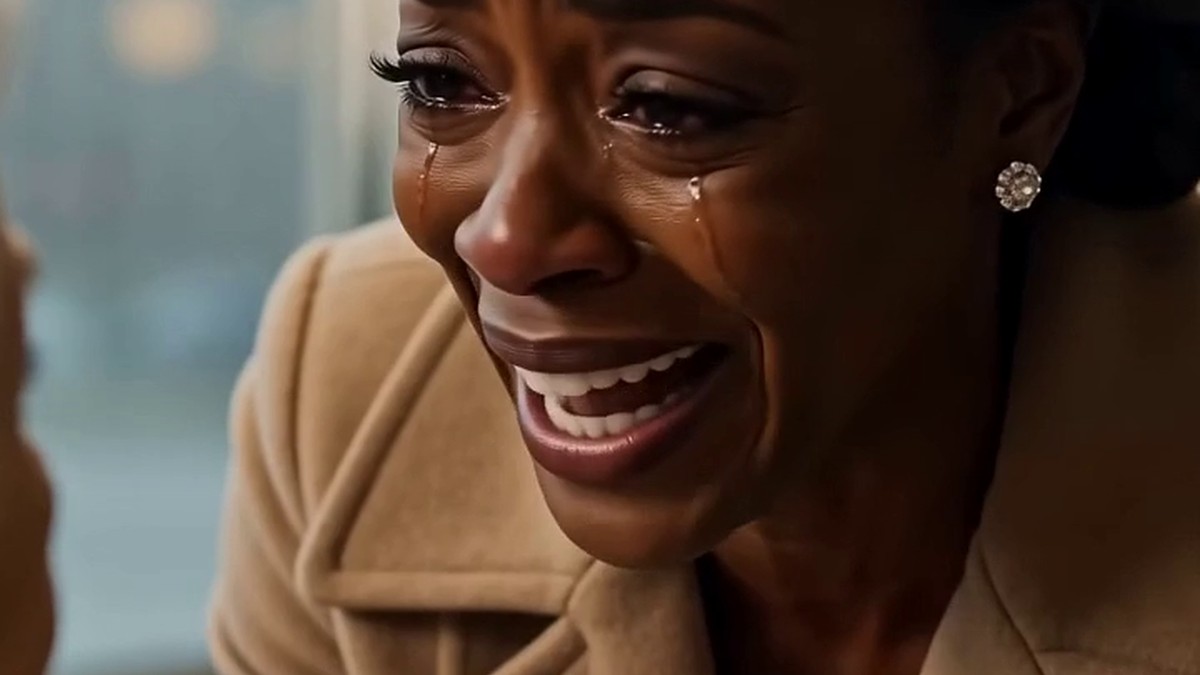
The brass bell above the door of Rudy’s Diner chimed on a rainy April afternoon, and a woman in a white silk dress stepped inside, her eyes already glistening with tears she couldn’t blink away. The lunch rush had faded, leaving only the smell of stale coffee and frying oil. A few truckers hunched over their plates near the window, and in the far corner, old Edna paused mid-wipe of the counter, her arthritic knuckles white around the rag.
The woman didn’t move at first. She simply stood there, clutching a small, worn purse, scanning the chrome stools, the cracked vinyl booths, the faded Coca-Cola sign. Something about the place had pulled her across three states and two decades. Her throat tightened.
Edna squinted. She saw a stranger—tall now, elegant, dark hair swept back, diamond studs glinting. But the way the woman’s lower lip trembled stirred a ghost of a memory Edna couldn’t place.
“Take a seat anywhere, hon,” Edna called, her voice scratchy with age but still warm. “Coffee?”
The woman nodded, then chose booth seven without hesitation, as if she’d sat there a hundred times before. She traced a finger over a scratch in the Formica. A single tear slipped down her cheek.
That’s when it all came flooding back—for her, and soon, for Edna too.
——
Twenty-two years earlier, a winter dusk had pressed its gray face against those same windows. The diner hummed with the clatter of silverware and the low mutter of a radio. Edna, then fifty-three and sharp as a tack, was refilling ketchups when she noticed a small figure hovering just inside the door.
A girl, maybe eight years old. Coat too thin, sneakers split at the toe. Her hair was matted, her face smudged with dirt, but her eyes—huge and dark—darted around the room with a hunger that went far beyond an empty stomach. She clutched nothing; no bag, no parent’s hand, no dollar bills curled in a fist.
A couple near the door glanced at her, then busied themselves with their phones. A businessman pulled his salad closer, as if poverty might leap the gap. The girl shuffled toward the counter, chin trembling, and tried to speak. The words came out a croak.
“Excuse me… ma’am… could I maybe have a glass of water?” Her voice was barely a whisper, laced with a terror no child should carry. “I… I don’t have any money.”
Edna set the ketchup down. She’d seen hard times herself—an abusive ex-husband, nights she went to bed hungry while her own kids were little. She knew the look of defeat. Without a word, she walked to the girl, crouched down until their eyes met, and gently touched the child’s icy cheek.
“Water won’t fix what you’re feeling, baby. Go on, slide into that booth—the one with the tear in the seat. The heater vent’s right underneath.”
The girl hesitated, then crept into booth seven. Edna vanished into the kitchen. A minute later she returned with a plate piled high: fluffy scrambled eggs, two buttermilk pancakes with a pat of melting butter, a small ramekin of syrup, and a glass of milk.
The girl stared at the food, then back at Edna with disbelief.
“I told you, I don’t have—”
Edna cut her off gently. She placed a hand on the girl’s shoulder and spoke three words that would ring through a lifetime: “Just eat, sweetheart.”
The girl ate. She ate like an animal rescued from a trap, pausing only to cry into the napkin Edna handed her. She never said her name, never explained how she’d ended up alone. But before she slipped out the door, she turned back and looked at Edna with a fierce, burning gratitude. Then she was gone, swallowed by the cold.
Edna never forgot that face. She’d wonder, on quiet afternoons, whether the girl had made it. Whether she was safe. Whether her three words had been enough.
——
Now, on that rainy afternoon twenty-two years later, the woman in the white dress finished her coffee and placed the empty cup precisely in the center of the saucer. Edna ambled over with the check, her knees complaining. “You okay, dear? You look like you’ve seen a ghost.”
The woman caught Edna’s wrist. Her grip was soft but insistent. “You don’t remember me, do you?”
Edna blinked. “I’m sorry, hon. My memory ain’t what it was. You’ll have to help me out.”
The woman reached into her purse and withdrew a tiny, yellowed square of paper—a napkin from this very diner, stained with old syrup and a faded lipstick smear. She placed it on the table. Then she whispered a sentence that made the entire diner seem to hold its breath, the rain outside sudden mute.
“Booth seven, pancakes with butter, and a waitress who told a broken little girl to eat.”
The color drained from Edna’s face. Her hand flew to her chest. The napkin trembled in her vision, and then the years collapsed: the freezing night, the matted hair, the ravenous eyes. She saw the child, saw the plate of food, felt the weight of her own words. “Oh, Lord,” she breathed. “It’s you. It’s really you.”
The woman rose, tears spilling freely now. She took Edna’s hands in hers and held them tight. “I never got to thank you. I was running away from a foster home that… that was a nightmare. You were the first person in months who looked at me like I mattered. After I left here, I walked straight to the police station instead of back to the streets. I told them everything. I got placed with a family who actually loved me. I graduated, went to medical school, became a pediatrician.” She laughed through her sobs. “I’ve spent my whole adult life telling hungry kids that they’re going to be okay. All because you fed me and called me sweetheart.”
Edna’s knees gave out. She sank into the other side of the booth, crying openly. All the small, unnoticed acts of kindness she’d scattered across decades suddenly bloomed into a universe of meaning right here in booth seven. She cupped the woman’s face with both palms. “What’s your name, honey? I never even asked.”
“Clara,” the woman said. “Clara Fields.”
Edna wept. “You came back. After all this time, you came back.”
Clara nodded, then slid into Edna’s side of the booth and wrapped her arms around the woman who’d saved her life with a plate of pancakes and three simple words. The truckers in the corner turned away, suddenly fascinated by their chili fries. The short-order cook peeked through the service window and quietly wiped his nose with the back of his hand.
The bell above the door jingled again as a customer entered, but neither woman noticed. They stayed like that, locked in an embrace that stitched together two broken timelines, until Clara finally pulled back and said, “I’ll be back tomorrow. And every week. And I’m paying off every single tab anyone runs up in this booth for the rest of your life.”
Edna laughed, a watery, joyful sound. “You don’t have to do that.”
“I do,” Clara insisted, squeezing her hand. “Because what you gave me had no price.”
They talked until Edna’s shift ended, then walked out together under a shared umbrella into the rain-washed evening. Clara drove her to a little house on Maple Street and made her a cup of tea. They’d spend the next two decades as chosen family—Edna at every medical conference in the front row, Clara at every Sunday dinner at Edna’s table—all because on the coldest night of a little girl’s life, one woman refused to look away.
And in Rudy’s Diner, booth seven was never the same. Edna had a small brass plaque affixed to the wall above it: “Just eat, sweetheart.” Every time a hungry soul sat there, they found a warm meal, no questions asked, paid forward by an anonymous doctor who never stopped believing in the miracle of a single act of love.