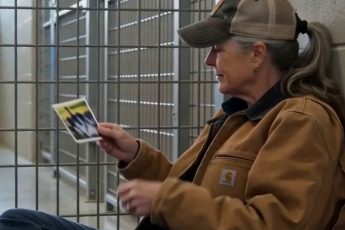
June was already bending down when Lorna Ryman took a step toward the broken frame. A folded deed had slipped out from under the glass and landed beside the leg of a chair. June picked it up by the edges, the way her father had taught her forty years ago.
“Pick up the rest,” Lorna said into the microphone. Her voice echoed off the ballroom ceiling.
“No,” June said.
Somebody at table six set a fork down. Mitchell stood next to his mother, looking at a butter knife. The deed felt dry in June’s hand, dry and warm from the lights.
Twelve days before that, Mitchell came home with a website open on his phone. Hawthorne & James, Jewelers. Broughton Street.
“Mom picked a pair of earrings,” he said. “Three thousand four hundred. For the party. Nothing crazy.”
June had a sheet of mulberry paper drying on the worktable. She took the phone and set it face down on the corner of the table.
“We agreed that money was for the roof,” she said.
“We can take it out of the joint account. My bonus comes in March. I’ll put it back.”
“Half of that account is mine.”
“I know. I’m not saying it isn’t.” He unbuttoned one cuff. “Dale Mercer will be at the party. I need to finish the port study for him. Mom’s seating us together. I can’t show up with a waffle iron.”
June lifted the phone and closed the browser tab. “We could pick a gift together.”
“You always do this.”
“Do what?”
“Make everything about meaning.”
She set the phone on the edge of the sink. “And you make everything about how it looks.”
Mitchell took the phone. The coffeemaker started a minute later, though he didn’t drink coffee after six. June checked the account before bed. The money was still there. She checked again in the morning. Still there.
Her father lived in a small house south of Forsyth Park, where the live oaks dropped leaves into the gutter all year. June told him only part of the story. He set his tea down and went into the back room where he kept his flat files. When he came out, he carried a piece of archival board tied with cotton tape.
June knew the drawing before he untied it. A hand-colored lithograph of the 1733 plan of Savannah, printed in London. Folded inside the backing was a property deed signed by their ancestor, a surveyor named August Ellison.
“I’m not giving this to Lorna,” June said.
“I haven’t offered it to Lorna.” He untied the tape. “I’m offering it to you.”
“You collected maps for forty years.”
“That’s why I want it with somebody who knows what to do with one.”
June took the drawing to a paper conservator at the college. The report came back in a gray envelope: paper, ink, binding, signature all verified. The insurance valuation said eight thousand dollars.
Mitchell read the report twice. “Eight thousand? You never told me that.”
“It’s not for sale.”
“Mom won’t care about the age. But she’ll understand eight thousand.”
“A week ago you called it an old drawing in a drawer.”
“I didn’t know.” He tapped the number. “Wrap it well. And don’t give a lecture. Mom doesn’t like long speeches.”
June wanted the argument to stop. She told herself the drawing would protect her parents from Lorna’s remarks. She spent three evenings making a custom portfolio from acid-free board and blue linen, and she printed a single page of provenance. Mitchell brought home tulips on Friday.
“I told Mom the gift would be substantial,” he said.
“Does she know it’s from my father?”
“No. Let it be a surprise.”
On the morning of the party, June’s bank app showed a debit at Hawthorne & James. Three thousand four hundred dollars. Gone.
She called Mitchell. He was at the barber on Bull Street.
“Did you take the money?”
“I ordered the earrings. Don’t start.”
“We had an agreement.”
“Nothing was signed.”
“Half of that was mine.”
“I’ll replace it after the bonus. The drawing can be from your parents. The earrings from us. That’s fair.”
June sat on the edge of the bed. The blue linen portfolio was on the chair by the window. She opened the banking app and froze the shared access. Then she moved the remaining money into her personal checking account. She called the jewelry store.
“The order is under Mitchell Ryman,” she said. “Paid from a joint account. Is it picked up?”
“Still waiting for courier, ma’am.”
“Change the pickup name to June Ellison. Hold it in your safe until tomorrow.”
She did not cancel the charge. She wanted the paper trail.
At the DeSoto Hotel, Lorna looked June over from the door. “Gray dress,” she said. “I knew it.”
“Happy birthday.”
“Where are the earrings?”
Mitchell stood behind his mother with an empty store bag. “Courier problem,” he said. “They’re coming later.”
He took June by the elbow and steered her toward a service hallway.
“What did you do?”
“Put the earrings in the safe.”
“You can’t.”
“I can. Half the money was mine.”
“Bring the box back before the gifts.”
“No.”
He squeezed the bag. “Then I’ll tell Mom you ruined her day.”
“Tell her.”
Back in the ballroom, the gifts began after the cake. Each one had to be held up for the photographer. When the host called Mitchell’s family, June carried the blue linen portfolio to the head table. She had a leather satchel over her shoulder.
“Just hand her the box,” Mitchell whispered. “The earrings can be a story for later.”
June opened the portfolio. Lorna reached across the table, her hand out. June kept the drawing back a few inches.
“This is a plan of Savannah,” June said. “It belonged to my father’s family. My great-great-great grandfather helped survey the original wards.”
Lorna stood. “A map? After everything I’ve done for you?”
“You haven’t heard the rest.”
“I don’t need a lecture.”
She grabbed the drawing by one corner and flung it. The frame hit the ballroom floor and the glass broke. The deed slid out, nearly under Lorna’s heel.
June picked it up.
Then she took the microphone from Lorna’s hand.
“This drawing was appraised at eight thousand dollars,” June said. “My father didn’t sell it. He gave it to me. I decided to give it to you because Mitchell convinced me you’d respect a family story.”
Lorna looked at the broken glass. “It was a joke. Have someone sweep it up.”
“No.”
“Excuse me?”
“The gift is no longer yours.”
Mitchell stepped forward. “June, don’t.”
But June had already opened her satchel. She set three items on the table by the microphone: the bank statement, the jewelry store receipt, and the empty bag from Hawthorne & James.
“The earrings are in a safe downtown,” she said. “Paid for from our joint account this morning. Three thousand four hundred dollars. Mitchell withdrew it without asking me.”
Lorna looked at the receipt. “That’s family money.”
“Then why did he spend it alone?”
Mitchell’s boss was watching from a table near the window. He didn’t look away.
Lorna grabbed the microphone back. “My son supports this woman. She works in a studio full of dead paper and now she counts every cent.”
June pulled out the bank statement. “Over the last two years I deposited more than half into that account. The transfers are right here. We split the mortgage and the truck payment.”
“You want to embarrass him in front of his boss?”
“No. I just won’t pay for a lie anymore.”
Mitchell reached for the statement. June slid it back into the folder.
“As of today, you don’t have access to my money,” she said. “The charge is still under review. The earrings haven’t been released. I changed the pickup to my name. If you want to stop the purchase, you can say right now that you took the money without my permission.”
Mitchell looked at his mother. Then at the room.
“I’m not discussing private family business here,” he said.
June took out another piece of paper. “Then I’ll discuss it tomorrow with a lawyer. This is a petition for divorce. I’m filing in the morning.”
Lorna slammed a hand on the table. Forks jumped.
“Stop her, Mitchell.”
He didn’t move. “June, you’re making a scene.”
“Say the drawing is mine. Say you took the money yourself. One sentence.”
He looked at the microphone.
“Don’t make me choose,” he said.
June put the papers back in her satchel. “You already did.”
She wrapped the broken drawing in a linen napkin, closed the portfolio, and walked toward the coat check. Her parents got up without a word. Mitchell caught her at the door and put his hand on the portfolio strap.
“Leave the map. Mom will calm down, and tomorrow we’ll all apologize.”
“Who is we?”
He let go. “You’ll destroy my career.”
“You did the work. Your career is yours to carry.”
“Dale Mercer saw everything.”
“So did I.”
The next morning June came back to the house with two folding boxes. Her father waited in the truck. Mitchell had set the table. A receipt from Hawthorne & James sat beside a plate of eggs.
“I picked up the earrings at nine,” he said. “Mom has them on.”
June stood in the kitchen doorway.
“You knew I was planning to cancel.”
“The store wouldn’t release them to anyone but me. The charge went through. Consider it my share of the account.”
“Half of that share was mine.”
“You going to sue over earrings?”
Lorna came out of the guest room in a bathrobe. The earrings caught the light from the window.
“I came to support my son,” she said. “He didn’t sleep after your little performance.”
June took out her phone and photographed the receipt, the earrings, and Lorna.
“For the bank,” she said. “And for the property division.”
“Delete that,” Mitchell said.
“No.”
Lorna removed one earring. “Take them if you’re that broke.”
“They’re in Mitchell’s name. He can return them himself.”
June packed her clothes, her tools, the lamp her mother had given her. She left the espresso machine and the good towels. When the boxes were by the door, Mitchell put the truck keys on top.
“We can sell it. I’ll give you half of the earring money.”
June took the keys. “First, write that down in a note you sign.”
“You don’t trust me?”
She opened the bank app and turned the screen toward him. “Not anymore.”
Lorna shook her head. “You’ll be back in a month. You can’t open a studio on an archivist’s paycheck.”
June sealed the last box with tape. “Watch me.”
She started the business two weeks later. A one-room studio on a brick lane off River Street, with a window that only closed after a hard shove. She sent proposals to historical societies, bookshops, private libraries. The first eight emails went nowhere. The ninth came from the Ossabaw Island Foundation: a set of 1880s newspapers. The pay was small, but the contract let her work under her own name.
In March, Dale Mercer called. “I saw how you handled that family heirloom,” he said. “Our company has a collection of nineteenth-century shipping manifests. Want to assess them?”
June took the job. It became the largest contract of her first year.
After Mitchell’s bonus, he transferred seventeen hundred dollars. He wrote that his mother still believed Dale had caused the divorce. June sent the transfer back. “This needs to go through the settlement. Give it to your lawyer.”
A week later Lorna showed up at the studio. She looked at the bare walls and the old press.
“So this is where my son’s wife went,” she said.
“I’m working.”
“Mitchell lost the lead spot on the port project.”
June kept sorting a stack of brittle newspapers. “Why?”
“Dale gave it to someone else. After your little speech, he doesn’t trust Mitchell.”
“That was Dale’s decision.”
“You started it.”
“No,” June said. “Mitchell took the money. You broke the drawing. I just stopped hiding it.”
Lorna placed the earring box on the edge of June’s desk. “Take them. Give Mitchell the money. No reason to keep fighting.”
“A return has to be handled by the purchaser.”
“He won’t talk to me.”
June slid the box back toward Lorna. “That is no longer my problem.”
Lorna grabbed the box, knocked a stack of folders off the desk with her elbow, and left without picking them up. June waited until the front bell stopped swinging, then bent down and gathered the papers one by one.
The divorce took four months. Mitchell agreed to sell the truck and repay part of the earring money only after June submitted the bank statements, the store receipt, and three photographs of his mother wearing the jewelry. Lorna refused to give the earrings back until Mitchell drove to her house and took them out of her jewelry box. He returned them to the store at a loss and paid the difference from his share.
The morning the decree arrived in an envelope from her lawyer, June came into the studio at seven. The drawing from her father lay on her worktable. She had already repaired the torn corner, reattached the folded deed, and built a new mat with a deep well so the glass wouldn’t touch the surface. A faint crease still ran across the lower corner where Lorna had grabbed it.
She cut a label from acid-free paper and wrote in pencil:
*Plan of Savannah, 1733. Property deed of August Ellison, 1841. On permanent deposit. Not for sale.*
Then she heard a knock. Through the window she saw Lorna standing on the brick walk, holding the blue Hawthorne & James bag by its ribbon. June set the label on the workbench and signed the divorce decree where the pen mark was flagged. She put the decree in a manila folder and wrote on the tab: *Closed.*
The knock came again.
June placed the folder in the bottom drawer of the flat file, next to a stack of unpaid invoices from the first month. Then she turned the bolt on the door and went back to her chair. The card stock for a new book cradling project was already measured and scored. She picked up the bone folder.