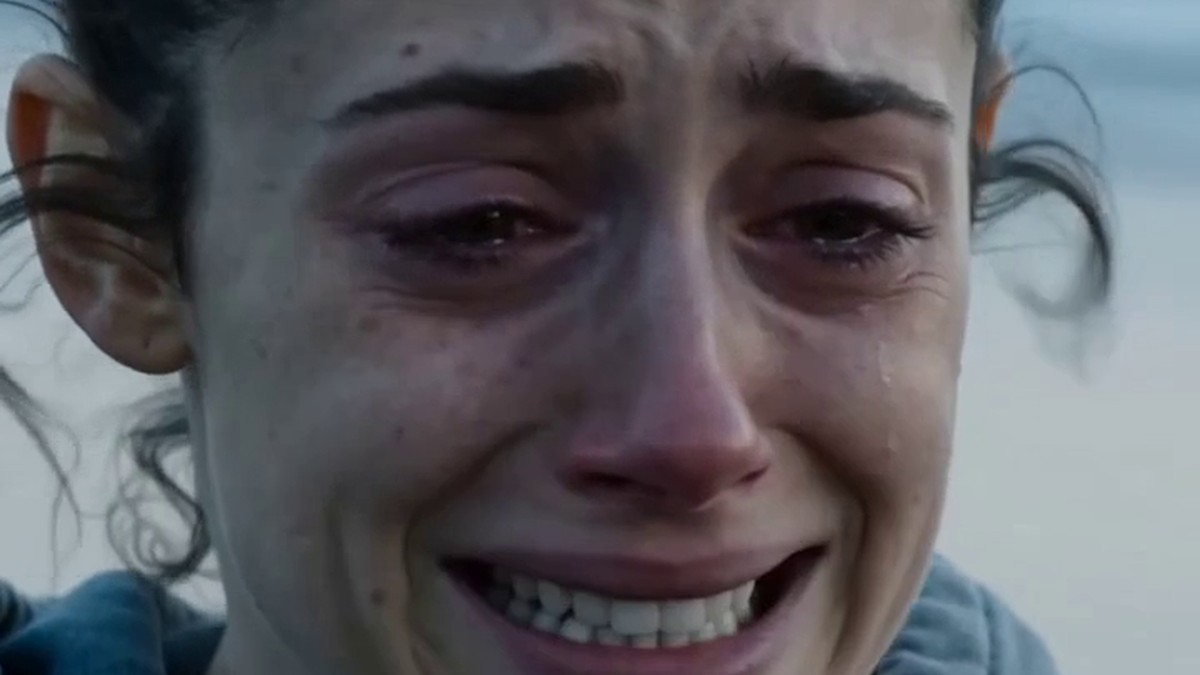
The first thing I registered was the way he bent his knees to scoop up the little girl. That half-crouch, weight on the balls of his feet, arms wide. I'd seen that move a thousand times—on the boat, in our kitchen, at the harbor when he reached for a rope.
The beach in Provincetown was nearly empty at seven in the morning. The sand still held the night's chill. A seagull had already taken a bag of chips off a blanket two spots to my left. The couple there didn't even bother to shoo it away.
I hadn't been this close to the ocean in three years. My therapist, Dr. Ellison, had suggested it on a Tuesday afternoon in May. She called it exposure, but she didn't use that word. She said, "You've been holding a funeral that never happened. Maybe you need to stand in the water and see that it's just water."
I went because I was tired of flinching at the sound of waves on a TV commercial.
So I walked the shoreline in Provincetown, letting the cold Atlantic lick at my ankles. And then I saw him.
He was maybe forty yards down the beach, playing with a little girl. She had a yellow bucket. He was helping her fill it with sand. The girl laughed, high and clear, and the man tossed her up like she weighed nothing.
My feet stopped. My chest went tight.
*Daniel.*
The name came up from some place I'd kept locked for three years.
I ran before I could talk myself out of it. The sand punished every step. My lungs burned. I tripped once, caught myself, kept going.
"Daniel!"
He didn't turn. The wind ate the sound.
Closer now. I could see his hair was longer, lighter at the tips. His arms were more tanned. But the slope of his shoulders—I'd know it anywhere.
"Daniel!"
He turned. Our eyes met.
And nothing.
Not a spark. Not a flinch. Just the polite blank expression of a man interrupted by a stranger.
"I'm sorry," he said, "do I know you?"
His voice was the same. The same low register, the same way his mouth shaped the words.
I couldn't breathe.
—
Three years earlier, on a Friday in late October, Daniel took the boat out alone. It was supposed to be a quick sail—a couple of hours, down to Cape Elizabeth and back.
He'd done it a hundred times. He knew Casco Bay the way I knew the back of his hand.
The storm came in fast. By the time the harbor master noticed the boat was missing, the water was already churning white. The Coast Guard searched for eleven days. They found pieces of the hull near Orrs Island. A life jacket with a torn strap. A cooler lid. A section of the mast split lengthwise.
They never found him.
The state declared him missing. Not dead—missing. The distinction mattered for insurance, for the house, for everything. I lived in a limbo where I couldn't bury him and couldn't divorce him.
I was eight weeks pregnant when he disappeared. Only Daniel knew. We'd agreed to wait until the second trimester to tell our families. He'd put his hand on my stomach the night before he went out and said, "This is going to be our best adventure yet."
Eleven days after the search was called off, I started bleeding. The doctor at Maine Medical Center said it was the stress. My body had just shut down.
I lost the baby on a Tuesday afternoon in a room that smelled like rubbing alcohol and cold air.
For three years, I avoided the ocean. I moved to the inland side of Portland. I took a job at a clinic in Westbrook. I stopped going to the places we used to eat. I stopped calling the friends we'd shared. I stopped living in any direction that might lead back to the water.
Then Dr. Ellison said, "Try a beach you've never been to. Provincetown, maybe. It's a different world."
So I went.
—
I don't remember driving back to the hotel. I remember sitting on the floor of the room with my back against the bed, my arms wrapped around my knees, replaying every detail of his face.
The scar above his left eyebrow—he'd gotten it falling off a dock when he was nineteen. The way his thumb hooked into his belt loop when he stood. The tiny chip in his front tooth from a hockey game.
It was him. I would have bet my life on it.
At seven that evening, someone knocked on the door.
I looked through the peephole. A woman—the one from the beach. The one who'd come over and said, "Honey, what's going on?"
I opened the door.
She looked different now. On the beach she'd been sun-warm and relaxed. Now her face was tight.
"Can we talk?" she asked.
We went down to the hotel courtyard. The ice machine at the end of the walkway was broken—a handwritten sign taped to it said *Out of Order. Sorry for the inconvenience.* The sign had been there a while; the tape was peeling.
We sat on a bench near the pool. The water was covered with a tarp. Someone had left a blue foam noodle on the deck.
"My name is Rachel," she said. "And I think you need to know something."
She took a breath. "The man you saw today—his name is Jake. At least, that's the name we gave him."
I just looked at her.
"Four years ago," she said, "he washed up on a beach near Truro. A storm had come through the night before. A couple of early-morning fishermen found him face-down in the surf. He was half-drowned, hypothermic, bleeding from a cut on his head. No ID. No phone. No wallet. Nothing."
She paused. "When he woke up in the hospital, he didn't know his own name. He didn't know the year. He couldn't tell us where he was from or if anyone was looking for him."
I couldn't speak.
"I was a nurse at the hospital in Hyannis," Rachel went on. "I was assigned to his room. We called him John Doe for the first two weeks. Then one of the techs found a canvas duffel bag tangled in some rocks near where he'd come ashore. It had a name written on it in black marker—'Jake.' We thought maybe it was his. So we started calling him that."
"Did you try to find his family?" My voice came out like a dry hinge.
"Of course. The police ran his prints. They searched missing persons. They checked dental records. Nothing matched. His injuries had damaged his memory—completely, not partially. The doctors said it was retrograde amnesia. He didn't remember anything from before the hospital. Not one second."
She looked away. "He still doesn't."
"I helped him through rehab," Rachel said. "He had to learn how to tie his shoes again. How to use a fork. How to walk without gripping the rail. I didn't fall in love with him right away. But somewhere in all those small steps, I stopped being his nurse and became his friend. Then more."
She paused. "Emma is my daughter. From a relationship before. She was barely a year old when Jake came into our lives. He didn't have to love her, but he did. From the first day, he treated her like she was his."
That explained the scene on the beach. The way he'd swung the girl up, the way he'd kissed her forehead. It wasn't an act.
"He never knew he had a past," Rachel said. "He never knew he was leaving anyone behind. He's not a man who ran away. He's a man who woke up with nothing and built a life from scratch."
She met my eyes. "He deserves to know who he was. And I think you deserve to tell him."
—
The next morning, I sat across from him at a small café on Commercial Street. The table was sticky with salt spray and yesterday's spilled lemonade. A paper napkin kept fluttering in the wind, pinned under a saltshaker.
Rachel was nearby, sitting on a bench by the water, keeping Emma occupied.
I had a folder on the table. Inside: photos, our wedding invitation, a copy of our marriage certificate, the deed to the house in Portland, a few pages from our business plan.
I opened it and started with a photo.
"This is our wedding," I said. "October fourteenth. Eleven years ago."
He looked at the picture. A man and a woman under an arbor, laughing. The man was him. The woman was me.
"We look happy," he said.
"We were."
He turned to another photo. Us on the boat, the summer before. Another: standing in front of a half-renovated house on Munjoy Hill. Another: me holding up a paintbrush, both of us covered in dust.
"They're good photos," he said. But his eyes never flickered with recognition.
I told him about his marine repair shop on the east end of Portland. About the mornings he'd come home smelling like diesel and salt. About the business we were going to start—a small boat charter company, four boats, maybe a dock on Peaks Island.
I told him about the pregnancy.
His face changed at that. The polite distance cracked.
"Claire," he said, and my name in his mouth hurt more than I expected. "I am so sorry."
"You didn't know."
"That doesn't make it less true for you."
I looked at him for a long moment. He was Daniel—the same hands, the same scar, the same way he tilted his head when he was thinking. But behind his eyes there was no past. Just a man who had learned to live with a blank space.
Then I did what I'd planned to do. I reached into my bag and took out a check.
"When you disappeared," I said, "we had a joint savings account. For the charter company. It was frozen for a long time because they needed proof of death. I had to wait three years to have you declared legally dead—that was the minimum in Maine. The account was released last month."
I pushed the check across the table. "It had one hundred sixteen thousand dollars in it. Your half is fifty-eight thousand."
He looked at the check like it was written in a language he'd never seen.
"I don't want this," he said.
"It was your money. You earned it. You just don't remember earning it."
"Claire—"
"It's yours." I stood up. "I'm not giving it to you because I want you to come back. I'm giving it to you because I need to close the account. I need to close all of it."
Emma ran over just then, her bare feet slapping on the deck. "Daddy, look! I found a sand dollar!"
She thrust it into his hands. He looked down at it, then up at me.
"Thank you," he said, and I knew he wasn't talking about the sand dollar.
I looked at Emma, at Rachel, at the man who used to be my husband.
"Take care of them," I said.
And I walked away.
—
That afternoon, I went back to the ocean. I took off my sandals and let the tide draw the sand out from under my feet.
The water was cold. It always is in June on Cape Cod.
I stood there for a long time, watching the horizon line where the Atlantic met the sky. The waves came in, one after another, and went back out. They didn't care that I'd spent three years hating them.
A seagull landed a few feet away and looked at me with one eye, waiting for food. I had nothing to give it.
I thought about the check. Fifty-eight thousand dollars. That was the last thread tying me to Daniel—or Jake, or whoever he was now. I'd cut it.
I thought about the house in Portland, still full of his tools and his clothes. I'd need to sell it. I'd need to find a smaller place. I'd need to call a realtor on Monday.
But those were tasks for later.
Right then, I just stood in the water and let it be water.
It had taken three years to get here. Three years of grief and anger and feeling like the ocean had stolen everything from me.
But the ocean didn't steal anything. It just carried a man from one life to another. It wasn't mine to hate.
I turned and walked back up the beach. The sand was warm on the dry part, hot against the soles of my feet.
I didn't look back.