The plan was a reckless one: borrow a dress, disappear into a glittering night, and walk away before sunrise like a ghost who’d never existed. That was the whole plan.
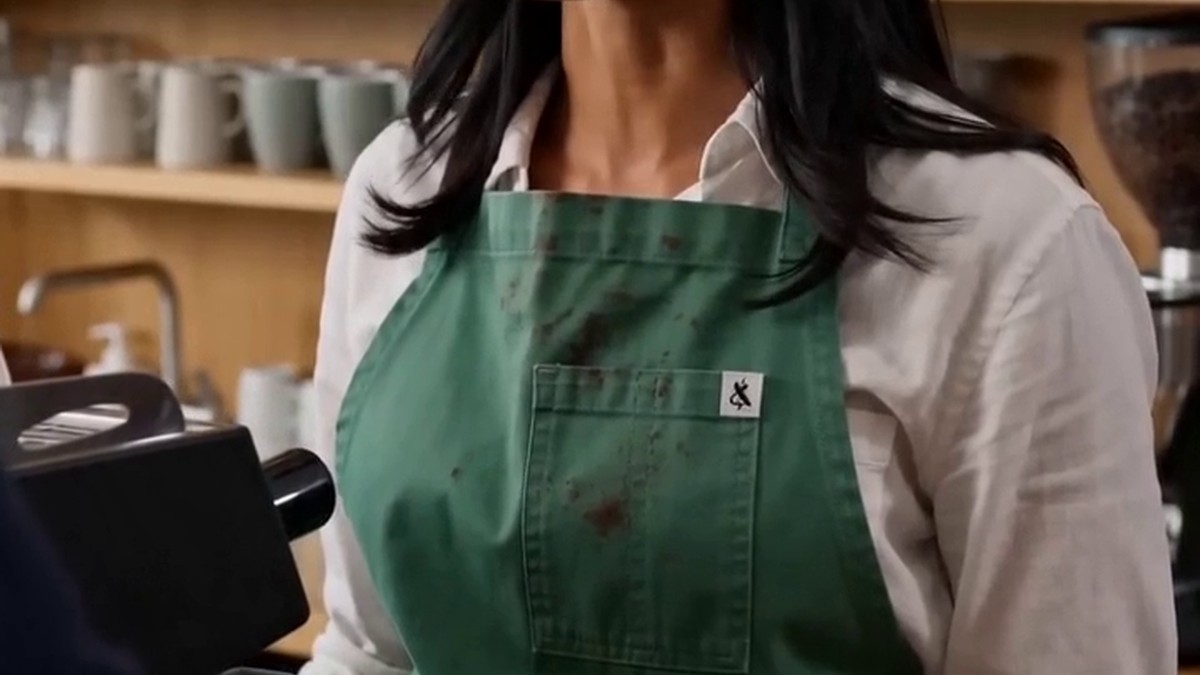
My name is Riley – just Riley, no middle name worth remembering – barista by paycheck, muralist by obsession, and someone who absolutely does not belong at a charity masquerade thrown by one of Chicago’s oldest dynasties. The invitation came from Mrs. Eleanor Prescott. She was seventy-eight, wore tweed coats even in July, and had been ordering a single espresso with a twist of lemon at The Wandering Bean every Tuesday for four years. One afternoon she slid a cream envelope across the counter with the regal certainty of a woman who’d never been told no.
“A masquerade?” I said.
“You’ll thank me,” she said.
“Mrs. Prescott, I have exactly thirty-one dollars in my checking account.”
“Wear mystery, dear. It’s far more interesting than a dress with a price tag.”
She was gone before I could refuse.
My best friend Mia found me a gown through someone who worked in a costume shop back in Logan Square — silver, liquid, nothing like my paint-stained jeans. The mask I found in a thrift shop on Milwaukee Avenue: delicate silver filigree, tiny imitation pearls stitched along the top edge, and a thin crack near the left temple that I fixed with super glue. I stood in my bathroom mirror, the overhead light buzzing, and didn’t recognize the woman staring back. Not polished. Not wealthy. But burning. Like a version of myself I’d only ever sketched in the margins of receipt paper.
The ball was held on the top floor of the Lakeview Grand, a hotel I’d only ever walked past while counting change for the bus. Marble floors polished to mirrors. Chandeliers dripping with light. Women in gowns that carried histories heavier than my entire bank account. I lasted maybe twenty minutes before I slipped onto a balcony that faced the lake, desperate for air.
That’s where he found me.
He stepped through the balcony doors holding two champagne flutes, wearing a black half-mask that covered the upper half of his face but did nothing to hide the quiet confidence in his shoulders. Dark suit, no tie, the kind of ease that comes with inheriting not just money but permission to exist anywhere without apology. His smile was a small, crooked thing.
“You looked like you needed one of these,” he said.
“I might need all of them.”
“Tough night?”
“Tough tax bracket.”
Our fingers brushed when I took the glass, and something sharp and electric shot up my arm. He noticed. The corner of his mouth twitched, and he didn’t look away. We stood side by side in the cold air, the city lights of Chicago blurring into a gold-and-silver smear beyond the railing. He didn’t ask where I was from. I didn’t ask his name. The masks gave us permission to be braver than introductions would allow.
Music shifted inside, something slower and older. He turned.
“Dance with me.” Not quite a question. But his hand hovered in the space between us, waiting, not demanding.
“I learned to waltz from a YouTube tutorial at three a.m.”
“I’ll survive.”
His hand settled on my waist, and every practical thought in my head went silent.
We found a corner just off the main floor, shadows and candlelight. He asked what I did. I told him — pulling espresso shots, painting on brick walls in alleys, mostly fire escapes with women on them. The space between leaving and arriving somewhere better.
He tilted his head. “That sounds like you’re painting freedom mid-transit.”
I froze. No one had ever understood it so perfectly on the first try. Not ever.
“That’s exactly what it is,” I said, my voice thinner than I wanted.
One dance became three. Three became long conversations in deeper corners. Then a private elevator with a keycard that flashed green without a sound. Then his penthouse, floor-to-ceiling windows that swallowed the entire lakefront, the city sprawled below like a circuit board of dreams.
“No names,” I said, standing in the center of his living room, my borrowed gown pooling at my feet.
“No names,” he agreed.
“No morning.”
Something flickered in his jaw, brief and controlled.
“Is that what you want?” he asked, his voice low.
I’d spent my entire adult life being practical — which bills to pay, which dreams were too expensive to feed, which hours I could afford to lose. Having someone ask what I wanted, in a room lit only by the midnight skyline, felt more dangerous than anything I’d ever done.
“I want tonight,” I whispered.
He stepped close enough that I could feel the heat radiating from his chest.
“Tell me yes.”
The word broke out of me like a held breath.
“Yes.”
He kissed me as if patience were a discipline he’d been practicing his whole life. I kissed him back as if the future belonged to someone else.
At 5:13 in the morning, I woke in his bed. The lake had turned a bruised blue-gray, the earliest light bleeding through the windows. I dressed without making a sound, my body still humming. At the door, I looked back — he was asleep, one arm stretched across the empty pillow where I’d been, his breathing slow and untroubled.
My mask sat on the nightstand.
I reached for it, my fingers inches away. And stopped.
If I left it there, the woman who’d worn it could stay, in that intangible way that moments stay in rooms long after people leave. I wanted her to stay. Even if I couldn’t.
I left it.
In the elevator, I told myself this was clean and simple and exactly what the plan had been — a single night, nothing but borrowed magic, no strings. By the time I reached the street, with the first CTA bus rumbling past, I wasn’t sure I believed anything anymore.
—
I went back to my life and tried to bury it. Two shifts at The Wandering Bean, one long afternoon on a scaffold painting a mural of a woman climbing a fire escape toward a flock of birds, and three sleepless nights where I could still feel his hand at my waist. The mask haunted me, but not as much as the way he’d said *freedom mid-transit*. I’d left that night certain I’d never see him again. I was wrong.
Five days later, Eleanor Prescott walked into the coffee shop — and she wasn’t alone.
The little bell above the door chimed, and I looked up to find her arm in arm with a man in a navy sweater, his face instantly, horrifyingly recognizable. Even without the mask, I knew the angle of his jaw, the way he moved through a room like it owed him nothing and everything at once. He was the man from the balcony. The man from the penthouse. And now he was standing three feet from my espresso machine, his gaze locked onto mine with the force of a collision.
“Riley, dear,” Eleanor said, beaming. “I want you to meet my grandson, Asher Prescott. He’s been absolutely desperate to come here ever since I told him about the barista who paints fire escapes.”
Asher didn’t speak. He looked at me, and I watched recognition land in his eyes like a thunderclap. His hand went to his coat pocket, and he pulled something out, setting it on the counter between us.
The silver mask. The cracked left edge, my super glue repair visible.
“You left this,” he said quietly. “I’ve been trying to find you ever since.”
I couldn’t move. Behind him, Eleanor’s smile faltered in confusion. The café, mercifully, was almost empty.
“I thought we said no names,” I managed.
“You said no names.” His voice was steady, but there was an urgency underneath. “I never agreed to no morning. You just didn’t give me a chance.”
My throat tightened. “This isn’t — I don’t belong in your world, Asher. I’m the girl who makes your grandmother’s espresso. I paint on abandoned buildings. I left because that night was everything, and I was terrified of watching it turn into nothing in the daylight.”
Eleanor, to her credit, stepped back toward the door, her expression unreadable but not unkind. “I think I’ll wait outside,” she said softly, and slipped away.
Asher didn’t move. “My grandmother has been talking about you for months. The girl who paints freedom mid-transit, she said. The girl who’s too busy making beautiful things to see how beautiful she is. When I found your mask, I knew. I knew it was you, and I knew I had to find you.” He leaned closer. “I’m not here because of some romantic impulse, Riley. I’m here because I haven’t slept in five days. Because you walked out of that room and took something with you that I didn’t know I could lose.”
I stared at him, my hands trembling on the counter. “What could I possibly have taken? I left everything.”
“You left the feeling that I’d met someone who actually saw me. Not the Prescott heir, not the trust fund, not the last name. You looked at me on that balcony and you didn’t care who I was. That doesn’t happen to me. Ever.”
The lunch rush was about to start, and I had milk to steam and counters to wipe, but the whole world had shrunk to the space between us. I thought about all the fire escapes I’d ever painted — women caught in the act of leaving, frozen in flight. Maybe I’d been painting myself. Maybe it was time to stop climbing away from good things.
“I’m not the kind of person who gets the fairytale,” I said, my voice cracking. “I’m the background character.”
“You’re the entire story,” he said. “If you’ll let me prove it.”
Two weeks later, I stood on the balcony of that same penthouse, wearing jeans and one of his shirts, watching the sun set over Lake Michigan. It wasn’t magic. It wasn’t a ball. It was just a Tuesday. But his hand was at my waist again, and this time, I didn’t have to leave before the morning. The mask sat on a bookshelf in the living room, no longer a question, but an answer I’d finally stopped running from.