The van pulled away from the curb on Sycamore Street, and I stood in the doorway of our split-level in Rockford, Illinois, holding a bouquet so big I had to brace it against my chest. One hundred yellow roses. I counted twice, because the number meant something.
There was no card. Just my name—Miriam—printed on the delivery slip in neat block letters.
My husband Gary was in Nashville, three days into a sales conference. Before he left, he'd been distracted, kissing my forehead absentmindedly while scrolling through gate information on his phone. But he'd surprised me before. Once, after a rough week, he'd had a clawfoot tub installed while I was at my sister's. So yes, a part of me wanted this to be him.
Except Gary knew I hated yellow roses. My mother grew white ones along the fence line in Naperville, and every bouquet he'd ever bought me—anniversary, birthday, apology—had been white. In eleven years of marriage, he'd never once brought home yellow.
I set the vase on the kitchen island and tried his cell. Straight to voicemail.
I texted. *Are you the one who sent flowers?* The message sat undelivered for nine minutes, then turned blue. No reply.
The house felt too quiet. Outside, the neighbor's dog—a fat beagle named Biscuit—barked at something in the cul-de-sac. The clock over the stove read 2:47. I made myself a cup of Earl Grey and didn't drink it.
I didn't believe in signs. I worked as a forensic accountant for a mid-sized firm in downtown Rockford; my job was finding patterns other people missed. But standing there, looking at one hundred yellow roses, all I could think about was the card my father had left on the kitchen table twenty-three years ago, before he walked out for good. He'd signed it with just a date. The date he left.
Gary knew that story. Gary knew everything about me.
I called the non-emergency line for the Rockford Police Department. The dispatcher sounded bored. I told her I needed someone to come look at a flower arrangement. There was a long pause. I said, "I used to consult for your fraud unit. Just send a car."
Two officers showed up thirty-one minutes later. The first one—Rodriguez, according to his badge—looked like he'd rather be anywhere else. His partner, a younger woman with a blond ponytail and the name Kendall stitched on her coat, leaned in close to the bouquet without being asked.
"Ma'am, do you have reason to believe these flowers are suspicious?" Rodriguez asked.
I explained about the yellow. About Gary knowing. About the number.
His jaw tightened, just barely. "A hundred roses is a standard premium arrangement. Could be a marketing thing."
"Count them," I said.
"We can count, ma'am."
"Then count them again. There should be one missing."
Kendall looked up. "Missing how?"
"In the middle. The rows are perfect—ten across, ten deep. But one stem isn't a rose."
That's not what I'd meant to say. I didn't know I believed it until the words came out.
Kendall pulled on a pair of nitrile gloves from her belt and parted the blooms in the center of the vase, carefully, like she was handling evidence. Which, I thought, she was.
"This one," she said. "It's not right."
The stem was thicker than the others, wrapped in green florist tape. When she peeled the tape back, there was a small plastic tube threaded along it. Inside was a rolled scrap of paper, the size of a fortune from a cookie.
She flattened it on the island. The handwriting was small and cramped, pressed hard enough with blue ballpoint to tear the paper in one spot.
*You never should have trusted him.*
"Okay," Rodriguez said. "We're taking this seriously now."
He pulled on his own gloves and started checking the other stems, turning each rose toward the window light.
"Got another one," Kendall said.
She'd found it folded into the paper wrapping. One corner had been dipped in something that left a brownish stain. She opened it, and I read over her shoulder.
*He isn't telling you the whole truth.*
That's when my phone rang.
The screen said *Gary*. I answered.
But it wasn't Gary's voice. It was a man's, low and measured, with a faint accent I couldn't place.
"Miriam," the man said. "You found the flowers."
I put him on speaker. Rodriguez went very still.
"Where's my husband?" I asked.
"In a room. He can hear us. He won't speak until I'm done, and I won't be long."
"Who are you?"
"I'm the person who tried to warn you three years ago. And before that, longer."
"What are you talking about?"
"The trip to Louisville, Kentucky. The one Gary told you got canceled two years ago. It wasn't canceled. He was there. With my sister."
I felt the kitchen tilt. "I don't know anyone in Louisville."
"You know of her," the man said. "Ask him about the medical bills he's been quietly paying out of your savings for the last year. Ask him where he really was every third weekend."
"Listen to me," I said, my voice steadier than I felt. "If you've hurt him—"
"I haven't hurt anyone." The line crackled. "There's a third thing in the flowers. You haven't found it."
"I found two—"
"Third one's in the vase."
I reached into the water. My fingers closed around something small and hard at the bottom—a folded index card, laminated against the wet. I pulled it out and wiped it dry against my sleeve.
"What is this?"
"Everything else you need is already in your house," the man said. "His desk. The bottom drawer, under the checkbook. That's your choice what you do with it. But I'd leave the police out of the rest."
The line cut.
—
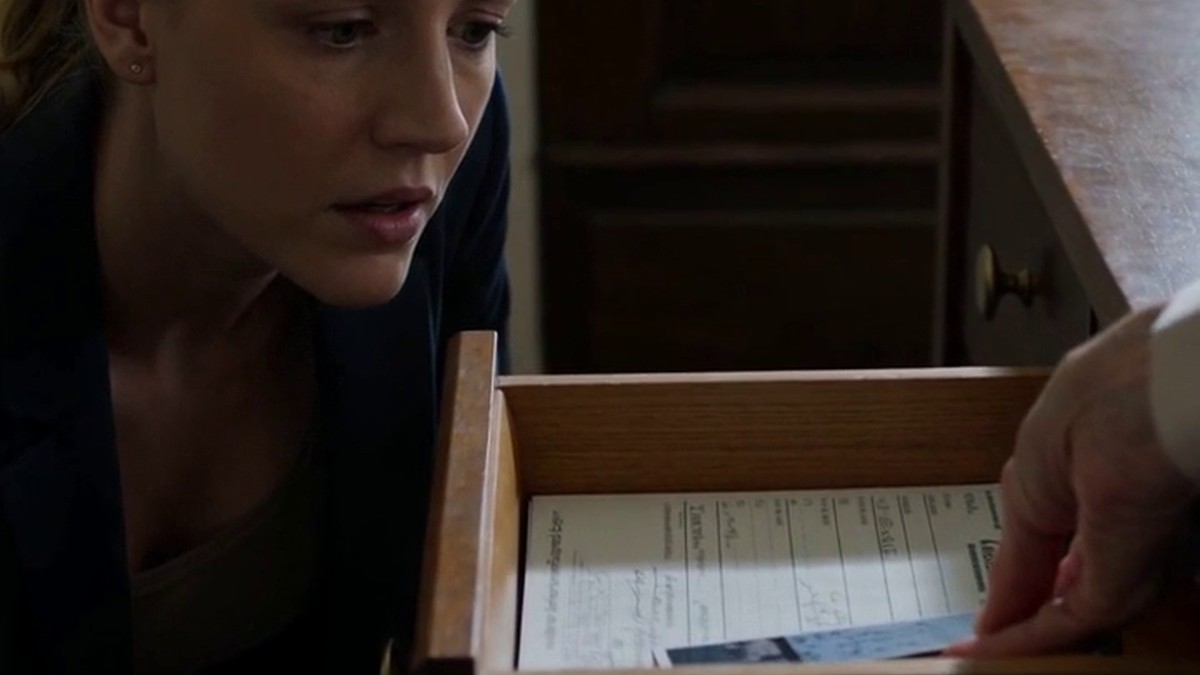
The bottom drawer of Gary's desk stuck when I pulled it, swollen with humidity like it hadn't been opened in a while. Under the checkbook I found a bank statement from an account I didn't recognize, and beneath that, photographs.
The first one nearly did me in. Gary at a restaurant I didn't know, his arm around a woman with gray eyes and dark hair. The same woman appeared in the next picture, sitting on the front steps of a white farmhouse. A third photograph showed them younger, holding hands on a street corner. The back was dated in Gary's handwriting: *the week we met.*
The woman in the pictures was the same person I recognized from a photo Gary kept face-down in this same drawer, beneath a stack of old receipts. I'd asked him about it once. He said it was an old family friend.
"You found them," Gary said.
He'd walked in without my hearing him, still in his coat, hands empty. On any other night, I would have gone to him. I didn't move.
"Tell me about Louisville," I said.
He sagged against the doorframe. "Miriam, it's not what you think."
"I think it's exactly what I think. Eleven years, and you've been driving to Kentucky."
"Not the whole eleven years." He looked away. "The first year, yes. Then it stopped, for a long time. It started again eighteen months ago. She got sick."
"Who?"
"Cora." He said the name like it cost him something. "I met her the same week I met you. We were together, briefly, before you and I got serious. I told myself it was over. It mostly was."
"Mostly."
"She called me eighteen months ago. Stage four glioblastoma. No family nearby to help her. I told myself I was just being decent." He rubbed his face. "I started driving down every few weeks. Then I started paying for treatment, out of the account with your name on it, and telling you it was the roof, or the car, or your sister's loan."
"That's three years of tight budgets," I said. "The trip we didn't take to the Grand Canyon."
"That was mostly this past year. It moved fast, at the end."
"Did you love her?"
He didn't answer.
The thing about being a forensic accountant is that you learn to wait. People want to fill silence. Gary lasted eleven seconds.
"She died two months ago," he said. "I told you I was in Nashville for a conference that week. I was at her funeral in Louisville."
I remembered that week. He'd come home gray-faced and quiet, and I'd assumed it was work stress. I'd made him soup.
"There's a daughter," Gary said. "Cora's. From before—from years before you and me, another relationship. Not mine. But I've been like an uncle to her since Cora got sick. Her name's Ruthie. She's fourteen."
Something in my chest loosened, just slightly, at *not mine*. Then tightened again at everything else.
"You let me grieve our daughter alone," I said. "The year I lost the pregnancy. You were already carrying all of this and you let me think it was just us against something unfair. You never told me you'd loved someone else, that she was back in your life, sick, dying, and that you were driving to see her while I couldn't get out of bed some mornings."
"I know," he said. "I know how it sounds."
"It doesn't sound like anything. It is what it is."
Kendall was still by the front door, giving us a kind of distance that felt impossible in a room so small. I was grateful for her.
"He wanted you to find out this way," Gary said, meaning the caller. "Because I told him I'd tell you myself, eventually, and I never did. He's been angry at me for years. Long before Cora got sick, he suspected something. He wrote you a letter once. Left a note on your car."
The memory surfaced: a white rectangle under my wiper at the grocery store, wind, the smell of rain. I'd tossed it into a trash can by the cart return, thinking it was a parking ticket.
"There's a safe deposit box," Gary said. "First National on State Street. The key's in my nightstand."
"What's in it?"
"Letters. Things I couldn't keep at home and couldn't throw away."
—
I went downtown the next morning, cash from the ATM, no coffee, no breakfast. I didn't tell Rodriguez. I didn't tell anyone.
The box sat on the table in a small private room. I opened it alone.
Inside: a stack of letters in a woman's handwriting, a manila envelope of medical records, and a small velvet box. I read enough of the letters to understand what fourteen months of dying looked like on paper—appointment reminders, a hospice intake form, a note in shaking handwriting that read simply *thank you for coming back.*
The velvet box held a ring. Not a diamond. A plain gold band. Engraved on the inside: *C & G, always the same week.*
I sat there for a long time. The fluorescent light hummed. I thought about my mother's white roses. I thought about the first time Gary kissed me, in the parking lot of a Trader Joe's, and how he'd tasted like the orange Tic Tacs I'd bought at the register the same week, I now understood, that he'd been falling into something else entirely with someone else.
Then I called the number back.
The man answered on the second ring.
"Did you find it?" he asked.
"I found it."
"You kept the police out?"
"Yes."
"Good." A pause. "Cora was my sister. What she and Gary had, they had before you. That's not the crime." He was quiet. "The crime is what he did with the eleven years after. Letting you believe you had all of him."
"Why did you wait until now?"
"I tried to warn you before she got sick. Nobody wants to hear that kind of thing from a stranger. Then she got sick, and I thought, let her have this without me making it worse. Then she died, and I watched him go right back to pretending nothing happened, and I couldn't stand it anymore." He cleared his throat. "Ruthie wants to meet you. Not because she thinks you're family. Because her mother talked about you sometimes. Said you seemed like someone who deserved better than what she was getting."
I didn't say anything for a long moment.
Then I hung up.
I sat in the bank lobby for twenty minutes. Long enough for the teller to ask if I was okay. I said I was fine, and I meant it.
When I got home, Gary was on the front steps, elbows on his knees, a mug of coffee going cold beside him.
"I'll sign whatever you want," he said. "I'll move out today."
"Good," I said.
"Mir—"
"Don't."
I went inside. I poured the hundred yellow roses down the garbage disposal, handful by handful, until the sink ran clear. The vase I left on the counter.
The next morning, I called a lawyer. Two weeks later, I signed the papers. I kept the house. Gary kept the boat he never used. I didn't ask for alimony—I asked for the truth, and he'd already given me that.
On a Saturday in early September, I got in my car and drove to Louisville. The trip took seven hours, and I didn't once turn on the radio. I met Cora's daughter, Ruthie, at a diner off Interstate 65. She had her mother's gray eyes and a way of tearing her napkin into small even strips while she talked. She ordered a chocolate milkshake and told me her mother used to describe me as "the wife Gary should have tried harder for."
I told her the truth. That I'd only just found out any of this existed. That I was still deciding what to do with it.
She nodded, like she'd expected that. Then she pulled a small envelope from her purse and slid it across the table. Inside was a photograph—Cora, laughing, much younger, alone on a porch swing. On the back, in a child's careful printing, a note Ruthie must have added years later: *Mom before everything got complicated.*
"I don't really know why I brought this," Ruthie said. "I guess I wanted you to see her as a person, not just the thing that happened to your marriage."
I wrapped my hands around the photograph, and for a long time we just sat there, two strangers bound by one careless man and a woman neither of us had asked to lose.
Then I put the photograph in my purse and drove home, the roads emptying out ahead of me, the whole seven hours quiet in a way that finally felt like mine.