Those pants showed up in our apartment on a Wednesday. My mother came home from work with a package wrapped in brown paper. She set it on the kitchen counter, next to the coffee maker with the cracked handle. She didn't say anything. That's how she always was when she brought home something you'd been waiting months for.
I unwrapped the paper. Maroon corduroys from the import shop on Fifth Avenue, the one that only took cash and sold things you couldn't find anywhere else in Pittsburgh. Wide at the top, tapered at the ankle, with metal rivets at the pockets. They smelled like the store, where you'd stand in line since six in the morning to even get in the door. I touched the fabric. It was stiffer than I expected, but that didn't matter. These were the most beautiful pants I'd seen in my entire eleven years of life.
"Forty dollars," my mother said, taking off her coat. "From your Aunt Carol. Under the table."
I didn't ask how Aunt Carol had forty dollars to spare. In the fall of 1983, you didn't ask questions like that.
I tried them on Saturday. I walked out of my room like the models I'd seen once on television, in a program about New York fashion. My mother stopped peeling potatoes. With a knife in one hand and a potato in the other, she looked at me longer than usual.
"Stand up straight," she said finally.
I turned to the mirror in the hallway. The floorboard creaked. That mirror only showed the top half of your body, so I had to stand on my toes to see my legs. They looked like something out of a Sears catalog, if Sears sold things this good. I came down off my toes. The board creaked again, like it agreed.
My father was on a work trip in Baltimore then. Installing something at the port, some kind of equipment for container loading. He'd been gone five weeks already. He wrote letters on plain notebook paper because he'd run out of stationery. In every letter he drew a seagull. My mother said that was because he missed us.
On Friday we were flying to see him from the Pittsburgh airport. First time in my life on a plane. My mother got the tickets through a friend from the union hall. We were going to spend two whole weeks in Baltimore. Me, my mother, and the maroon corduroys.
A week before the trip I couldn't sleep. At night I'd get up, go to the hall closet, open the door that creaked like an old elevator. The pants hung on a wooden hanger. I'd touch them in the dark. Check that the rivet hadn't come loose during the day. The neighbor's dog downstairs, Duke, barked in the stairwell. My mother sighed in her sleep through the wall.
We took the 28X bus to the airport. I remember the number because my mother had been repeating it like a chant since the day before. The bus smelled like cigarettes and wet raincoats. Somebody stepped on my shoe. I didn't say anything, because you can't get upset in pants like that.
The Greater Pittsburgh terminal was gray and loud. Someone read names over the loudspeaker. Women sat on suitcases with their coats bunched around them. Men smoked by the doors. Everything smelled like vending-machine coffee and floor wax.
I walked through the departure hall with the stride I'd practiced all week in front of the mirror. My mother carried a travel bag with cheese sandwiches and a thermos of coffee inside. I remember the strap on her bag was torn and tied back together with string. She said she'd buy a new one, but only after we got back.
"You're walking like a flamingo on stilts," my mother said, not turning around.
I didn't answer. You don't argue with anyone in pants like this.
Then there was a step. One single step at the entrance to the departure hall. My mother saw it and said "watch it." I saw it too. But my shoe slipped. I remember my toes at the edge of the step. I remember thinking: no, not the pants.
I hit my knee on the concrete. I heard a sound like someone tearing a newspaper. The pain came a second later, and with it, something worse.
There was a hole the size of a hand in the right knee. The fabric had ripped along the seam, and blood was seeping from the cut underneath. I looked up at my mother. She stood over me with the bag, and her face looked like she'd seen something no tailor on earth could fix.
But this wasn't just any mother. This was Diane, who could make dinner for four out of nearly nothing, who could fix a toaster and a radio, who'd tiled the bathroom herself the year before because my father was away on a job. Who knew half the poems in her old high school textbook by heart and hummed union songs under her breath, even though she was born long after any of that happened.
She pulled me to a bench by the window, next to a soda machine that didn't work. Somebody had jammed an empty milk carton in the coin slot.
"Take them off," she said.
I looked around.
"Take them off, I said. Who's going to see you."
I pulled off the pants, folded them into a square, and handed them to my mother. I sat on the cold bench in my tights, the bandage showing through where my mother had already wiped my knee with a tissue soaked in rubbing alcohol from her purse. It stung worse than the hole in the corduroys.
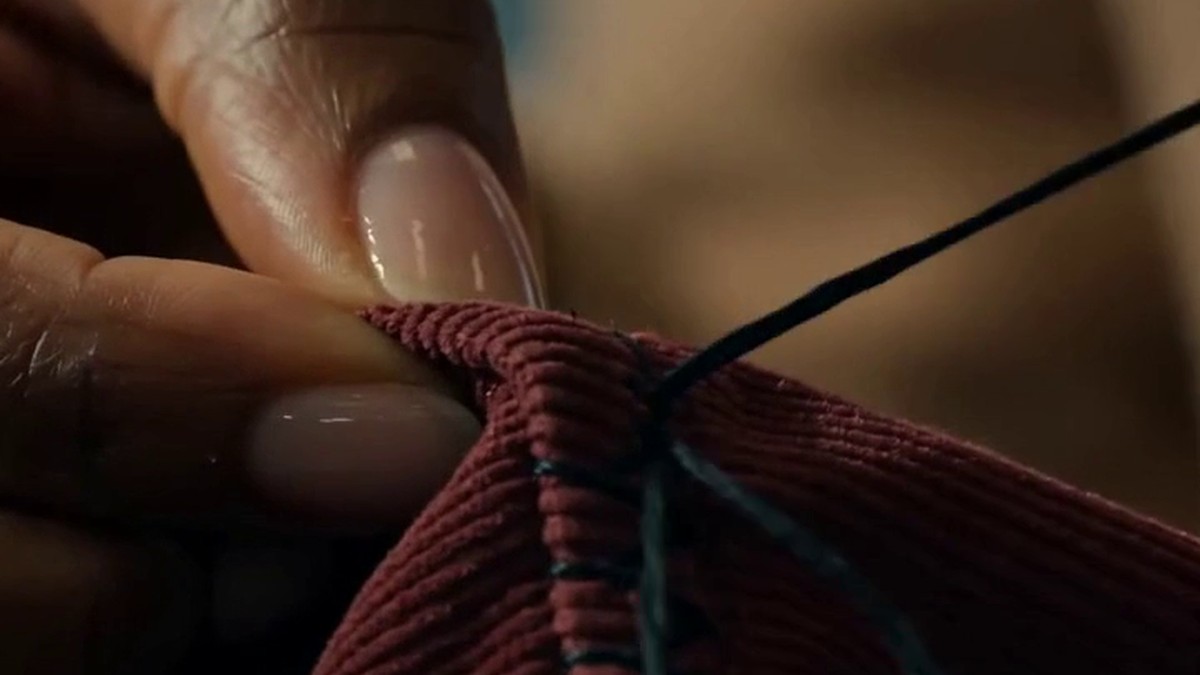
My mother opened the bag. She took out a tin that used to hold hard candy, and from inside it — a needle, a thimble, and spools of thread. Three colors. Black, white, green. No maroon.
She started sewing. The black thread went into the maroon fabric like a stranger's stitch. I watched her fingers work fast, like she'd done this her whole life. The thimble tapped against the needle. Tap-tap-tap. That was the only sound reaching me. A plane roared outside the window as it took off, but all I could hear was that tapping.
"There was a boy once," my mother said, not stopping her sewing. "At my school. Had a brand-new windbreaker. First one like it in the whole neighborhood. Everybody was jealous."
I looked at her. Tap-tap-tap.
"He caught it on a nail in the fence. Tore the whole sleeve open. He thought it was the end of the world too. You know what he did?"
I didn't know.
"He rubbed his elbow against a tree trunk and told everyone it was a souvenir. Wore that jacket with the hole all winter. And everybody thought it was some new style."
She paused for a second. Pulled the thread through. Tap-tap-tap.
"Only he knew it wasn't a style. But nobody ever asked him."
She finished. Turned the pants inside out. The stitching was even, but visible. The black seam on the maroon knee looked like somebody's crooked signature.
"Put them on," she said.
I stood up. The zipper was cold. The fabric smelled now of rubbing alcohol and the stale terminal air. I pulled the pants on and checked my knee in the window glass. In the reflection the black stitch looked like a spider that had landed on the fabric.
"You can walk out like that," my mother decided. "Looks like a patch. On purpose."
It didn't look on purpose. But my mother had already stood up, already swung the bag over her shoulder, already started toward the gate. And I followed her, placing my feet carefully so I wouldn't catch on any tile, any step, any nail that wasn't even there.
At the gate she looked at me and buttoned my coat collar. Her fingers were cold. The thimble hung from a string around her wrist.
On the plane I sat by the window. Outside the glass, ground crew stood with orange flags. My mother took a slice of buttered bread with sugar sprinkled on it, wrapped in wax paper, out of her purse. She handed it to me. I didn't eat it. Instead I slid my hand into the pocket of the pants.
At the bottom of the pocket lay a piece of black thread. A scrap my mother must have dropped when she folded the pants on the bench. I pulled it out. It was long, almost the length of my hand. I wound it into a little ball and put it back in the pocket.
The plane started moving. It shook all over, like the old elevator in our building. My mother closed her eyes. I watched the window, the runway, the way the concrete slabs blurred into one long gray line.
I held the ball of thread in my pocket. I could feel it through the fabric. It was hard, like a cherry pit you'd carry in your cheek as a kid, just to see how long you could go without swallowing it.
From Baltimore I wrote my father a short letter, because my mother told me to thank him for the plane tickets. At the end I added: "The pants survived the trip." I didn't mention the hole. My father wrote back: "Good. Seagull."
I wore those pants for two more years. Then they got too short. My mother put them in a bag for the church clothing drive. As she stuffed them into the sack, a little ball of black thread fell out of the pocket and rolled across the floor.
I picked it up. My mother stood there with the bag in her hand.
"Leave it," I said.
She nodded and tied off the bag. I put the ball of thread in the old candy tin, where my mother kept her needles. It's still there today.
And sometimes the hall closet still smells like corduroy, even when nothing's hanging in it.