Her voice dropped to a ragged whisper. "When your husband gives you a necklace — leave it in water. Overnight. Promise me."
She was gone before the next stop.
The young wife stood on the platform, heart thumping, telling herself it meant nothing. Just another unhinged stranger in a city full of them. She almost believed it.
Almost.
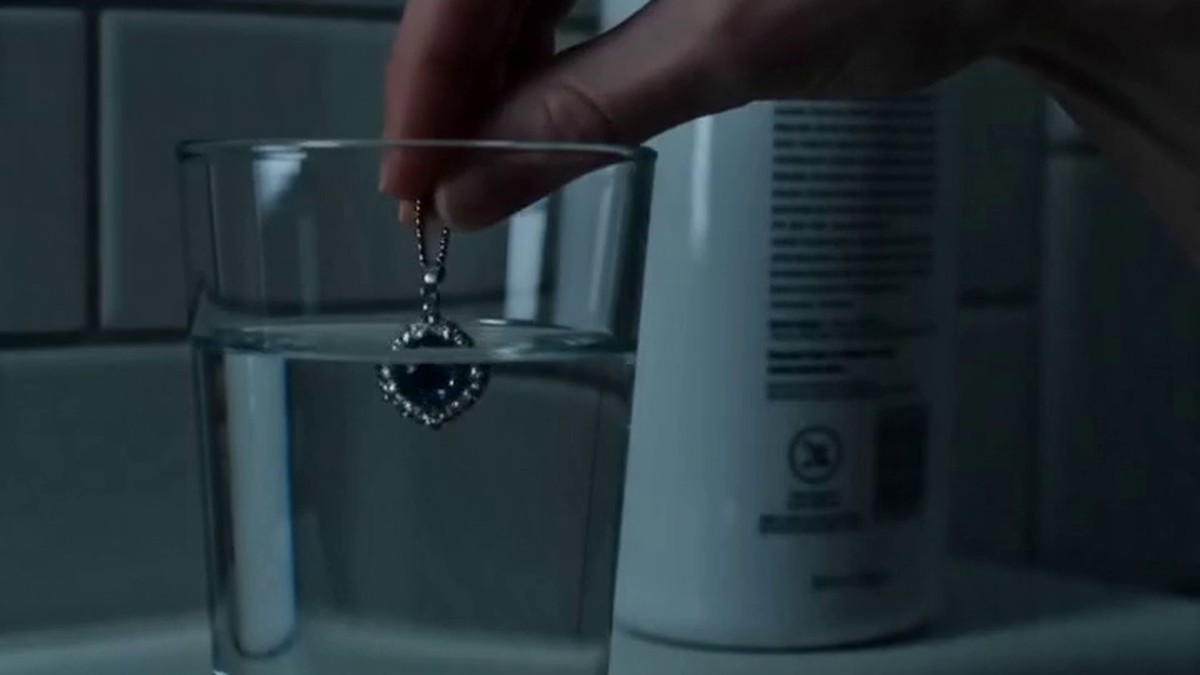
That evening, she unclasped the necklace — the one he'd pressed into her hands with that slow, certain smile on their anniversary — and lowered it into a glass of water on the bathroom shelf.
She didn't sleep well.
Morning light poured through the kitchen windows. She moved toward the shelf almost without deciding to. Picked up the glass.
The water had gone murky. Gray-white. Like something had bled into it.
She tilted the glass.
The pendant was gone.
What remained sank slowly to the bottom — small, dense, metallic. Nothing like jewelry. Nothing romantic at all.
A tracking device. Compact, sophisticated, designed to survive anything except, apparently, one glass of water and one desperate old woman's warning.
Her hands went cold.
He hadn't given her a gift.
He'd given her a leash.
Every errand. Every coffee with a friend. Every quiet afternoon she thought was hers alone — he'd known. All of it.
She set the glass down carefully, the way you set something down when you're afraid of what you'll do if you don't.
Her husband was in the next room. She could hear him humming.
And she had no idea who he actually was.
She stood very still.
The humming continued — something tuneless, almost lazy — and she recognized the sound for what it was now. Not contentment. Control. The sound of a man who had never once worried about what she might do, because he'd always known exactly where she was.
She looked at the glass. At the thing resting at the bottom of it.
Then she looked at her reflection in the dark window above the sink.
*Think.*
She'd been a practical woman before she met him. She remembered that version of herself dimly, the way you remember a city you lived in years ago — the general shape of it, the feeling underfoot. That woman had trusted her instincts. Had known when something was wrong.
She'd stopped listening to that woman three years ago. He'd made that easy.
Her phone was on the counter. She thought of picking it up, then didn't. If there was a tracker in a necklace, there could be software on a phone. She'd read enough to know. She'd just never applied it to her own life, because that was the kind of thing that happened to other people.
She turned off the faucet she hadn't realized she'd turned on.
*Don't change anything. Don't change anything yet.*
She dried her hands. Put the glass back on the shelf, device and all. Then she walked into the kitchen doorway.
He was at the table with his coffee, phone face-down, reading something on his laptop. He looked up when she appeared. His smile arrived precisely on schedule.
"Morning." He tilted his head slightly. "You sleep okay? You look pale."
"Didn't sleep great," she said. True enough. "Bad dreams."
"Come sit." He patted the chair beside him.
She sat.
—
She spent the day performing herself.
That was the only way she could think of it. She moved through their apartment like an actress who'd played this role so long the blocking was automatic — made lunch, answered emails, laughed at something he said around two in the afternoon. She couldn't have told you what it was.
He watched her the way he always watched her. She'd used to call it *devotion.* A little intense, maybe, but flattering. The way his eyes tracked her across a room. The way he always seemed to know when she'd come home before she'd made a sound.
She understood the mechanism now.
What she didn't understand was *why.* And that was the thing that kept snagging at her, the loose thread she couldn't stop pulling. Jealousy? Control? Or something she hadn't let herself name yet, something larger and colder than a bad marriage?
Who was he?
She thought about the old woman on the subway. The rawness of her voice. The grip — not gentle, not crazy-person frantic — *precise.* The grip of someone delivering a message they'd rehearsed. Someone who knew.
Someone who had been where she was now.
At 4:15, he said he was going to the gym. He kissed her forehead. She listened to the door close, counted to sixty, and moved.
—
She didn't touch her phone.
She went to the one place she was fairly certain was clean — the hallway closet, floor level, where she kept boxes of old books she'd never unpacked. She dug until her fingers found the paperback at the bottom of the third box, the one with the folded note inside the back cover. Her sister's address. Handwritten, never photographed, never sent digitally.
Old habit. Her sister traveled, moved constantly, didn't trust clouds or apps or anything she couldn't touch.
She memorized the address again, though she already knew it by heart, and put the book back.
Then she went to the bathroom shelf. Looked at the glass one more time.
She reached in and palmed the device. Carried it to the bedroom. Slipped it under his side of the mattress, still damp.
Let him track himself for a while.
She changed her shoes. Took only her keys, her transit card, and forty dollars in cash she'd been keeping in a tampon box for no reason she'd ever consciously articulated. She was starting to understand her own instincts better.
She walked out the door and didn't look back at the apartment.
—
Her sister opened the door on the second knock.
Meg was two years older, sharper around the edges, and she took one look at her face and stepped aside without asking a single question. That was the thing about Meg. She'd never liked him. She'd said so exactly once, three years ago, and then never again — not because she'd changed her mind, but because she understood that saying it again would only push her sister further in.
She was smarter than people gave her credit for.
"How long do you have?" Meg asked, closing the door.
"I don't know." She sat down on the couch. Her legs had started shaking somewhere on the subway and hadn't stopped. "I found something in the necklace he gave me. A tracker."
Meg went very still.
"I need to know who he is," she said. "I mean really. I need to know what I'm dealing with."
Meg crossed the room and opened her laptop. "Tell me everything."
—
It took them three hours.
What they found wasn't dramatic, at first. His name checked out. His job — consulting, always vague in ways she'd accepted without examination — had a real company behind it, real colleagues on LinkedIn, real conference photos she now looked at differently. The men beside him. Who they were. What they did.
It was Meg who found the connection. Meg, who had once spent six months investigative-reporting a financial fraud case and knew how to read corporate structures like other people read weather.
"This company," she said quietly, turning the laptop. "The one that funds his firm. Shell, inside a shell, inside another shell. But if you unwind it all the way —" She tapped the screen. "It's the same group that was investigated in the Harland case. Four years ago. Money moving through private accounts. Three witnesses who were going to testify."
She remembered the Harland case. It had been on the news. She'd been dating him by then.
"What happened to the witnesses?" she asked, even though she already felt the answer moving through her like cold water.
Meg closed the laptop.
"Two relocated. One didn't."
The room was very quiet.
"He knew I was a witness," she said slowly. The shape of it assembling itself in her chest like a structure she hadn't wanted to see. "At the coffee shop. That's where we met. I'd just been interviewed — I'd seen something at my old firm, financial records that passed through my desk. I filed a report and then —" She stopped. "And then I met him."
Six weeks later.
She thought about his smile. The slow, certain kind. The one that had made her feel chosen.
"He wasn't falling in love with you," Meg said. And her voice was careful, and kind, and terrible. "He was managing you."
—
He called at 7:42.
She watched Meg's phone — her own she'd left on the counter at home, powered on, sitting next to her keys so the GPS would keep reporting she was there. He'd discover the tracker moved eventually. She had until then.
"Don't answer," she said.
He called twice more.
Then he stopped.
That was worse.
At 8:10, Meg's building intercom buzzed.
They looked at each other.
"He doesn't know this address," she said. But her voice didn't quite hold.
"No," Meg agreed. "But he knows you're not home."
The intercom buzzed again. Long. Insistent.
Her hands were cold again. She pressed them flat against her thighs.
"We call now," Meg said. "Right now." She was already reaching for her phone. "The federal case didn't close. The investigator — I have a name from the article, let me —"
"Meg."
"I'm calling."
The intercom went silent.
And then they heard footsteps in the hallway.
—
She crossed the room in four steps and looked through the peephole.
He was standing in the hall in his gym clothes, which meant he'd come straight here, which meant he'd known exactly where to come, which meant she had underestimated something.
His face through the fish-eye lens was arranged into an expression of concern. Patient. Reasonable.
It was the most frightening thing she'd ever seen.
"I know you're in there," he said. Quiet voice. Conversational. "I just want to talk. You're scared, I understand that. But you don't have the full picture."
She didn't move.
"You found something. I know. I'm not angry." A pause. "But you need to understand what's actually happening before you do something that puts you in real danger. There are people involved in this situation who are not — who are not safe. And I've been keeping you out of their sight. The tracker was protection. Not what you think."
She heard Meg behind her, murmuring into the phone. Urgent, low.
"Whoever you've been talking to," he continued, "you don't know their full interests. You need to trust me."
She pressed her forehead lightly against the door.
*He's good,* she thought. Even now. Even knowing what she knew, some trained-in part of her registered the logic of his words, reached for the possibility he was telling the truth. That was the real thing he'd built over three years. Not just surveillance. *Doubt.* He'd made her doubt herself so thoroughly that she was still doing it while he stood outside the door.
She straightened.
"Meg," she said. "Is he on the phone?"
"Yes," Meg said. "He's on. I'm sending the address now. He says he knows the case."
She turned back to the door.
"There are federal investigators on their way," she said. Loud and clear, so he could hear every word. "I've given them the device. I've given them the corporate structure. I've given them your name, your firm, and the connection to Harland."
Silence.
"And I need you to know," she said, "that I haven't done anything wrong. I saw something at my old job and I reported it. That's all I did. You spent three years making me forget that I was ever someone who would do that. But I still am."
Nothing moved in the hallway.
"So you can stand there and explain yourself," she said, "or you can leave. But either way, this is over."
The footsteps came back. Slow. She watched through the peephole. His expression had changed — the concern was gone, and what was underneath was harder and more honest, and in a way she was grateful to finally see it. The real face. The one she'd been sleeping next to without knowing.
He held her gaze through the door as though he could see her seeing him.
Then he turned and walked away.
—
She didn't follow.
She stood in Meg's hallway while her legs decided whether they still worked, and she listened to his footsteps diminish down the stairs, and she let out a breath that felt like it had been trapped for three years.
The investigator arrived forty minutes later. He had a federal ID and tired eyes and a manner that suggested he'd been waiting for exactly this call for longer than was comfortable. He sat at Meg's kitchen table and he listened without interrupting, and when she was finished he told her that yes, the case was still open, and yes, her original report had never been buried — it had been paused, because they needed a larger pattern to build on.
"You just gave us the pattern," he said.
Her husband — she was already thinking of him in the past tense, she noticed — was taken into custody before midnight. Two other men, names she didn't recognize, were picked up in the same sweep. It happened quietly, which was how these things apparently happened when they finally happened.
She found out from the investigator's follow-up call, two days later, in the spare room at Meg's apartment, sunlight coming through a window she didn't know yet, a mug of coffee going warm in her hands.
—
Weeks later, she thought about the old woman on the subway.
She'd tried to find her, in the dim hope that a city might give you that, might let you say *thank you* to the right stranger. It hadn't. The city was full of people who appeared once and then disappeared back into their own lives, their own histories, their own reasons for knowing what they knew.
But sometimes, early in the morning, she'd think about that grip on her wrist. The precision of it. The way the old woman had looked at her with something that wasn't pity and wasn't fear but was something close to recognition.
*She knew,* she thought. *Someone put her through it first.*
Maybe that was the chain of it. Not the one around your neck. The other kind — the one that moved forward instead of binding you in place. A woman who survived passing a warning to a woman who might.
She pressed her palm flat against the glass of the kitchen window and felt the cool of it. Outside, the city moved in its ordinary morning chaos, indifferent and alive.
She was still here.
She was still herself.
That felt, for now, like exactly enough.