The assignment came through at 4:36 p.m. in a staffing office on South Jackson Street. Julia Peralta was sitting in a plastic chair that had a crack down the middle when the woman at the counter tapped a printed schedule with one acrylic nail. “Fremont Hotel. Black Ballroom, seven o’clock. Black tie. Holloway Family Foundation.” The woman paused to take a bite of a tamale from the truck outside. “You speak English, right?”
Julia said yes. She had a master’s degree in early childhood education from UW and a resume that went back eleven years. But the agency had stopped checking those things.
She read the name twice. Holloway. She almost handed the schedule back.
Then her phone buzzed. Renton landlord: “Friday or eviction. No exceptions.” Her bank app showed $81.42. So she signed the temp form and rode the Number 7 bus to the hotel in the rain.
At seven forty-five, the top-floor ballroom looked like a photograph from a donor brochure. Candles in glass globes. Chandeliers the color of warm butter. Rain sliding down the tall windows, the Space Needle a red smudge beyond the glass. The room smelled like beef short ribs and somebody’s twelve-hundred-dollar perfume.
Julia kept her head down. She straightened the silver forks. She stacked the cocktail napkins. She was not there to be seen. She was there to earn twenty-two dollars an hour and leave before the buses stopped running.
Then she saw the boy.
He came around the far side of the buffet with his jaw already crumpled. His tuxedo jacket was too wide at the shoulders. His hair had escaped whatever side part someone had tried to force on him. He was crying.
Julia set down the tray before she knew why.
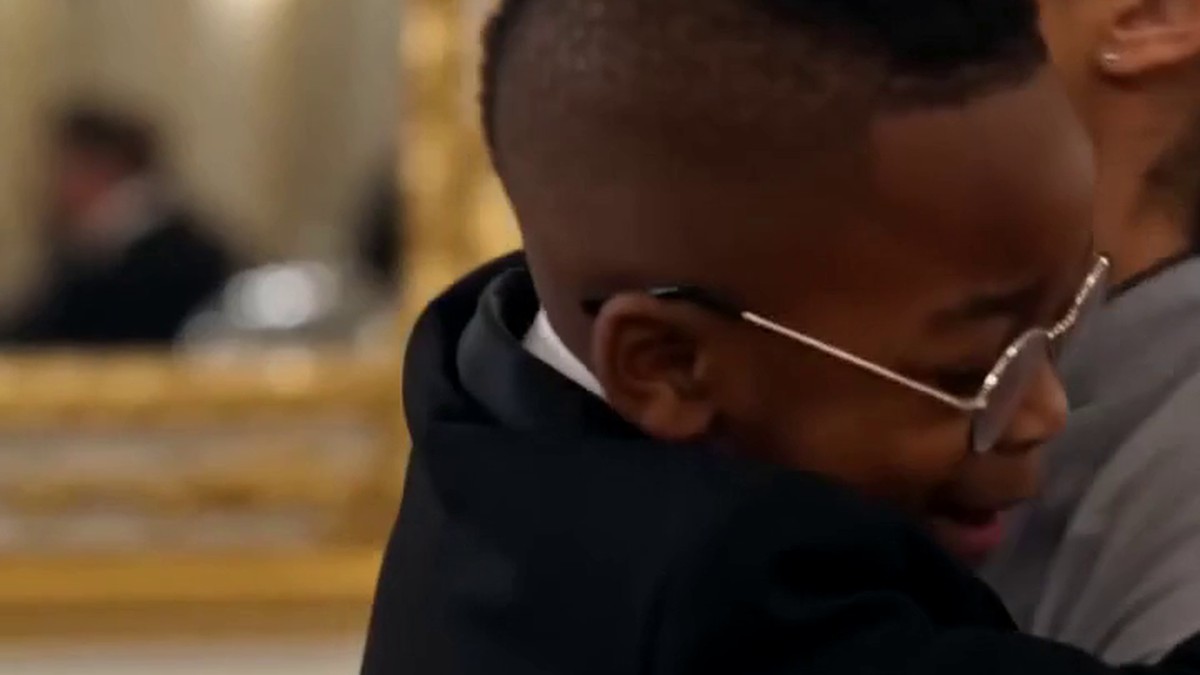
He hit her waist like a small car braking too late. His arms locked behind her back. “Mama.” His face ground into the gray uniform. “Mama, you came back.”
The ballroom went dead. A server froze with a bottle of champagne tilted over a glass. A woman in an emerald dress set her clutch down. A man near the window raised his phone, then lowered it as if the moment had a voltage.
Julia put a hand on the boy’s back. The other hung at her side.
“Eli,” she said. “Hey, I’m here.”
But she heard the word he had used, and she knew. It wasn’t a hug. It was proof.
At the far end of the room, Meredith Holloway was already moving.
She crossed the floor in a wine-colored gown, heels snapping against the parquet. She didn’t shove anyone. She didn’t need to. The crowd split for her the way traffic splits for an ambulance.
“Get away from my son.”
Julia kept her hand on Eli’s back. “I didn’t come here for you, Meredith.”
“You were told never to contact us again.”
“I was assigned to this station. I didn’t know he’d be here.”
It was a lie mostly. She had known. She had taken the shift because eight months of silence had eaten through her savings and her patience, and because some part of her wanted the Holloways to see her standing upright.
Meredith tilted her head. “You expect anyone in this room to believe that?”
“I don’t care what they believe,” Julia said. “I care why your son thinks I was coming back.”
“Don’t speak about my son.”
“He brought it up.”
Eli’s fingers twisted deeper into her jacket. “Don’t go again. Please.”
From the head table, Grant Holloway walked over. He had the face of a man who’d spent twenty years trying not to make a mistake in public. “Eli.” His voice was lower than his wife’s, but no less final. “Come now.”
“No.”
“Eli.” Grant’s jaw flexed. “This isn’t the place for this.”
“He said I took money,” Eli said. His voice cracked. “He said you left because they gave you money.”
The room went from dead to worse. A board member near the table turned. A donor set her champagne glass down with a click.
“Who told you that?” Julia asked.
Eli opened his mouth. His eyes moved to his mother.
“I told him the truth,” Meredith said. “You signed a release. You accepted a settlement of thirty-five thousand dollars. You agreed to leave and not contact him.”
Julia felt the heat move up the back of her neck. “I never signed anything.”
“We have the document.”
“Then bring it out.”
Meredith’s mouth flattened. “This isn’t a courtroom.”
“No,” Julia said. “It’s a room full of witnesses.” She bent to the black nylon bag she had shoved under the buffet. The zipper stuck for a second. Then she opened it and lifted out a manila folder.
The action made Meredith step back.
Julia set the folder on the white tablecloth between a silver chafing dish and a neat stack of napkins. She opened it. She removed a single sheet of paper and put it face up.
“This,” she said, “is the release. The one you’ve been showing people for eleven months.”
Grant stepped forward. “Where did you get that?”
“Your former house manager sent me a copy after I was fired. He thought I should know what I supposedly signed.” She tapped the line at the bottom. “The signature says Julia Peralta. It’s dated May fourteenth.”
“That’s the date,” Meredith said.
“I was at Swedish Cherry Hill at eleven a.m. on May fourteenth,” Julia said. “I have the urgent-care discharge papers. I had a kidney infection. I was in a hospital bed, with a fever of 102.8. I couldn’t sign a receipt for delivery soup, let alone a release.” She turned the paper over. “The signature is a photocopy from a birthday card I sent Eli in March. I know because I write my lowercase ‘a’ differently every time. This one”—she pointed—“has the exact loop from the card. A forensic examiner confirmed it. I paid him with the last four hundred dollars I had.”
Nobody spoke.
“So no,” Julia said. “I didn’t take thirty-five thousand. I didn’t leave because of money. I was fired at nine a.m. on May fifteenth and told to leave through the service door. My final paycheck came eleven days late. My health coverage ended at midnight. And someone”—she looked at Meredith—“told a seven-year-old boy that I sold him out.”
Eli’s face was wet. His hands had loosened. He looked from his mother to Julia and back.
“That’s a lie,” he said.
“Yes,” Julia said. “It is.”
Grant’s throat moved. “Julia, we can handle this privately.”
“No.” She said it without shouting. “We handled it privately for eleven months. I applied to eighty-four jobs. I got three interviews. You know why? Because your family office sent a reference letter to every agency north of Portland. Nineteen words. ‘Ms. Peralta left under circumstances involving confidential household matters. We cannot recommend rehire.’” She lifted another sheet from the folder. “Blacklisting is a civil violation in Washington State. So is misclassifying a nanny as an independent contractor if she works more than forty hours a week. I have the timecards. I have your emails. I have the signatures.”
She set a black USB drive on top of the folder.
“This morning at nine fourteen a.m., I filed a complaint with the Washington State Department of Labor and Industries. Case number 25-2-14681. I’m asking for fourteen thousand six hundred twenty dollars in unpaid overtime and damages. I also contacted the Seattle Times.”
At the edge of the room, a woman in a gray suit looked up from her phone. Her lanyard said SEATTLE TIMES.
Meredith saw it. She opened her mouth, then closed it.
Julia zipped the bag. She picked up the folder and left the USB drive where it was. Eli reached for her sleeve.
“Don’t go.”
She took his hand. She pressed something into his palm—a folded sheet with her phone number. “You memorized that number by your fifth birthday,” she said. “You can call me whenever you want. That part doesn’t change.”
Then she looked at Grant. “Your son has been telling the truth for eleven months. You just didn’t want to hear it.”
She walked through the service door near the buffet. The last thing she heard was Meredith’s voice, thin and breathless, asking who the woman with the lanyard was.
The service corridor smelled like bleach and dishwater. Julia passed the industrial elevators and a stack of folded banquet tables. Her hands were shaking. She didn’t use the staff exit out of shame this time. She used it because it was the fastest way to the bus stop.
The rain had stopped. The sidewalk on Fourth Avenue reflected red from the hotel sign. She stood under the awning, pressed the paper with Eli’s number between her fingers, and waited for the Number 7.
Behind her, through the glass doors, a man in a black suit ran into the lobby. He said her name twice before the doors closed.
She didn’t turn around.