The waiting room at DoveLewis smelled like wet fur and isopropyl alcohol. On the TV bolted to the wall, a chef was being yelled at by a judge. I had my phone in my hand, thumb on the banking app. The joint account was still there. Fourteen thousand seven hundred fifty dollars. The kitchen fund.
A year earlier, that money was meant for granite counters and a farmhouse sink.
A year earlier, I was carrying a dying dog three blocks through the rain, and my wife was already gone.
It began on a Tuesday in October. Portland, Oregon — the one where it doesn’t pour, it just drizzles from the first week of October until May, and everything smells like moss, diesel exhaust, and wet leaves. I was walking to the Safeway on Lombard Street to grab coffee and a loaf of sourdough. Three blocks from our apartment.
Behind the store, next to the loading dock, there’s a chain-link fence and a row of dumpsters. Under the dock, in the mud, a dog was lying.
He was soaked through. I could count his ribs from twenty feet away. He didn’t bark. He didn’t move. He just lay there with his head on his paws, blinking rain out of his eyes, the way dogs blink when they’ve been chased off enough times that they’ve stopped hoping. Not asking. Not begging. Waiting for me to walk past so he could go back to ignoring the weather.
I walked past.
I bought the coffee. I bought the bread. I was almost to the front door of our building when my feet turned around on their own. He was still there. I crouched down six feet away and tore off a piece of bread. Set it on the wet ground. He didn’t move for five minutes. Then he crawled — not walked, crawled on his belly like he was apologizing for occupying space — and ate the bread in two seconds.
Then he looked at me.
That look decided everything. Not the argument with my wife. Not the ultimatum. That look, at seven in the morning, in the rain, behind a Safeway.
I went home and told Allison. She was my wife of four years. We had a one-bedroom in St. Johns, north Portland, with a view of a gas station and a kitchen that hadn’t been updated since the first Obama administration. The neighbor on the second floor had a parrot that mimicked the microwave beep, and the hallway always smelled like wet wool and someone else’s cigarettes.
She listened while I washed my hands. “And what do you want to do?”
“Bring him home. Clean him up. Feed him.”
“Ben. We live in six hundred square feet.”
“I’ll walk him before work.”
“You hit snooze three times every morning. I hear it through the wall.”
She was right. I didn’t have an answer.
“For two weeks, you’ll be all about this dog,” she said. “Then the novelty wears off, and I’m the one scrubbing dog hair out of the couch cushions while you’re at the hardware store.”
“It’s not a novelty.”
“Everything’s a novelty with you. For two weeks. Then it joins the rest of the pile.”
We went around like that for an hour. She talked about the remodel we’d been planning since spring — the island, the open shelving, the tile backsplash. She talked about money, and she was right, because our entire future was sitting in that joint account and not a dollar more. She talked about how fall in Portland was already hard enough without a traumatized animal shedding on the only piece of furniture we owned that wasn’t from IKEA.
I thought about that dog under the dock.
“Are you even listening to me?” she asked.
“I’m listening.”
“And?”
“And I’m still going to get him.”
That’s when she said it. She didn’t raise her voice. She didn’t cry. She said it the way you tell someone the total at the register — flat, final, no room for negotiation.
“If you bring that dog into this apartment, we’re done.”
I knew she wasn’t testing me. Allison never said anything she didn’t mean. It was the thing I’d loved about her from the start — you always knew exactly where you stood.
“Allison,” I said. “You’re really making me choose.”
“I already made my choice. I’m just waiting to see if you’ll make the same one.”
I grabbed my jacket. It was already on. I’d been standing in the doorway with my keys in my hand for the entire conversation.
I closed the door behind me.
It took forty minutes to get that dog to trust me enough to touch him. I sat in the mud in my work clothes, talking to him about nothing — the Mariners game from last night, my mother’s meatloaf recipe, the way the apartment smelled like cinnamon because Allison lit a candle every evening at six. Eventually, I put my hand out, and he rested his chin in my palm.
He weighed twelve pounds. A dog his size should weigh twenty-five. I carried him three blocks, and he didn’t fight it. He breathed against my neck the whole way.
When I got home, Allison was gone. On the kitchen table, next to a cold cup of coffee, there was a note. Two words: “Choose better.”
I didn’t keep the note.
That first night, I slept on the bathroom floor because the dog was too afraid to come into the bedroom. He lay on an old towel and shook. Not from cold — from not understanding what was happening to him. I named him Gus, after the first baseman for the Mariners, because it was the only name that surfaced in my brain.
The first two weeks were rough. He flinched if I reached for a mug on the top shelf. He wouldn’t eat if I was in the same room. He barked in his sleep, these high, panicked yelps that woke me at three in the morning.
The money went fast. A vet visit turned into bloodwork, which turned into antibiotics and special food. The food was seventy dollars a bag. I picked up weekend shifts. In November, I dipped into the joint account for the first time — a few hundred for a follow-up exam.
The kitchen remodel had already stopped existing. Nobody was ever going to pick out granite.
Over the next few months, Gus changed. At one month, he ran to meet me at the door instead of cowering behind the sofa. At three months, he discovered he could jump on the couch and carried on like it had always been his. By spring, he’d packed on fifteen pounds. His coat came in thick and reddish-brown, like a fox. One ear stood up; the other flopped sideways, so he always looked a little confused about what day it was.
We walked the St. Johns Bridge. We hiked Forest Park. In the summer, I drove him out to my parents’ place in Sandy, where he saw a cow and barked at it for fifteen minutes, then hid behind my legs.
He followed me everywhere. Into the bathroom. Into the kitchen. Onto the tiny balcony. If I sat down, he dropped onto my feet. If I stood up, he stood up, even if he’d just fallen asleep. Sometimes I’d walk from the living room to the kitchen and back just to watch him follow me, sighing like an old man who’s seen too much.
In September, nearly a year later, I saw Allison on the MAX Yellow Line. She was reading something on her phone. She’d cut her hair. She looked good. We made eye contact for half a second. She lifted her chin, just barely — an acknowledgment, not a greeting — and went back to her screen.
I won’t pretend I didn’t have nights where I sat in that apartment, the same one where she’d left the note, and thought: my wife of four years left me because of a dog. Because of a dog.
But I knew that wasn’t it. She didn’t leave because of Gus. She left because she’d already decided, long before that Tuesday, that the relationship was a contract with an exit clause. She just needed the dog to be the exit.
Nobody gives an ultimatum like that unless they’ve been waiting for one.
Which brings me to last night.
Gus ate something he shouldn’t have — a sock, the vet thinks, or a piece of a rope toy — and by midnight he was pacing and retching and pressing his belly against the floor. I drove him to DoveLewis, the only place in Portland that answers the phone at two in the morning.
They took him back. The vet came out after the imaging and said he’d need surgery to remove the blockage. She gave me an estimate. Fourteen thousand seven hundred fifty dollars.
I don’t know if you’ve ever sat in a veterinary waiting room at two a.m. with a dog you love in surgery and a number like that on a piece of paper. It’s a very particular kind of silence. The only sounds are the TV and the receptionist tapping keys.
I had barely two thousand in my checking account. The joint account had fourteen thousand seven hundred fifty dollars.
I sat there with my phone in my hand, thumb on the banking app. The account was still labeled “Kitchen Fund.” I could see the deposits from the previous year, before Allison and I split. The balance was exactly fourteen thousand seven hundred fifty dollars, minus the few hundred from November.
I didn’t call her to ask. I knew what she’d say. And I knew what I was going to do either way.
I transferred the full amount. Then I closed the account.
The bank sent a notification to her phone. It was 2:47 a.m.
At 3:15, she called.
Her voice was tight. “Ben. What did you do?”
“Gus needed surgery.”
There was a long pause. I could hear her breathing. “You used our savings.”
“The account was for a kitchen. There’s no kitchen. There’s no ‘our.’”
“That money was half mine.”
“I know,” I said. “Maybe I should have asked. But I didn’t. I’m at DoveLewis. He’s out of surgery in an hour.”
She hung up.
At 4:10, the vet came out. She said Gus was out of surgery, resting. The blockage was a sock — a single black sock, size medium. I started crying in the waiting room, right there in front of the receptionist and a woman holding a cat in a carrier.
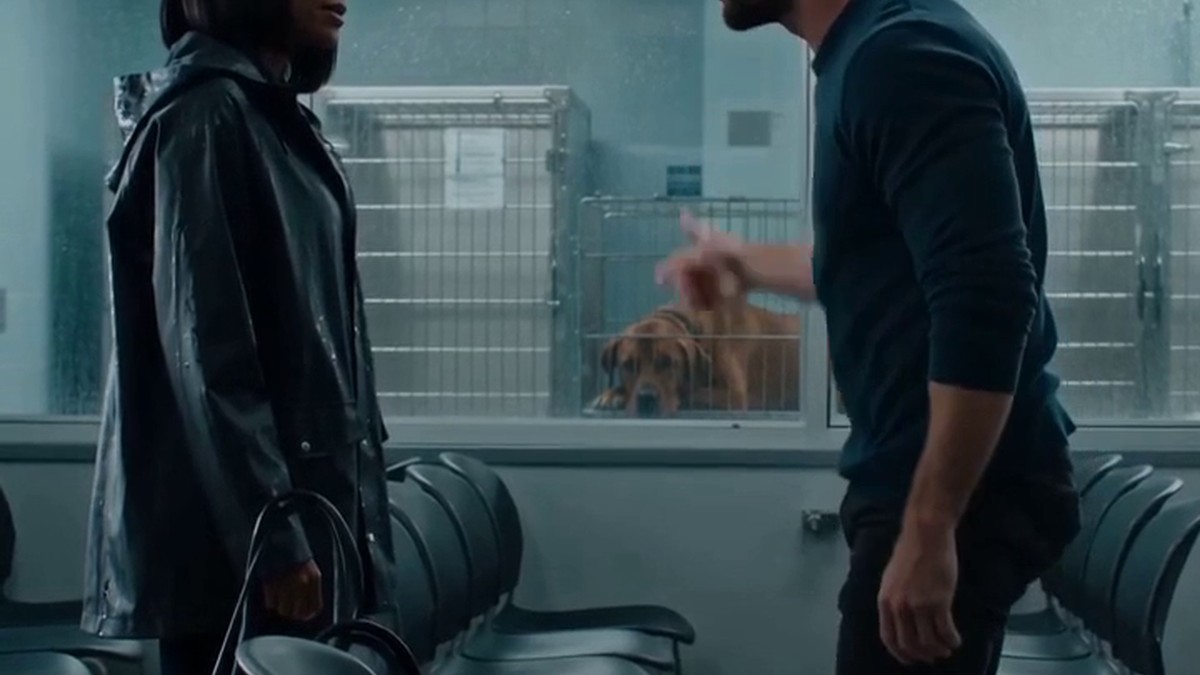
At 4:25, Allison walked in.
She was wearing a rain jacket, and her hair was a mess. She looked around the waiting room and found me. In her hand was her phone, still open to the bank notification.
“You closed it,” she said. Not a question.
“He’s alive because of that money.”
She walked over to the window of the exam area, where they’d set up a recovery kennel. Gus was still groggy, his tongue lolling, his one good ear up. Allison looked at him for a long moment — a dog she’d told me to leave in the rain.
She turned back to me. “The bank said the balance was transferred.”
“Fourteen thousand seven hundred fifty,” I said. “To the vet. Paid in full.”
She didn’t say anything for a while. Then: “I’m not going to fight you over the money. I just wanted to hear you say it.”
“Say what?”
“That you chose a dog.”
I looked at Gus. He was awake now, trying to stand, his legs wobbly from the anesthesia. His tail was going in that way dogs’ tails go when they know you’re there.
“It wasn’t a choice,” I said. “It was a different life.”
Allison put her phone in her pocket. She walked out of the clinic. The automatic doors slid open, and the rain came in — a cold, fine drizzle, the kind that doesn’t stop until May.
At six a.m., they brought Gus out wrapped in a fleece blanket. I carried him to the car. The bill was paid. The receipt was in my jacket pocket — fourteen thousand seven hundred fifty dollars, zero balance.
Gus lay in the passenger seat, head on my thigh, one ear up, tongue still hanging out from the meds. He didn’t know anything about bank accounts or ultimatums or ex-wives. He just knew the car was warm and I was driving and he was coming home.
I put the receipt on the dashboard, face up.
The kitchen fund was gone. The kitchen was still there, with its old Formica counters and the cabinet door that never quite closed.
Gus sighed, the way he does, and shifted his weight against my leg.
We drove home in the rain.