I had the aisle, 7C. Boston to Charlotte, the 9:40 redeye I'd taken a dozen times since my sister got sick, but this one stuck with me. The terminal still smelled like burnt Dunkin' and jet exhaust, and the guy across from me at the gate kept refreshing baseball scores on his phone—Red Sox down by two, top of the eighth—and I remember thinking: this is just another flight.
Then she walked down the jet bridge.
A young mother, mid-thirties maybe, with a six-year-old girl gripping her hand so hard the girl's knuckles had gone white. The girl's name was Sophie, I'd learn later, and she had that specific stillness some kids get when the world is wired too loud. Her mother, Karen, was carrying a small backpack shaped like a ladybug, and she guided Sophie toward the window seat, 7A.
But there was already a woman in it.
She looked about fifty, dressed in a cream blazer that probably cost more than my whole round-trip ticket. Blonde hair pulled tight, tapping on an iPad. When Karen quietly showed her the boarding pass, the woman didn't look up.
"System error," she said, like a CEO dismissing a typo. "I have the same seat. They'll sort it at the gate."
A flight attendant came over. Young guy, earnest, name tag said *Marcus*. He checked both passes, then leaned in. "Ma'am, I do apologize. There's an empty window seat just one row back, 8A. Would you mind—"
"I'm already seated." She buckled her seatbelt. "I don't move for children."
Karen's face went pale. Sophie started humming, a low note that vibrated in her throat, and she pressed her palm flat against the plastic wall where a window should have been. Karen didn't argue. She steered Sophie into the middle seat, 7B, buckled the strap twice to be sure, and leaned close to say something I couldn't hear over the engine whine.
I'd been a school librarian for twenty-three years. I knew what a meltdown at thirty thousand feet could look like, and so did Karen. A window seat wasn't a luxury. It was a tether: the clouds, the wing, the light doing predictable things while everything else roared and clicked and scared you.
The woman in 7A put in her earbuds and turned toward the glass.
We took off hard, the way summer storms make a plane climb fast to get above them. Sophie rocked in her seat, and Karen held both of her hands, thumb rubbing circles over the knuckles, over and over, the same four inches of skin. I set my book face-down on my tray. Some scenes you don't look away from.
Marcus made two more passes down the aisle before he ducked into the galley and picked up the handset. I watched him talk low, cupping his hand around his mouth, glancing back at row 7 twice.
Twenty minutes later, the captain's voice came through the cabin.
"Folks, this is Captain Miller. Sorry for the bump on climb-out, we'll be smoothing out shortly. Marcus tells me we've got a young lady on board today named Sophie. I've got something for her, if her mom doesn't mind."
The cockpit door opened. Captain Miller wasn't a tall man, but there's something about a pilot in uniform walking down a moving aisle that pins sixty people to their seats. He carried a small blue cardboard box, the kind a hardware store gift shop might sell, tied shut with kitchen twine instead of a ribbon.
He crouched by row 7, knees cracking audibly, and set the box on Karen's tray table instead of Sophie's, the way you hand a lit candle to a parent, not a kid.
"Ma'am, I think you knew a man named Daniel."
Karen's hand went still on Sophie's knuckles.
"He was my instructor, years ago, out of a little strip in Concord. Taught me on a 152 that smelled like a locker room." Captain Miller worked the twine loose with two fingers. "He kept a paper butterfly clipped to his sun visor the whole time I flew with him. Said his daughter made it. Said her name was Sophie and she folded it when she was four."
He lifted the butterfly out first — old graph paper, gone soft and gray at the creases, ink veins drawn along each wing in a shaky child's hand. He held it out, not to Karen, but down at Sophie's eye level, and waited.
Sophie stopped humming. She looked at the butterfly for four full seconds — I counted, I don't know why — and then took it with both hands like it might still be able to fly away.
"Daniel passed two years ago," Captain Miller said. "I lost track of the family after that. Saw the name Sophie M. on this morning's manifest and figured — well. Small chance. I had to check."
The rest was still in the box: a pair of pediatric noise-canceling headphones, bright green, tags still on, and a die-cast model of the exact plane we were sitting in.
"Picked those up at the layover counter at six this morning," he said. "Twenty-two dollars. Figured a kid who likes windows might like planes too."
Karen's mouth opened and nothing came out for a second. Then: "He kept it. This whole time, he—" She stopped, pressed the back of her wrist hard against her mouth, breathed once through her nose.
The woman in 7A had gone rigid, iPad dark in her lap, one earbud still in.
Captain Miller straightened up, knees cracking again, and looked at her — not long, three seconds maybe — before he said, "Ma'am, there's 8A still open, one row back, whenever you're ready," and walked back up to the cockpit like that was the whole of it.
She didn't move.
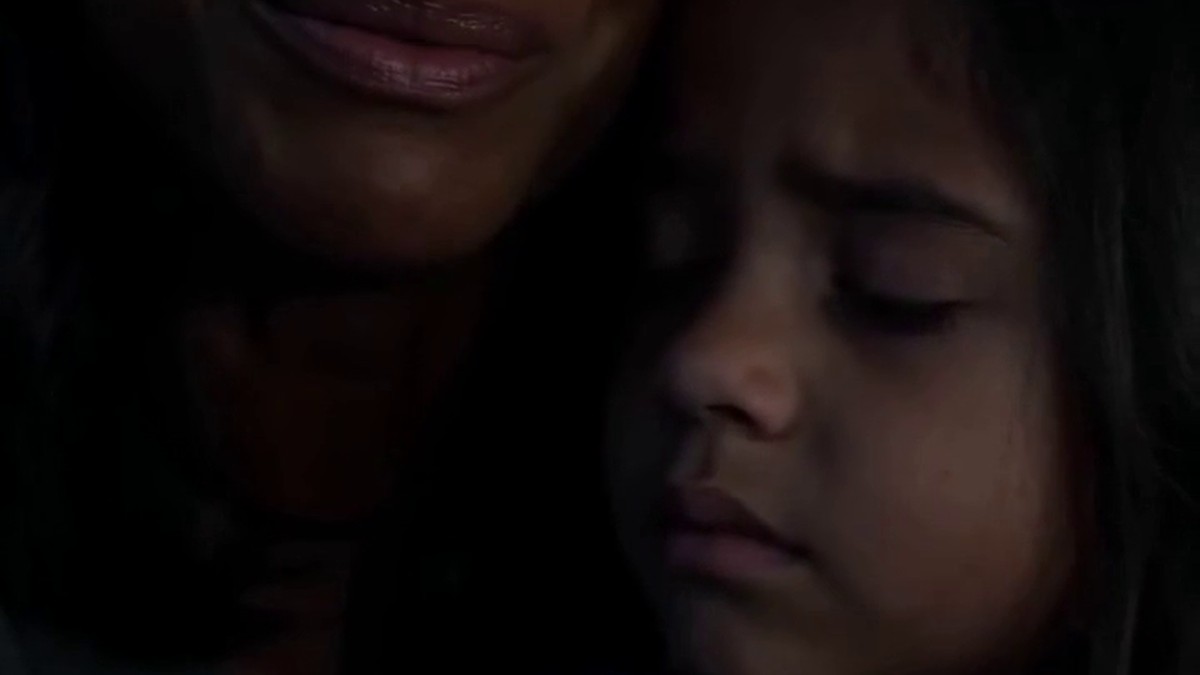
Karen lifted Sophie half onto her lap, careful of the seatbelt, and let her hold the butterfly against her chest with both hands. She didn't turn to the woman in 7A. She didn't say a word to her at all. She just leaned down to Sophie's ear and said, "Look, baby. He kept it. Daddy kept it," and Sophie pressed her forehead into her mother's collarbone and went quiet, actually quiet, for the first time since the jet bridge.
We started our descent into Charlotte an hour later. Somewhere over the Virginia line, the woman in 7A reached into the blue box, still sitting untouched on Karen's tray, and picked up the green headphones. She turned them over once, set them back down exactly where they'd been, and put her own earbud back in.
She never said a word the rest of the flight.
I was one of the last off. She was still in 7A when I passed, seatbelt off, the little die-cast plane sitting alone on the tray table where Karen must have left it deliberately. The woman was looking at it like it had asked her a question.
At baggage claim I saw her by carousel 4, blue box tucked under one arm, watching the black SUV pull away from the curb outside — a small butterfly-shaped shape pressed flat against the rear window as it went.
A Red Sox cap sat forgotten on a bench near the rental counter. I picked it up and handed it to the guy from my gate.
"Sox lost," he said, checking his phone one more time.
"Yeah," I said. "I saw."
I got in a cab outside the terminal, gave the driver my sister's address on Sharon Amity Road, and didn't open my book the whole ride.