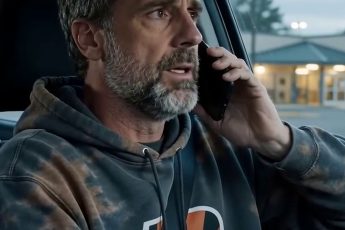
Luke rolled into the village just before the sun dropped behind the Green Mountains. The new GMC Sierra Denali ate up the last three miles of washboard dirt like it was nothing—chrome grille flashing, tires spitting pebbles into the roadside goldenrod. He’d left Boston at five that morning, a coffee thermos in the cupholder and an envelope from the dealership on the passenger seat. A surprise. No phone call, no warning. His grandmother Dottie hadn’t seen him in two years, not since he took over the construction firm and started sleeping four hours a night.
Her place was the last house on a gravel lane that dead-ended at a maple sugar shack. A white clapboard farmhouse with a swaybacked roof and a porch that sloped a good three degrees toward the vegetable garden. The window boxes had petunias. The screen door had a patch in the lower corner where a raccoon had clawed through in ’08, and she’d never replaced it. Luke killed the motor and sat for a second, his hands on the wheel. The air smelled like cut hay and woodsmoke and something baking—apple, maybe, with a hit of nutmeg.
Dottie was already on the porch, wiping her hands on a dishtowel. Eighty-three years old, maybe ninety pounds in her housedress and wool cardigan. Her hair was a white puff tied back with a child’s barrette. She squinted at the truck, then at him.
“Luke.” Not a question. Just his name, flat and certain, the way a person says *rain* when they feel the first drop.
He got out and hugged her, careful. Her shoulder blades felt like bird wings under his palms. “Missed you, Gram.”
“Missed you, too. Come inside. I made stew.”
The kitchen was exactly the same. Yellow linoleum, a woodstove, a single photograph on the wall: Luke at seventeen, in a cheap navy suit, holding a corsage. She’d sold her grandmother’s Spode china to buy that suit for his junior prom. He hadn’t known until years later, when he found the empty space in the china cabinet. Tonight she set two bowls on the table and poured iced tea from a pitcher with a cracked spout, and Luke put a spoonful of her blueberry preserves on the side of his plate and felt something in his chest unclench.
After the dishes were stacked, he said, “Come outside, Gram. Got something for you.”
They walked to the truck. The evening light made the black paint look wet. Luke pressed the key fob into her palm. “It’s yours.”
Dottie looked at the fob, then at the vehicle. She didn’t say anything for a good ten seconds. A dog barked two houses down—the McGillicuddy’s old hound, that had chased Luke’s bicycle when he was ten.
“What would I do with a truck?” she said finally. Her voice wasn’t sharp, just genuinely curious.
“Drive it! It’s got all-wheel drive, heated seats, lane assist, the works. You can go into Montpelier anytime you want. No more waiting for the county van.”
She walked a slow circle around the Sierra, her house slippers crunching on gravel, and paused by the driver’s door. She didn’t open it. Instead she turned and looked at him with those pale blue eyes that had watched him learn to walk, to drive a tractor, to lie about where he’d been at midnight.
“That’s a generous gift, Luke. But I need to ask you for something else. We’ll talk in the morning. Get some sleep first.”
He blinked. “Gram—”
“Morning.”
At seven a.m. she was at the stove frying eggs in bacon grease. A manila folder sat next to his plate. Dottie set down the spatula and sat across from him.
“I been thinking about this for a while,” she said. “I want my affairs in order. Not because I’m sick—don’t give me that face—but because I’m old, and waiting doesn’t make things easier. I’m asking you to drive me to Samuel Hatch’s office in town and let me sign the house over to you.”
Luke’s fork stopped halfway to his mouth. “Gram, no. I don’t need the house. I want you here, in it.”
“I’m not leaving it. I’m just taking my name off the deed and putting yours on. Vermont lets you do that—a transfer-on-death deed, Sam calls it. No probate, no mess. I’ll live here till the day I stop. But after that, the place is yours. No argument, no paperwork for you to chase. I need to know it’s settled.”
He tried to argue. She tapped the folder. “I already made the appointment. Eleven o’clock. Will you drive me, or do I call Dorothy McGillicuddy and ask her to fire up the old station wagon?”
They took the new GMC. Dottie sat in the passenger seat with the folder on her lap and a purse the size of a brick. She pointed out every pothole. “See, that one’s been there since Memorial Day. Town won’t fix it.”
Sam Hatch’s office was above the hardware store on Main Street, in a room that smelled of old law books and radiator steam. Sam was a man in his sixties with ink on his fingers and a tie he’d probably worn since the Reagan administration. He had the documents ready. A quitclaim deed, crisp and official. Dottie put on her reading glasses—the ones with the rhinestones in the corners—and reviewed every line.
“What about the property tax?” she asked. “He won’t get stuck with a bill right away, will he?”
“No, Dottie. The transfer-on-death only takes effect after your passing. Till then, nothing changes. You still own it, you still pay the tax. It just means Luke here becomes the owner automatically when the time comes. No court.”
She nodded. Her pen moved across the signature line in a careful, looping cursive. Sam stamped it, signed as notary, and slid a copy across the desk to Luke.
Dottie didn’t stop there. She opened her purse again and took out a small cloth pouch with a drawstring. Inside was a passbook from the Northfield Savings Bank and eleven hundred-dollar bills in a rubber band.
“Now this,” she said. “For a long time I put away a little every month. Started when your mother left. I was going to give it to you for college. But you got that scholarship, and you never asked for a dime. So the money just sat. It’s twelve thousand four hundred dollars.” She pushed the pouch toward him. “I want you to take it. Not as a gift. As your own money, that I held onto too long. I want you to spend it on something that makes you think of this place.”
Luke’s throat closed. “Gram, I don’t…”
“You will. Take it. I’ve been carrying this around for thirty-one years, and I’d like to put it down now.”
So he took it. The passbook felt heavy in his hand, the paper worn soft at the edges. He opened his mouth, but she was already standing, smoothing her dress.
“Good. Now let’s go home. You can fix the hinge on the back gate before supper.”
He stayed three more days. He fixed the gate, replaced two rotted boards on the porch, and cleaned the gutters. On Thursday morning he drove into Montpelier alone and made a few calls. By Friday afternoon a flatbed truck was backing into Dottie’s driveway with a slab of Vermont granite on it—nothing huge, just a low stone the size of a bench, sanded smooth on one face. A local monument company had sandblasted it overnight: DOTTIE’S HOUSE — EST. 1942.
Dottie came out onto the porch and watched the crew set the stone at the foot of the front walk, next to the rose bush that hadn’t bloomed in four years. She didn’t say a word until the truck pulled away. Then she walked over, bent down with a little grunt, and touched the letters with her fingertips.
“Twelve thousand four hundred well spent,” she said.
Luke left the Denali parked by the sugar shack. She still wouldn’t drive it. But the day he got back to Boston, his phone buzzed with a picture from Mrs. McGillicuddy: Dottie on the porch in her rocking chair, a book open in her lap, the stone glinting in the late-afternoon sun. On the seat of the GMC, visible through the windshield, lay the key fob—right where Luke had left it. She’d put a piece of masking tape on it, and written in black marker: *For when you come home.*