I was dead on my feet after a sixteen-hour shift at the E.R., my scrubs still smelling of antiseptic and someone else's blood. The apartment was too bright for midnight—a light in the kitchen, the living room lamp on, and a pair of sneakers at the door. Tiny sneakers, scuffed at the toes, with cartoon dinosaurs on the laces.
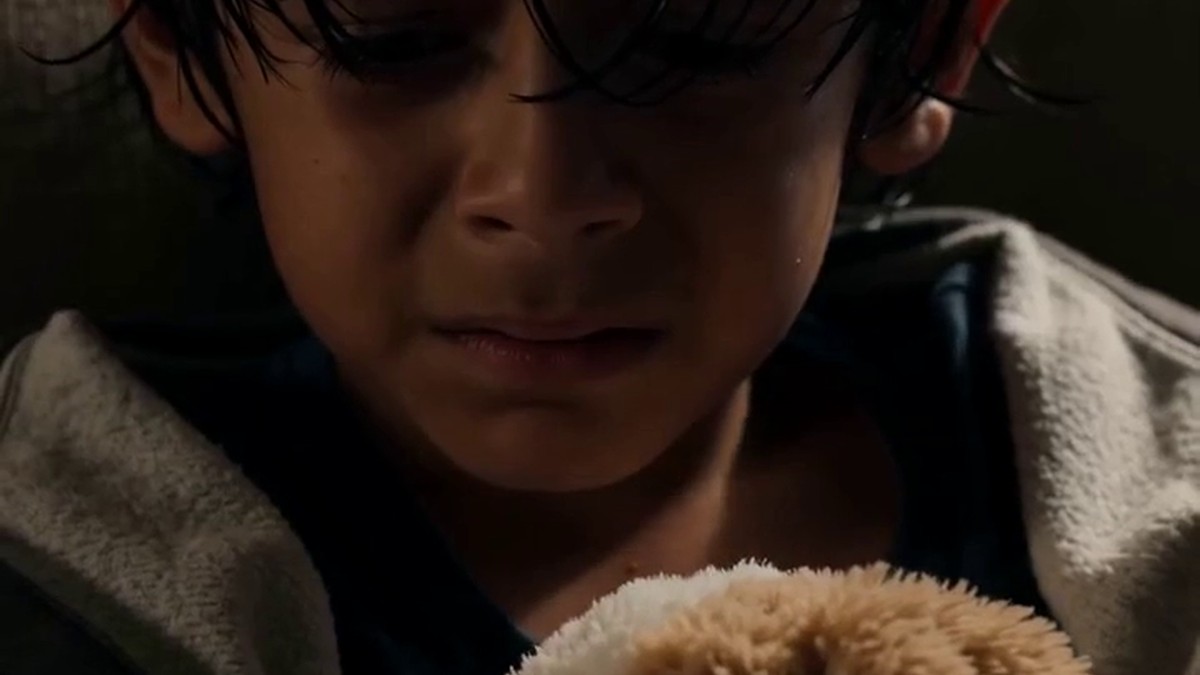
I set my badge down on the hall table, my fingers still humming with exhaustion, and walked into the living room. Mark stood with his back to the window, the city's perpetual drizzle tracing gray lines down the glass. Beside him, on the edge of my grandmother's old armchair, sat a boy. Seven, maybe. Thin wrists, dark hair plastered to his forehead from the rain, wearing a jacket three sizes too big. He clutched a stuffed dog with one ear missing and a patch of dried glue on its side. His eyes, red-rimmed, fixed on my face like he was waiting for a door to slam.
Mark's mouth opened, but no sound came at first. The neighbor's orange tabby chose that moment to yowl from my fire escape, like a bad omen. Then Mark said, "Rachel… we have to talk."
I didn't sit down. "Who is this?"
"This is Leo." He swallowed. "My son."
Four words. I heard the drip of the kitchen faucet, the rattle of the streetcar on Powell Boulevard, the boy's shallow breathing. "Your what?"
"My son. He's seven."
I looked at the kid, not with anger, but with the hollow realization that the man I'd married five years ago had been a stranger the entire time. We'd been through three miscarriages. I'd sobbed into his shoulder, felt his arms around me, heard him promise that we'd find a way to be parents. Meanwhile, a boy with dinosaur sneakers was living somewhere in Portland, eating breakfast, drawing pictures, and I never knew.
I made myself speak. "You've had a son all this time."
Mark fumbled with his keys. "It's complicated—"
"No. Complex is the new electronic health records system. Your son is not 'complicated.'"
The boy, Leo, hunched his shoulders. The tabby cried again, scratching at the screen, and I realized my left hand was gripping the door frame so hard my knuckles had gone white.
Mark's story came out in a jagged mess. Before me, there was a woman named Claire. They'd dated for a few months, broke up, then she learned she was pregnant. She didn't want him in her life, didn't want to "mix things up." He sent money every month through a state registry, saw Leo a couple of times a year at a park, and that was it. Claire told him her sister would raise Leo if anything happened. But the sister—Aunt Dana—called two days ago, said Claire had a brain aneurysm and died on a Tuesday, in the produce aisle of a WinCo. The neighbor had been watching Leo, but she couldn't keep him. So Mark brought him home. And he didn't tell me because he was terrified.
"Three days," I said. "You've known for three days, and you said nothing. You ate the pasta I cooked. You slept in our bed. And you looked at me and didn't tell me you had a child."
He didn't have an answer, so I turned to the boy. He still hadn't taken off his jacket, even though the radiator was hissing heat. "Leo," I said, crouching to his level. "Are you hungry? Do you want something to drink?"
His voice was so soft I almost missed it. "I don't want to be a bother."
Those words cut through every shred of my own anger. I fetched a juice box from the fridge, apple, the kind with the bendy straw, because I didn't know what else to offer. He took it without meeting my eyes. He said, "My mom said not to make a mess in a stranger's house."
I felt like a stranger in my own home.
I got him settled on the couch with a blanket, the damp jacket finally draped over the radiator. He sat still as a statue, the broken toy dog pressed against his chest. Back in the kitchen, Mark tried to explain again, but I just held up a hand. "I can't talk to you right now without saying something I can't take back. Sleep in the guest room. I'm staying here with Leo."
I sat in the armchair across from the couch that whole night, watching the boy sleep. At some point, the tabby jumped onto my lap, and I let him stay. The rain stopped around 4 a.m., leaving a deep stillness. Leo whimpered once, something about his mom, then rolled over.
The next week was a minefield. Leo ate only if I sat with him. He asked permission to use the bathroom, to turn on a light. He said "ma'am" to everyone, even the barista at the coffee cart. I heard him through the wall two nights in, crying into his pillow and murmuring, "I'll be good, I promise." So I knocked, pushed the door open, and sat on the floor beside the pull-out bed.
He peeked at me. "Do you need me to go?"
"No." I kept my hands folded. "My mom used to rub my back when I couldn't sleep. Do you want me to try?" He hesitated, then turned his back to me. I rested my palm between his shoulder blades, the bones sharp under his t-shirt, and moved it in slow circles until his breathing quieted.
I didn't hate Mark then. I was too exhausted for hate. But the trust was gone, a snapped electrical wire that couldn't just be twisted back together. When I finally confronted him, we were in the kitchen with the door shut. I said, "Every time I held a negative pregnancy test, you knew about Leo. You knew you'd already been a father for years. That's not a lie of omission. That's a betrayal you woke up and chose every single morning."
He looked at the floor, and I saw him in a new light: a man so scared of losing his second chance that he pretended his first never happened. He said, "I'll go to counseling. Whatever you need."
I said, "You, me, and Leo. Separate and family therapy. Non-negotiable." He agreed.
Leo started calling me "Rachel" after about a month, dropping the formalities. He'd watch me make lemon poppy seed pancakes on Saturday mornings, his small hands helping me stir the batter. He'd laugh a real laugh when the neighbor's cat darted in and stole a piece of sausage. I hung his drawings on the fridge with a magnet shaped like Mount Hood. One afternoon, he asked, "Do you have a closet big enough if I need to hide?" I froze. "Why would you hide?" He shrugged. "In case you get tired of me."
I knelt in front of him, right there by the fridge. "Leo, look at me. I'm not going anywhere. If I need space, I'll tell you, but I will always come back. You're not a secret I'm keeping, you're a person I'm choosing." I think that was the first time he believed an adult's promise.
The aunt, Dana, came to empty Claire's apartment in Northeast Portland. She was thin, exhausted, with two kids of her own and a studio she barely afforded. She looked at Mark like he was gum on her shoe, then turned to me. "You're the wife?" I nodded. "I'm sorry," she said. "You didn't deserve this either." She handed me a leather-bound photo album from a shelf. Inside were Claire's pictures: Leo as a wrinkly newborn, Leo on a tricycle, Leo holding a birthday cake with a lopsided "5" candle. Not a single photo of Mark. I gave the album to Leo that night, and he pressed it against his heart like he'd found his mother's pulse.
I knew I couldn't live with Mark, but I wouldn't abandon Leo. So I rented a studio on the ground floor of a building in the Hawthorne district, two miles away. The day I moved, I gave Leo a key. "This opens my door anytime. You can come over after school, on weekends, whenever. I'll be there." He turned the key over in his hand, put it on a string, and wore it under his shirt.
Life became a careful choreography. I went back to the house on weeknights, helping with spelling quizzes and tucking him in, while Mark and I existed in a tense truce. My mother-in-law called once, saying Mark had told her I was "breaking up the family." I asked, "Did you know about Leo?" Silence. She'd known since his first birthday. I said, "You sat at my table, ate my food, and kept a child hidden from me. Don't ever call again." I blocked her number and deleted her contact. That felt like unlocking a cage.
A year passed. The tabby cat had become Leo's cat; he'd named him "One-Ear," and I let the creature become a permanent resident of my studio. Leo turned eight. I took him to OMSI and let him press every button in the museum. He'd lost the stiffness, now yelling my name across a park, coming to my apartment in his pajamas for movie marathons. One evening, he put down his hot cocoa and said, "I think my mom would've liked you. She always said she hoped someone else would love me, too." I swallowed the ache and managed, "She raised a brave kid." Then I went into the bathroom, turned on the fan, and cried until my chest let go.
But the final piece I owed myself and Leo had nothing to do with tears. I needed something with a stamp on it, something that said "seen" and "secured." So I met with a financial advisor at a credit union downtown. I liquidated a chunk of my savings—$62,000—and set up an irrevocable trust in Leo's name, for his education. I made myself the trustee, not Mark. The boy's future was no longer a secret handshake between a ghost and a coward.
I asked Mark to meet me at a coffee shop on Alberta Street, the one with the mismatched chairs. I walked in, the door chime a bright note in the drizzle. He was already there, looking older, more tired. I sat, slid a manila envelope across the table. He opened it, the trust document thick and official.
"What is this?"
"It's a college fund for Leo. It has $62,000 in it now. The account is in my name, for him. You don't have access, and you never will. I'm not doing this to hurt you. I'm doing this because that boy has been let down by every adult in his life except his mother, and I refuse to be the next person who disappears when it's inconvenient."
His jaw tightened. "Rachel, I've been in therapy. I've tried—"
"I know. And I'm not punishing you." I placed my wedding ring on top of the envelope. It made a soft clink against the paper. "But I've filed for divorce, Mark. I'll be by tomorrow to pack what's left. Leo knows I'll pick him up from school Friday. He's staying the weekend at my place."
He opened his mouth, and I knew the words that were coming: another apology, another plea. But I stood, pulled my coat on, and said, "You hid him because you were afraid. I'm making sure he's never hidden again. That's the difference between us."
I walked out into the rain, the coffee shop door chiming behind me, and I didn't look back.
That Friday, Leo showed up at my door with his backpack and One-Ear stuffed under his arm, the cat winding figure-eights around his ankles before darting off toward the closet where the board games lived. We made lemon poppy seed pancakes, and while the batter rested, he pulled Claire's photo album onto his lap and started humming something low and off-key. I recognized it after a few bars — the lullaby he sometimes murmured in his sleep. I hummed along under my breath, not quite catching all the notes, and he glanced up at me and kept singing anyway, louder now, like he wanted to make sure I heard every word.