Nobody ever questions a base commander. That’s the first thing they teach you at the War College, and it’s the one truth I’d built twenty-two years on. You give an order, it gets followed. You walk into a room, conversations stop. You set the rules, and everyone else lives by them.
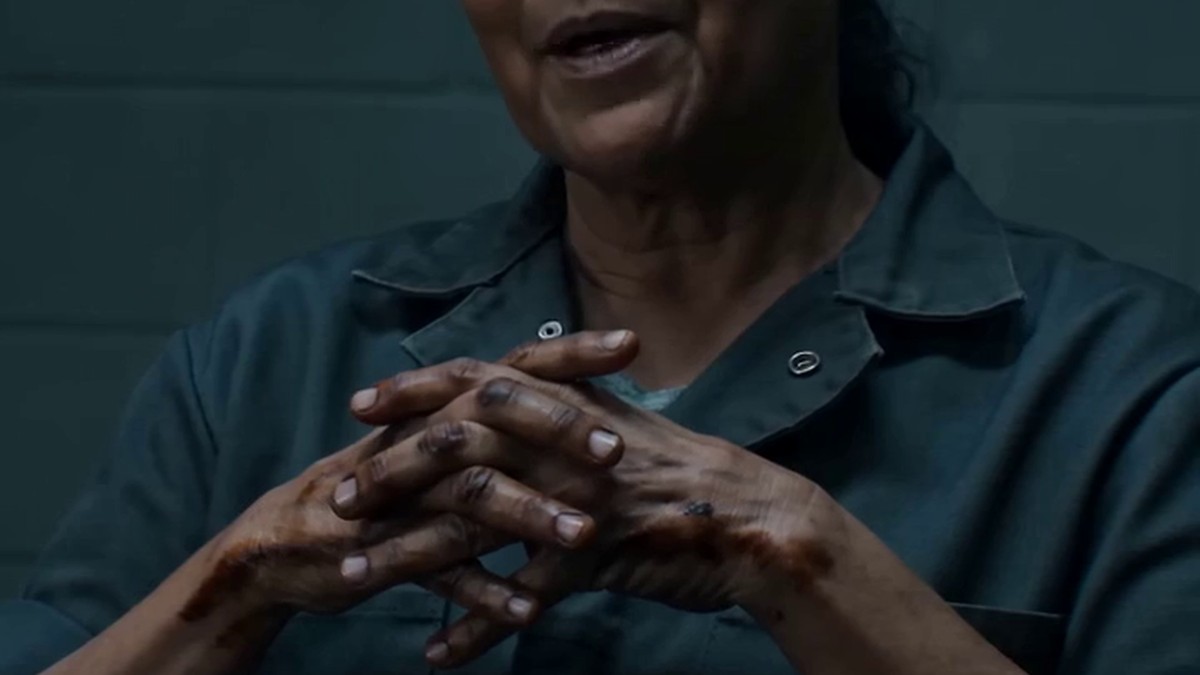
So when a civilian plumber with gray-streaked hair and grease under her nails walked into my interrogation room and sat down like she owned the place, I knew something was off.
Her name was Elena Navarro. That’s what the personnel file said, anyway. Hired six months prior through a defense contractor out of San Antonio. Maintained the HVAC systems, fixed busted pipes, kept the boilers running. The kind of worker you don’t notice until the heat goes out in January and suddenly everyone’s screaming.
But I noticed her. Because three hours earlier, my best patrol dog—a Belgian Malinois named Shadow with more bite reports than any animal on Fort Drum—had broken formation during a perimeter exercise and gone straight to her. Sat at her feet. Rolled onto his back.
Shadow. The dog who’d sent two handlers to the infirmary last year.
“Explain something to me,” I said, leaning back. “Where’d you learn to handle military working dogs?”
“I’ve never handled them.”
“Then why’d they follow you like puppies?”
She held my gaze. Not challenging, exactly. Just… unbothered. “They probably figured I wasn’t going to hurt them.”
Sergeant Riley stood by the door with his arms crossed. Young kid, sharp, the only MP on base I actually trusted. I caught his eye and gave him a look. *Dig.*
What he dug up took three weeks.
First, nothing. Clean employment record, no priors, no disciplinary actions. Before Fort Drum, she’d worked at a community college in Tulsa. Before Tulsa, a hospital in Tucson. Before Tucson—nothing. A blank. Three years scrubbed so clean you could see the eraser marks.
Riley went deeper. Called in favors with contacts at Lackland. Got stonewalled. Called again. Got hung up on.
Then one Tuesday morning, he walked into my office with a thumb drive and a face like he’d seen a ghost.
“Her name’s not Elena Navarro, sir. It’s Elena Marchetti.”
The name meant nothing to me. Riley pulled up a folder with newspaper clippings. San Diego Union-Tribune, twelve years ago. A fire at a naval kennel facility. Twenty-seven dogs trapped inside. The article had a photo of a woman in Coast Guard utilities, face smeared with soot, holding a Labrador puppy against her chest.
Elena Marchetti. K-9 rescue specialist. Cited for pulling nineteen animals out of that building before the roof collapsed.
Nineteen. She’d saved nineteen.
The article also noted, in the last paragraph, that eight dogs hadn’t made it out.
I found her in the motor pool, wrist-deep in a water heater someone had cross-threaded past saving.
“You’re Coast Guard.”
She didn’t stop working. “Was.”
“San Diego. 2011.”
The wrench paused.
“Pulled nineteen dogs from a burning kennel. Walked away from a commendation. Disappeared. Changed your name.” I stepped closer. “You let everyone think you were some retiree’s widow fixing radiators in upstate New York. Why?”
Elena wiped her hands on a rag. Slow. Deliberate. “Because people ask fewer questions when you’re unremarkable.”
“Shadow knew you.”
“Shadow’s smart.”
“That’s not an answer.”
She looked at me then—really looked—and for the first time I saw something that wasn’t calm. It was exhaustion. The kind that sits in your bones and doesn’t leave.
“His grandmother,” she said. “The line. Shadow’s from a kennel in Virginia, right? Their breeding stock came from San Diego. One of the dogs I pulled out of that fire—a young female, barely a year old—she was shipped to a breeding program six months later. I recognized the eyes.”
Nobody talks to a base commander like that. Flat. Without deference. Like we were two people having coffee.
I didn’t like it.
So I started watching her. Started assigning her the worst shifts—overnight maintenance in the auxiliary fuel depot, where the heaters broke every time the temperature dropped below ten degrees. Started denying her leave requests. Started waiting for her to crack.
She never did. Not once.
The thing about waiting for someone to fail is that it gets under your skin. You start seeing defiance everywhere. The way she nodded to the MPs at the gate. The way the dogs’ ears perked when she walked past the kennels. Every small thing became proof of something I couldn’t name.
Then came the night of February third.
I was doing rounds near the auxiliary depot when I heard a voice from inside one of the storage rooms. Quiet. Steady. Elena.
I pushed the door open.
She was kneeling next to two transport crates. Inside, a pair of young shepherds—new arrivals, waiting for evaluation—were crammed into enclosures half the size they needed. One had a choke chain pulled so tight the dog could barely lower its head.
Elena had already opened the first crate. Her hand was on the latch of the second.
“What do you think you’re doing?”
She didn’t flinch. “The chain on this one’s cutting into his neck.”
“Those animals are under my authority.”
“Then you should’ve checked on them.”
I took a step toward her. The words were out before I could stop them: “You think anyone’s going to listen to you over me?”
That’s when the alarm went off.
The fuel depot alarm. A sound I hadn’t heard outside of drills in fourteen years.
Lights started strobing in the corridor. Someone on the PA—Riley’s voice—shouted about a leak in the auxiliary tank. Then smoke began seeping under the door at the far end of the hall.
Elena was already running. Shadow, who’d somehow gotten loose from the kennels, tore around the corner and fell in beside her. Then another dog. Then another. By the time Riley intercepted her at the north access door, fifteen dogs were moving as a single unit behind a sixty-year-old plumber who hadn’t spoken a command.
She raised her hand. All fifteen stopped.
The fuel odor hit me then. Strong. Flammable. In my head, I was running calculations: response time for the fire crews from Watertown, wind conditions, how much fuel was in that tank.
Elena didn’t calculate. She pointed.
“Shadow—search.”
The dog bolted. The pack fanned out behind him.
Two minutes later, barking from a storage bay. I got there just as Elena and two soldiers were dragging a technician clear of a collapsed shelving unit. The guy had been pinned under steel brackets when the initial pressure release knocked everything over. His face was gray. He wasn’t breathing right.
Elena knelt next to him. “Stay awake. Look at me. We’ve got you.”
The soldiers pulled him free, and we got him ten yards clear before the first explosion hit.
The blast knocked Elena flat. When she got up, her face was bleeding and she was staring past me at the depot.
Three dogs. Still inside.
The fire was spreading fast now—fuel-fed, the kind of fire that doesn’t wait for anyone. I stood there running tactical assessments while Elena Marchetti walked directly into a burning building.
No hesitation. No order. Just a sixty-year-old woman disappearing into smoke, and me watching from a safe distance because that’s what commanders do. They don’t run into fires. They manage them.
Cold air bit through my jacket. My hands were shaking. I wanted to move. My feet wouldn’t.
The roof groaned.
Then Riley sprinted past me into the smoke, and something in my chest just… stopped.
He came out moments later with Elena leaning on his shoulder, three dogs swarming at their heels. The sprinkler systems engaged. The fire crews arrived. The foam trucks rolled in and drowned what was left of the auxiliary depot in chemical white.
And I was still standing there.
The after-action investigation didn’t go well for me. The security footage showed the condition of those transport crates. Animal welfare violations. Negligent oversight. Then they found Elena’s incident reports—six of them, filed over four months—documenting safety hazards around the auxiliary tank that I’d ignored. Every single one stamped *Received* by my own office.
A major from Division spent two hours interviewing me. Then he spent four hours with Elena. When he was done, I was relieved of command pending a formal inquiry.
They held the ceremony on a Thursday in March. Wind coming off Lake Ontario, that particular cold that finds every gap in your clothing. I stood at the back. I wasn’t invited.
Riley presented the commendation. A Civilian Service Medal. He said something about remembering what it means to protect those who depend on us.
Elena took the medal. Held it for a moment. Then looked toward the kennels, where fifteen dogs sat watching through the chain-link fence.
“If anyone earned recognition,” she said, “it’s them.”
Shadow pushed through the gate first. Then a second dog. Then a third. One by one, without a single command spoken, all fifteen dogs crossed the yard and formed a loose circle around her.
They weren’t following orders. They were following her.
Elena knelt. Shadow pressed his head against her shoulder, and she wrapped her arms around him and didn’t let go.
The wind kept blowing, cold and steady, but she stayed there in the center of that circle, surrounded by every last one of them.
My replacement arrived the following Monday. I was packing up my office when I saw Elena through the window, walking toward the motor pool with a toolbox in one hand and Shadow trotting beside her.
He looked up at her once. She reached down and rubbed behind his ears without breaking stride.
I finished packing. Drove off base at 4:15 in the afternoon.
The gate MP didn’t salute.