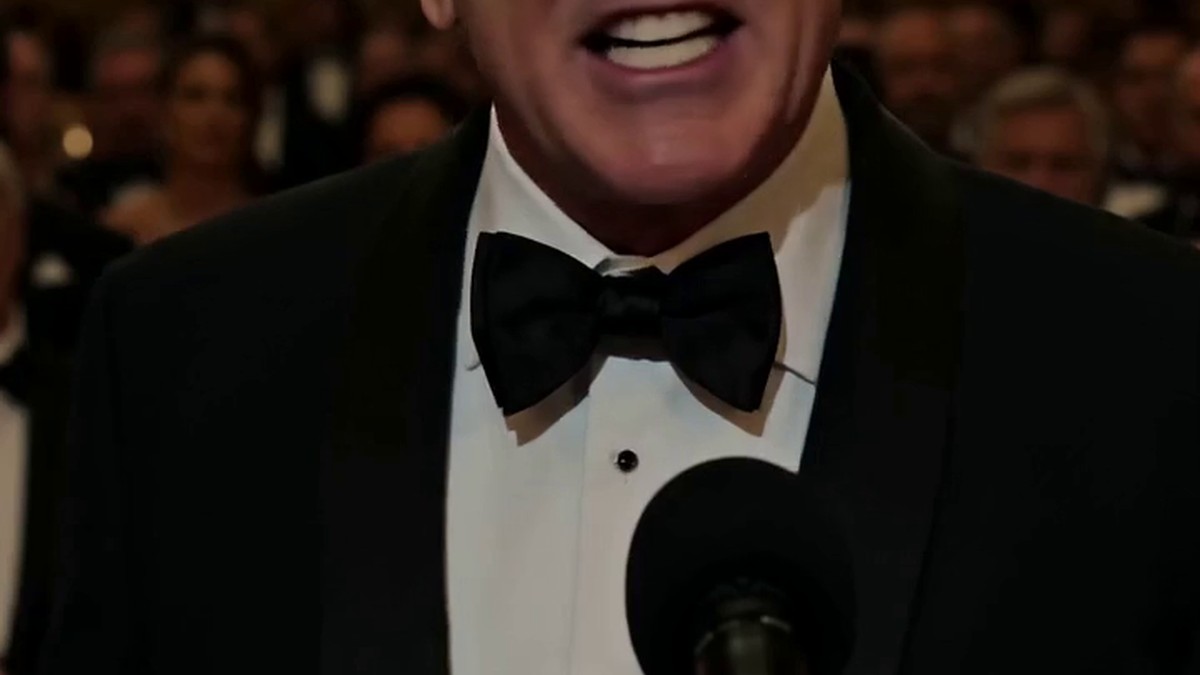
Charles Hartley stood at the microphone, his champagne flute trembling in his grip. The Fairmont’s grand ballroom glittered with three hundred of San Francisco’s most powerful people, but he couldn’t see a single one of them. All he saw was the small, pale figure at the front table—his nine-year-old daughter Sophie, in a pink dress, her eyes fixed on a wilted rose centerpiece. She hadn’t spoken in four hundred and twelve days.
“Please,” Charles said, and his voice cracked through the speakers. “If anyone here can give my daughter her voice back… I’ll hand over everything. Every last cent.”
A wave of uneasy murmurs rolled through the crowd. Everyone knew the story. Charles had built a billion-dollar tech empire from a garage in SoMa. He’d once bought an entire city block to build a park just because Sophie liked the oak trees. But tonight, under the dripping crystal, he looked like a man who’d been hollowed out with a spoon.
Sophie’s silence had started the night Rebecca disappeared. The cops found Rebecca’s SUV crumpled against a guardrail on a back road near the Presidio. No body. Just a smear of blood that vanished into the wet brush. Sophie, then eight, had been discovered sitting on a boulder two hundred yards away, soaked from the rain, staring at nothing. She hadn’t uttered a word since.
Charles had spent millions. Neurologists from Boston, hypnotists from Zurich, a speech therapist who flew in from Sydney every week. Nothing worked. The doctors all said the same thing: the trauma had locked something inside her. Maybe she’d seen something that night. Something her mind refused to put into words.
This gala was his last, desperate gamble. He’d offered a ten-million-dollar reward to anyone who could bring his daughter back.
That’s when the boy in the faded gray hoodie stepped away from the wall near the kitchen entrance and started walking.
He couldn’t have been older than sixteen. Dark curls tumbled over his forehead. His jeans had a hole in the left knee, his sneakers were scuffed white, and he smelled faintly of dish soap. Security guards stiffened. Heads turned. Someone hissed, “Is that a busboy? Get him out of here.”
But no one moved. The boy didn’t stop.
He crossed the dance floor with a strange, quiet certainty, weaving through the clusters of gowns and tuxedos until he stood just a few feet from Charles.
“I can do it,” the boy said.
Charles’s grief snapped instantly into rage. “This isn’t a sideshow. Leave. Now.”
The boy didn’t flinch. “I know why she can’t speak.”
The room went so quiet you could hear the ice melting in the champagne buckets.
Charles took a step forward, his jaw tight. “I’ve had the greatest minds on this planet flown here. And you, in a hoodie, think you know something they don’t?”
“Yes.” The boy’s voice was steady, almost gentle. “Because I was there.”
Charles froze. And then Sophie moved.
It was just a tiny lift of her head, but Charles caught it. Her eyes, vacant for so long, found the boy’s face. Her fingers curled around the edge of the tablecloth.
“Sophie?” Charles whispered.
A single tear slid down Sophie’s cheek. She wasn’t looking at her father—she was staring at the stranger as if he’d stepped out of a nightmare she’d been trying to wake from.
The boy crouched down, his eyes level with hers now. “You remember me, don’t you?”
Sophie’s mouth opened. Her whole body began to shake. Another tear fell, then another.
The entire ballroom held its breath.
And then Sophie made a sound—a raw, scraping rasp that was somewhere between a sob and a word. It was the first noise she’d made in over a year.
Charles dropped to his knees beside her chair. “Honey, it’s okay. It’s okay. Talk to me.”
But Sophie kept her gaze locked on the boy, and the boy said very softly, “It’s alright. You can say it.”
Sophie’s voice came out like a splinter of glass. “You carried me.”
The words hit Charles like a punch to the chest. He went completely still.
The boy nodded, his own eyes welling. “I did. I carried you all the way to the gravel road by the bridge, and I called 911.”
Charles looked from Sophie to the boy, utterly lost. “What are you talking about? Who are you?”
The boy took a shaky breath. “My name’s Marcus. I was out running that night, on the trail near Baker Beach. I heard the crash. When I got there, the car was smoking, and your wife… she was pinned under the dashboard. She was hurt bad, but she was still alive.”
The color drained from Charles’s face.
Marcus’s voice cracked. “She kept saying your name. And Sophie’s. She told me to get Sophie out of the car. She said, ‘Please, get my daughter away from here. Keep her safe.’ I pulled Sophie from the back seat—she was screaming, kicking—and I carried her as far from the wreck as I could, because I could smell gas. The whole time Sophie was crying for her mom. I told her it would be okay. I said it over and over. And then…”
He stopped and swallowed hard. Sophie buried her face against her father’s shoulder.
“There was an explosion. The car went up.” Marcus’s hands were trembling now. “I called 911 and waited until I could hear the sirens. But I couldn’t stay. I was scared. I’m just a kid from Hunter’s Point—my dad’s a mechanic, his record isn’t clean. I thought the cops would pin it on me. So I ran. I didn’t know Sophie’s name until I saw her picture on the news a week later. And I saw she’d stopped talking. I knew why. She’d heard her mother’s last words. She’d seen the fire. And then I left her alone on that road, and she never got to say goodbye.”
The silence that followed was the heaviest thing that ballroom had ever held.
Sophie pulled back. She reached out a trembling hand and touched Marcus’s cheek, right where his tears had made a clean track through the kitchen grime. “You came back,” she whispered, her voice growing steadier.
Marcus nodded. “I’m sorry it took me so long.”
Sophie’s face crumpled, and she pressed it into her father’s chest. Her words were muffled but clear. “She told me to tell you… Daddy, she said, ‘Tell him I love him. And take care of our girl.’”
Charles broke. He’d never cried in front of another human being—not once. But in that room full of strangers, he sobbed into his daughter’s hair.
Marcus just stood there, arms at his sides, not sure if he should bolt or stay.
It was Sophie who decided. She wiped her eyes with the back of her hand, took a deep breath, and looked up at her father. “He’s the one who saved me, Daddy. He stayed with Mommy when I couldn’t.”
Charles lifted his head and met Marcus’s gaze. For a long, raw moment, the man who’d lost everything and the boy who’d carried the secret just stared at each other.
Then Charles rose to his feet, crossed the small distance in two strides, and pulled Marcus into a tight embrace. The applause that erupted around them was deafening, but neither of them heard a single clap.
—
Months later, they held a small memorial where it happened—right by the curve in the road near Baker Beach. Charles planted a eucalyptus sapling. Sophie poured water from a tin cup she’d decorated herself. Marcus stood with them, hands shoved in the pocket of a new navy hoodie Charles had bought him the week after the gala.
Sophie talked freely now. She talked about her mom’s laugh, the way she’d always sung off-key in the car, the boy who’d held her hand in the rain while the world burned. The nightmares had stopped.
As they walked back toward the car, Sophie glanced up at Marcus. “You know,” she said, “you’re really, really bad at running away.”
Marcus snorted, and then a laugh bubbled up from somewhere deep. “Yeah, well. Good thing I came back.”
Charles set a hand on Marcus’s shoulder. For the first time in more than a year, Sophie smiled—the kind of smile that starts small and then lights up your whole face and doesn’t go away for a very long time.