Sometimes a single sentence can silence a room. Mine came at exactly 8:42 p.m. on a Saturday night in a Sonoma vineyard, dressed in a forty-dollar dress from the clearance rack at Macy’s, when my stepsister Brittany lifted her champagne flute and told 150 people I was “just a nurse.”
She laughed, a high, brittle sound that bounced off the chandeliers. My father, Steve, laughed first and loudest. Linda, my stepmother, did her favorite thing—smiled like she’d just bitten into a lemon and found it sweet. A few guests followed, the kind of forced chuckles you give when you’re not sure if you’re at a wedding or a firing squad.
I stood there, the hem of my dress already coming unstitched at the left seam, and did what I’d been doing my whole life in that family. I swallowed the humiliation so fast I almost choked on it.
What Brittany didn’t notice was the man at the head table.
Jonathan Whitmore, the groom’s father, wasn’t laughing. He wasn’t even looking at her. He was staring at me like I was a photograph he’d lost and just found in a coat pocket.
My name is Emma Hart. I’m twenty-nine, an ER nurse at Zuckerberg San Francisco General, and until that moment I honestly believed I’d reached the end of my capacity to be surprised by my own family.
—
The invitation had arrived three weeks earlier, printed on card stock so thick it could stop a knife. My name, naturally, was misspelled—Emilee—and right above the RSVP line was a handwritten note: *no plus one*. Not that I had a plus one to bring. They just wanted to make absolutely certain I understood the seating chart wasn’t a democracy.
I almost tossed it. Then my dad called.
“You have to come, Em. Brit needs you for the family photos.”
He didn’t say she wanted me there. He said she needed the frame to look full.
Brittany had spent six months curating a social media fairy tale for Kyle Whitmore’s family. Sunday brunches with “my amazing blended family,” all of us laughing over maple syrup I’d never been invited to pour. I’d scroll through her Instagram and see photos I wasn’t in, captioned *sister time!*, knowing I’d worked a sixteen-hour double that day. The Whitmores bought it completely.
A week before the wedding, I caught Brittany in the kitchen, talking to Linda while I was refilling my water bottle in the hallway.
“She has to be in the pictures,” Brittany said, “but after that, I want her to melt. She’s got this thing about making everything about her pain or whatever.”
Linda’s reply was instant, almost maternal: “Don’t worry. Emma knows her place.”
I filled my water bottle and pretended I hadn’t heard a word.
The thing is, in that house, I did know my place. It was the corner of every room, the seat closest to the kitchen door, the last sentence of every toast. At work, though? In the trauma bay? That was a completely different universe.
My shifts often ran twelve, sometimes fourteen hours. I held pressure on gunshot wounds while surgeons scrubbed in. I talked panicked mothers through seizures during the worst nights of their lives. A year earlier, our chief of emergency medicine, Dr. Adewale, had handed me the hospital’s Nightingale Award for clinical excellence. When I told my dad, he’d said, “That’s nice, honey. Did you know Brittany got promoted to regional manager?”
So I stopped telling them.
And the one thing I never, ever mentioned—not to my father, not to Linda, not to a single soul in that family—was the night of October 17th, three years ago. The night of the pileup on the 101.
—
It had been pouring, the kind of rain that makes the windshield wipers useless because they can’t keep up. I was driving home from a shift at 11:53 p.m. when I came around the bend just north of the Golden Gate and saw headlights scattered like dropped silverware. A semi had jackknifed. There were six vehicles tangled into a metal fist.
I pulled over, still in my scrubs, and ran toward the worst of it. A black Mercedes S-Class was crushed between two SUVs. The driver was pinned from the waist down, half-conscious, blood trickling into his left eye. I couldn’t get him out. The door was a pretzel. So I climbed halfway through the shattered window, knelt on broken glass in the rain, and held his head steady.
When you can’t do anything else in an emergency, you talk.
“Sir? Can you hear me? What’s your name?”
He slurred something about a daughter, a speech he was supposed to give. Then his eyes flicked down and caught on my locket. A simple gold oval, worn thin. My mother’s.
“That’s pretty,” he said, like someone coming out of a fog.
I told him it was my mom’s. She’d died when I was twelve. I talked about her while the fire crews used the Jaws of Life, the metal screaming like an animal. Forty-seven minutes. I counted every single one. I told him about her laugh, the way she’d hum Otis Redding while she cooked, the night she gave me the locket and made me promise to never take it off. I told him everything, until the paramedics pulled me aside and loaded him into the ambulance.
I never saw him again.
The department gave me a commendation for “consistent clinical excellence and composure.” I didn’t even know the man’s name. I went home, showered the glass out of my hair, and never mentioned it to my family because what would I say? That I’d sat in the rain for almost an hour and all I’d done was not let go? They’d have nodded and asked me to pass the butter.
At the vineyard, the night before the wedding, I got another taste of all that.
It was a pre-reception on the Whitmore estate, twinkle lights and oysters. When Kyle’s mother asked who I was, Brittany said, “Oh, that’s Emma. She works at some hospital downtown,” and then spun her away toward the dessert table. Later, Linda cornered me near the restrooms.
“Please don’t do anything to pull focus tonight. Brittany’s under a lot of stress.”
I nodded. I always nodded.
Then I saw Jonathan Whitmore across the lawn, a glass of scotch motionless in his hand. He was staring at me with a look I couldn’t name. His eyes kept darting to my face, then down to my neck, then up again, like he was scrolling through a file in his head and didn’t trust the search results.
—
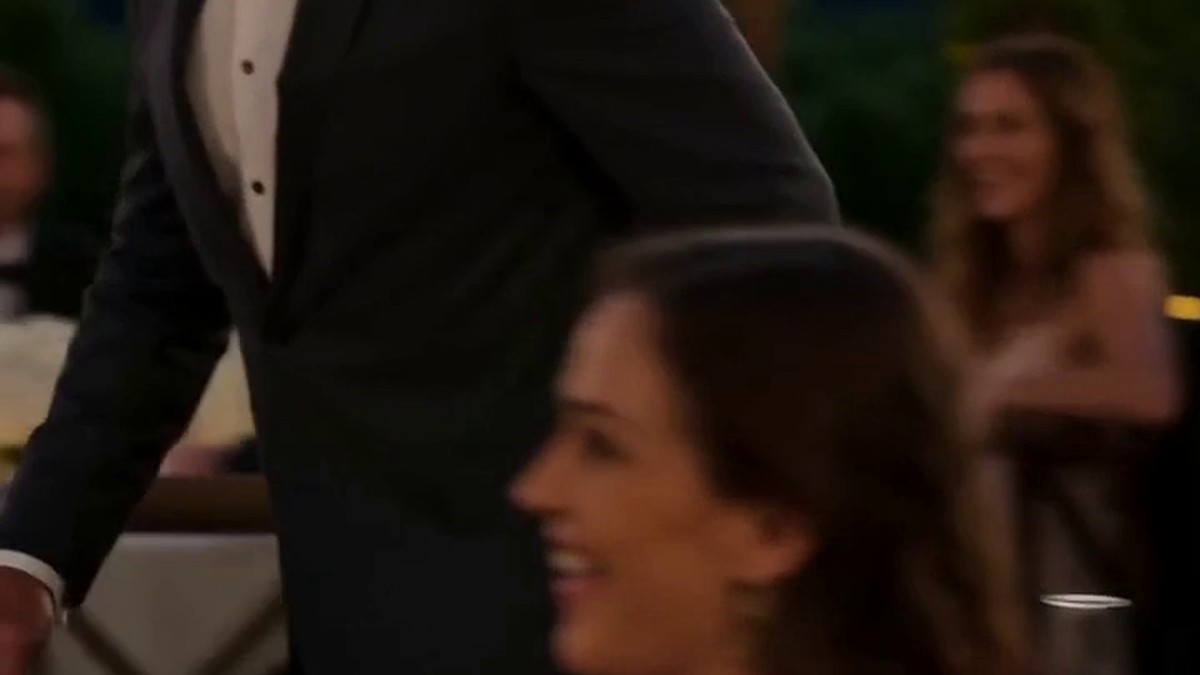
The wedding itself was impeccable. Peonies. A string quartet. My assigned seat was Table 15, wedged behind a floral arrangement so massive I could barely see the head table. Directly to my right, the kitchen doors swung open and shut with every course, blasting me with steam and the clatter of silverware. I ate my filet mignon one-handed, because the chair next to me was empty and I used it to hold my clutch.
When the toasts started, Brittany stood, every inch the radiant bride in a dress that probably cost more than my first car. She thanked her parents—“my dad, Steve, and my incredible mom, Linda”—like I’d never existed. Then she got to me.
“And I want to thank my stepsister Emma for coming tonight,” she said, her smile sharp as a corkscrew. She flicked a hand in my direction. “She’s, you know… just a nurse.”
The laughter rippled.
I gripped my napkin.
And that’s when I noticed Jonathan Whitmore. He hadn’t touched his scotch. His wife leaned in and whispered something. He shook his head, pushed his chair back, and stood.
The room quieted in stages, like a volume dial being nudged. Brittany kept smiling, her champagne still raised, but the smile turned sideways when she followed everyone’s gaze. My father and Linda looked confused. Jonathan walked past the cake, past the dance floor, past the table of groomsmen, and stopped directly in front of me.
He looked at my face. Then at my locket. Then into my eyes.
“Excuse me,” he said, his voice low and hoarse. “I have to ask you something.”
Brittany’s champagne hand wavered. “Jonathan? What are you doing?”
He ignored her. “Three years ago, on October 17th, there was a crash on the 101. A woman in scrubs held my head and talked to me about a gold locket and Otis Redding for almost an hour while they cut me out of my car. Was that you?”
The entire vineyard went completely silent. You could hear the fountains.
I just stared at him for a second, my brain struggling to stitch his face to that rain-soaked memory. And then I saw it: the same crease between his eyebrows, the same way his left eye drooped a little. I nodded, barely able to get the word out. “Yes. That was me.”
Jonathan Whitmore, a man worth more than the entire county, reached down, took both of my hands in his, and pulled me to my feet. Then he turned to the room, his voice booming like an auctioneer’s.
“This woman,” he said, “this ‘just a nurse,’ crawled into my car while it was on fire and saved my life. She held my neck still when every ER doctor later said one wrong move would have paralyzed me. I asked her about that locket three times because I was terrified I was dying and I wanted the last thing I heard to be something beautiful. She gave me that. My son is standing at an altar today because of *her*.”
Brittany’s champagne glass tipped. The liquid ran down her wrist. Linda’s mouth opened and closed like a fish. My father’s face went the color of bone.
I should have said something cutting. Something that would twist the knife. But I was so tired. Twenty-nine years of being the footnote in someone else’s story. So I just looked at Brittany and said, very quietly, “You should probably get that dress cleaned.”
Jonathan’s wife was crying. Kyle, the groom, looked at me with a mix of awe and horror, like he’d just discovered his bride had been lying about the foundation of their whole relationship. Jonathan draped his arm around my shoulder and walked me toward the head table, smoothing over the moment like a diplomat.
“We’re going to have a real toast now,” he announced. “To Emma. And to every nurse who’s ever been called ‘just’ anything.”
The applause that followed wasn’t the polite kind. It was the kind that shakes the floor.
I didn’t stay for the dancing. I slipped out around 10 p.m., while Brittany was in the restroom trying to salvage her makeup and Linda was hissing at my father to “fix this.” I walked across the gravel parking lot, the cool Sonoma air finally filling my lungs, and climbed into my ten-year-old Toyota.
I sat there for a long minute, engine off, and touched the locket. My mom’s locket. I hadn’t taken it off since I was twelve. I’d worn it through nursing school exams, through every code blue, through my father’s second wedding where I was the only person not asked to give a speech. I’d worn it through the night I held a stranger’s head in the rain, thinking *please don’t die, please don’t die*.
My phone buzzed. A text from an unknown number. *Emma, this is Jonathan. If you ever need a letter of recommendation, a job, or just a drink on me, call this number. Forever grateful.*
I didn’t reply. I just started the engine.
As I pulled onto the main road, the vineyard lights shrinking in my rearview mirror, I turned on the radio and Otis Redding was halfway through “Try a Little Tenderness.” I laughed, unstitched hem and all, and drove forty miles over the speed limit all the way back to the city.