The Crystal Room of the Sterling Hotel had never looked more obscenely opulent. Chandeliers dripping with teardrop glass. Waiters gliding like swans. Three hundred of Manhattan's untouchables clinking champagne flutes and trading air-kisses while a string quartet played something no one was listening to. It was the Thornton Foundation Centennial Gala, and Celia Thornton—CEO, iron monarch, the woman who fired a CFO on live television—stood at the head of the mahogany table on the dais, wearing a pearl-white gown that cost more than most people's apartments.
She was mid-laugh, one perfectly manicured hand resting on the shoulder of a junior senator, when the noise started. Not the music. A different kind of noise—the sharp intake of breath, a dropped fork, the unmistakable scrape of a chair being pushed back too fast.
A small boy had walked in.
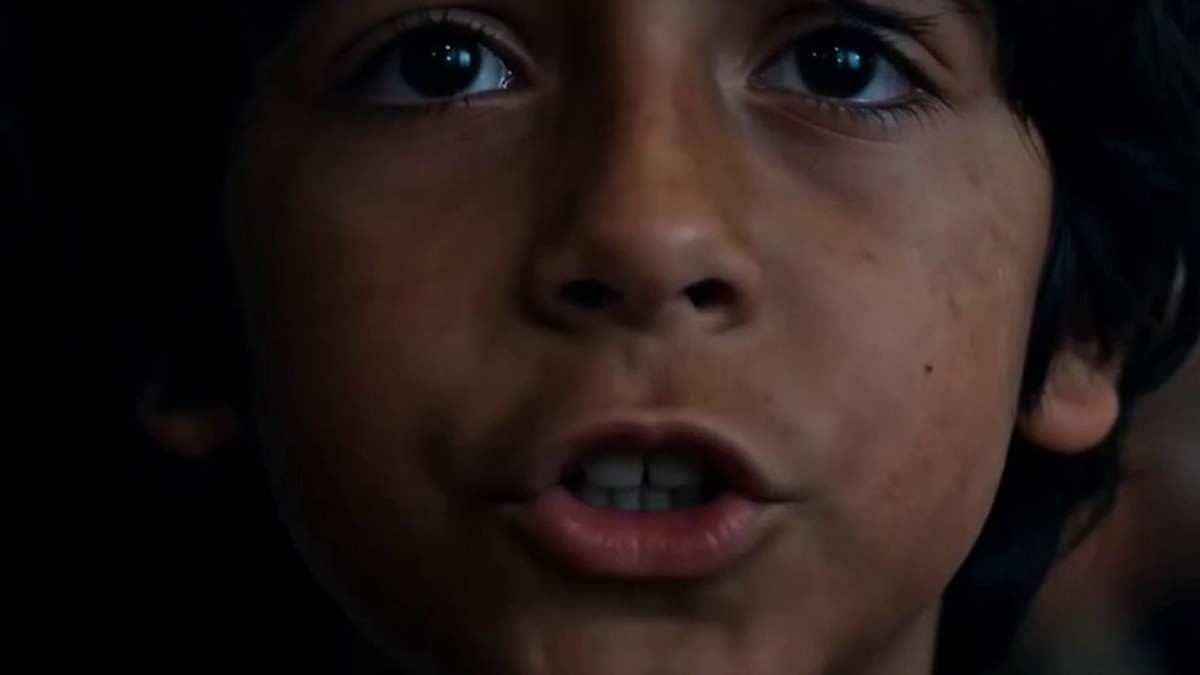
Barefoot. His feet left faint, damp prints on the marble. Jeans two sizes too big, patched with a dishrag. A faded flannel shirt, sleeves rolled to show wrists thin as twigs. His hair looked like someone had cut it with kitchen scissors in the dark.
The security guards near the entrance were already moving, speaking into their earpieces. Two of them broke toward him, but the boy weaved through the tables with a weird, unchildlike purpose, ignoring the gasps, the woman who jerked her Hermès bag away as if he carried the plague. He didn't look at the buffet, the desserts, the towering ice sculpture of a phoenix—the Thornton family crest. He looked only at Celia.
He reached her table just as a guard's hand closed around his shoulder. The boy didn't flinch. He just reached up, his grimy fingers brushing a strand of Celia's honey-blonde hair that had fallen loose.
The senator stumbled backward. Three board members shot to their feet, wine sloshing onto white linen. A bodyguard drew his weapon halfway before Celia raised her palm—a tiny motion, but it froze the room like a spell. She stared down at the child, her face carved from ice.
"Who are you?"
The boy swallowed. His voice cracked. "My mother said you'd know."
Someone behind her snorted. Celia's eyes narrowed. "Know what?"
Instead of answering, the boy reached into his pocket. The guards tensed, hands on holsters. A woman near the front whimpered. The boy pulled his hand out slowly, carefully, like a magician revealing a dove. He opened his palm.
A tiny silver charm, tarnished and bent. Half a phoenix wing—the matching half of a broken pendant that had once belonged to the Thornton heir. The other half, everyone in this room knew, was still locked in Celia's private safe.
Celia's expression didn't change. But her knuckles went white around the stem of her glass. She knew that charm. She'd last seen it fifteen years ago, in the smoking rubble of the Hamptons estate fire. The night her brother Julian, the golden boy who was supposed to run the empire, died in the flames. The coroner had found no body, only a molar and a melted cufflink. Julian's six-month-old son, Leo, was listed among the dead too. The whole thing was a tragedy that became a legend that became a public relations crisis that Celia had spent a decade burying.
"Where did you get that?" Her voice didn't waver, but it lost some of its polish.
The boy looked down at the charm. "My mom kept it hidden. In a box under the floor. She said never to show anyone unless I had to." He paused, his lower lip trembling once before he bit down on it. "She died last month."
No one breathed. Celia took a step closer, her heels clicking on the marble. Something was tugging at the edge of her consciousness, a memory she'd crushed long ago. Then her gaze dropped to the boy's neck.
Just above the collar of his ruined shirt, a small, crescent-shaped birthmark sat like a pale moon. The same mark. The exact same shape, in the exact same spot, that her sister-in-law had cooed over in the hospital maternity ward. The one the nanny had pointed out to Julian three hours before the fire.
The room seemed to tilt. Celia felt a rush of cold despite the wall of bodies. The boy untangled a knotted blue thread from the charm, and a second object slid into his hand. He held it up.
A signet ring. Ancient, heavy gold, the phoenix crest unmistakable. It was the ring Julian never took off. The ring that had been bequeathed to him by their father on his twenty-first birthday. The ring that should have melted in a blaze hot enough to turn steel beams to butter.
The boy's eyes, a dark hazel just like Julian's, locked onto Celia's. He spoke so softly that the entire room had to strain forward to hear.
"My mother said this proves who my father really was."
The senator's wife dropped her clutch. Somewhere in the back, a waiter collided with a tray of champagne glasses and didn't even notice the shatter. The silence that followed was thick enough to choke on.
Celia stared at the ring, then at the charm, then at the birthmark. The pieces assembled in her mind with a terrible, irrevocable click. Julian survived the fire. Somehow, impossibly, her brother had gotten out—with his son. And he'd stayed hidden for fifteen years. Raising this boy in poverty, in secret, while Celia sat on a throne built from his death.
"Who did your mother say your father was?" Celia's voice came out a whisper, and it was the first time in a decade anyone had heard her sound small.
The boy's jaw tightened. He didn't bow. He didn't cry. He just met her gaze and said five words that collapsed an empire.
"His name was Julian Thornton."
He didn't say 'is.' He said 'was.' Because Julian Thornton had died four months ago, unknown and uncelebrated, in a walk-up apartment in Queens. And the boy—Leo—had kept his promise to his dying mother: go to the gala, find the woman with the ice eyes, and make her see.
Celia's hand, the one that signed billion-dollar mergers, lifted slowly, trembling. She reached out and took the ring from the child's dirty fingers. She turned it over in the light. On the inside of the band, a tiny inscription she'd almost forgotten: *J.T. — you carry the flame.*
A single tear carved a path down her powdered cheek. The board members looked at each other in panic. The PR strategist already had her phone out, her face pale. This wasn't a scandal. This was a succession war wrapped in a five-year-old's flannel shirt.
The child—no, the heir—stood motionless, waiting. The ring now rested in Celia's palm like a live grenade. She looked from the heirloom to the boy's crescent mark, to the eyes that were the exact shade of a ghost she'd abandoned to the ashes.
Finally, she knelt. Right there, in front of three hundred of the world's most ruthless people, the most powerful woman in the room knelt on the marble floor until she was eye level with a barefoot boy.
"Leo," she said, and the name tasted like smoke and forgiveness. "Welcome home."
The murmur that erupted wasn't the sound of outrage or confusion. It was the sound of a dynasty realizing it had just found its true bloodline in a threadbare shirt. The boy didn't smile. He just pressed the broken phoenix charm into her other hand and waited, his whole life a question no one in this glittering room was prepared to answer.