I quietly moved to the farthest table and spent the entire evening hiding how much it hurt.
At my son’s wedding, my new daughter-in-law politely asked me to relocate to a distant table, explaining that it would be more convenient for everyone. Without a word, I gathered my purse and walked to the back of the room, forcing a smile so no one would see the crack spreading through my chest.
My name is Evelyn, I’m sixty-six years old. I live alone in a house my husband and I built brick by brick in a small Pennsylvania town where the mailboxes lean toward the road and everyone knows which chickens lay the best eggs. He passed a decade ago, and I raised our son Michael mostly by myself while my husband worked construction out of state for months at a time. Michael grew up with dirt under his fingernails, collecting eggs from the coop before he could tie his sneakers. Later, he left for college in Chicago, became a software developer, and a year ago he married a city girl named Madison.
Madison grew up in a high-rise in downtown Chicago. She’s never seen a live chicken, never had to pull weeds to save the tomatoes. She’s sweet enough, but when she talks about brunch spots or boutique pop-ups, it feels like she’s describing another planet.
The wedding was in September, in a flickering candlelit venue in Chicago’s old warehouse district, with a jazz quartet and trays of champagne that cost more than my weekly grocery budget. I wore a dress my neighbor Helen sewed from a pattern she found in a yellowed issue of *Good Housekeeping* — buying new felt wasteful. I arrived early, nervous, and set my purse on a chair at the main family table.
That’s when Madison approached, clipboard in hand.
“Evelyn, I’m so sorry — we made a small adjustment,” she said, her smile polished to glass. “I think you’ll be more comfortable at table five, with some of the relatives from out of town.”
I nodded and walked into silence. Table five was shoved against the speakers, the bass rattling the silverware so hard conversation was impossible. Around me sat distant cousins I hadn’t seen in twenty years, their faces warmed by cheap wine and confusion about who I even was. I laughed at the right times, clapped for the toasts, and ate prime rib without tasting a bite. Inside, I felt like a ghost haunting my own son’s celebration.
Then the DJ announced the mother-son dance.
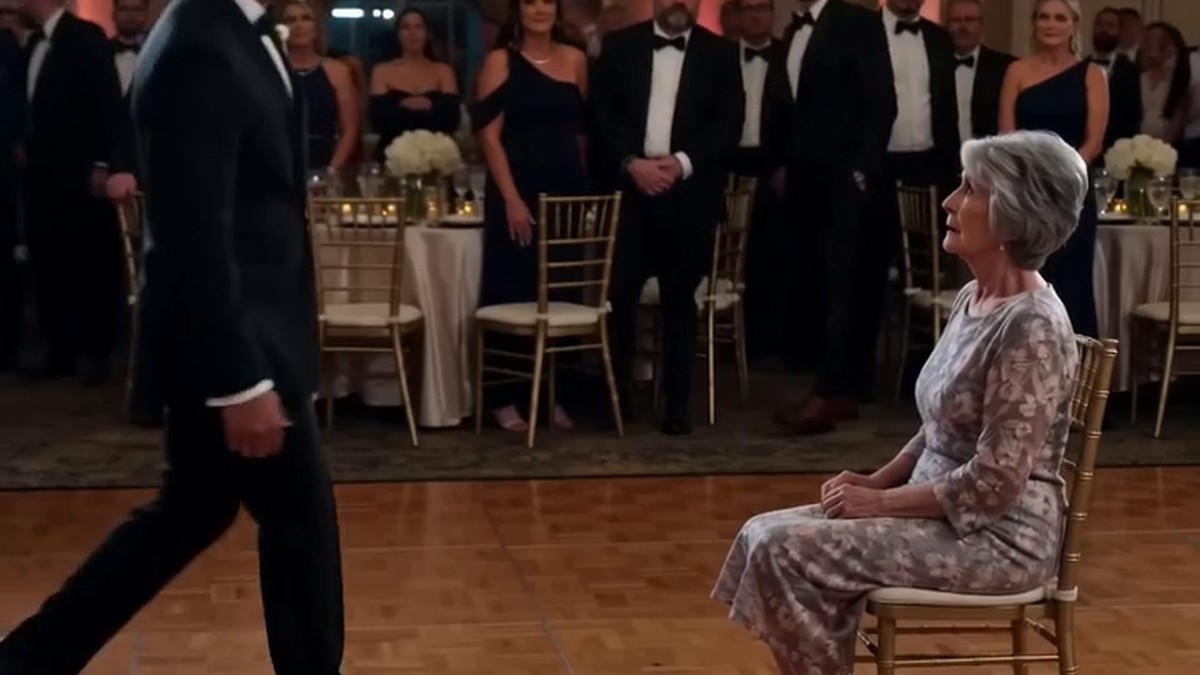
Guests began swiveling their heads, scanning the head table for the groom’s mother. I felt my insides fold inward, caught between the hope that Michael would come find me and the terror that he wouldn’t. That’s when Michael rose from his chair. He walked across the entire room — not fast, but without hesitation — and stopped right in front of me.
The air turned thick. Every face at every table was watching. I knew, in that single stretched second, that whatever happened next would either shatter my heart permanently or burn itself into my memory for the rest of my life.
“Mom,” he said, his voice low and steady, “this dance is for you. No matter where they seated you.”
I stood on trembling legs. He took my hand and led me to the center of the dance floor as the music swelled. The room hushed, lit by the glow of a hundred candles. We began to turn slowly, the way I’d once spun him on the kitchen linoleum when he was small enough to carry on my hip.
“I’m so sorry about the table, Mom. I only found out twenty minutes ago,” he murmured into my hair.
“It’s fine, sweetheart,” I whispered.
“No.” His jaw tightened. “It’s not.”
I laid my head against his shoulder, breathing in the scent of his cologne, and the years collapsed — there he was, six years old, me holding the handlebars of his bike on the gravel road, yelling at him to just keep pedaling. The tears came on their own, silent and hot.
When the song ended, he hugged me so tightly I felt my ribs shift. “It doesn’t matter what city I live in,” he said. “You’ll always be my mom. The one who raised me in that garden. The one who taught me everything that matters.”
He guided me off the floor, not back to table five, but toward the head table — toward the empty seat that should have been mine from the start. That’s when Madison appeared, blocking our path, her face a brittle arrangement of forced composure.
“I see you found your way back,” she said, her voice syrupy but her eyes sharp. “I really think the seating chart—”
“Madison, stop.” Michael’s voice cut through the jazz that had started up again. “You put my mother next to the speakers. You gave her seat to your college roommate. I didn’t say anything earlier because I didn’t want to ruin our day, but this isn’t okay.”
A few nearby guests turned to stare. Madison’s cheeks flushed crimson. “Excuse me for trying to organize a perfect wedding,” she hissed, low enough that only we could hear. “This isn’t some backyard potluck. I didn’t think she’d even *want* to be at the center of everything.”
The words landed like broken glass in my stomach. I took a shaky breath and touched Michael’s arm. “It’s all right. I’ll just head back to my table. No need to fuss.”
But Michael wouldn’t let go of me. He looked at Madison, his expression equal parts hurt and astonishment. “You really don’t get it, do you? That woman over there — she’s the reason I’m the man you married. And you just tried to hide her in a corner.”
The DJ had paused the music. Conversations were dying. The room tilted toward us, and I felt every stare like a needle. I wanted the floor to swallow me whole. But then something shifted inside my chest — the same stubborn spark that had carried me through widowhood, through sleepless nights and a silent house — and I realized this moment couldn’t end with me simply retreating again.
I let go of Michael’s arm and turned toward the dance floor, walking directly up to the DJ, who looked startled. “Could I say a few words?” I asked, my voice steadier than I felt.
He handed me the microphone.
I faced the room, two hundred faces swimming in candlelight, and I started to speak. “I wasn’t supposed to be up here tonight. I was supposed to be at the back, clapping when everyone else clapped.” A nervous laugh rippled through the crowd. “But my son just reminded me that a mother’s place isn’t determined by a seating chart.”
I paused. Madison was frozen near the head table, her mask finally cracking.
“I raised Michael in hand-me-down overalls. He learned to count by collecting eggs, and he learned to read by flashlight in a tent we made out of bedsheets. Every single night I prayed he’d find a life bigger than that little town. And he did. He found this city and he found you, Madison.” I turned to face her directly, my eyes blurry with tears. “You are his wife now. That means you are my daughter. And I don’t need a front-row seat to bless this marriage. But I do need you to know — he was loved before you ever met him, and he will be loved until the day I’m gone.”
A weighty silence filled the room. Then Madison’s shoulders dropped. The brittle defense she’d been carrying crumbled, and tears slid down her cheeks — real ones, not the delicate ones you dab with a napkin. She crossed the floor and stopped in front of me, her hands shaking.
“I’m so sorry,” she choked out, loud enough for everyone to hear. “I was so focused on the stupid details. I didn’t think — I didn’t realize — please forgive me.”
She threw her arms around me and sobbed into my shoulder, the same shoulder Michael had rested on just minutes earlier. I held her. Michael wrapped his arms around both of us, and somewhere behind us, my neighbor Helen started clapping. Then the whole room followed, a wave of applause that rattled the wine glasses and nearly drowned out the sound of my own crying.
Later that night, Madison pulled me aside, her wedding makeup ruined beyond repair. “I spent so much time planning this party,” she whispered. “I forgot the family I was marrying into. I promise you, Evelyn, I’m going to learn. I’m going to come see those chickens.”
Months have passed since that night. Madison kept her word. She’s visited my little house three times now, learning to collect eggs without flinching and helping me replant the basil that the groundhogs destroy every summer. She still can’t tell the difference between a weed and a seedling, but she tries. And when I look at her and Michael sitting on my porch, laughing about something on their phones, I realize that the distance between a city high-rise and a farmhouse isn’t a gap that needs measuring — it’s just a road, and all it takes to travel it is the courage to show up and love the people who matter most.