The woman didn’t recognize them. Not at first.
Years ago, they were just three gaunt boys slumped on the side of a dirt road outside Jackson, Mississippi, bellies empty and hope gone. She had shuffled over with a cracked plate of red beans and rice—nothing special, just what was left in her pot—but to them, it was a miracle. She never said her name. They never forgot her face.
Now she stood in that same sun-scorched spot, silver-streaked hair pulled back under a faded bandana, spooning stew into bowls for a new circle of hungry children. The afternoon heat shimmered off the asphalt. A gust of wind kicked up red dust.
Then two black Cadillac Escalades tore around the bend and stopped so fast the gravel screamed.
Doors swung wide. Three men stepped out—crisp suits, leather shoes that reflected the sun, an air of quiet authority that didn’t belong anywhere near this forgotten stretch of highway. The children froze. The woman tensed, tilting her chin up.
“Can I help you?” she asked, voice steady but tight.
The man up front—broad shoulders, silver cufflinks catching the light—didn’t answer right away. His eyes traveled from the creased plastic spoon in her hand to the little faces squatting on cardboard. Then back to hers.
Something in his face softened.
“You already did.”
Confusion crept across her brow. He stepped closer, and the scent of expensive cologne mixed with the smell of simmered tomatoes.
“Years ago,” he said, quieter now.
The words sank into the air. Behind him, the other two lowered their heads in a gesture that felt almost familial. The woman’s spoon hung motionless, a bead of stew falling silently to the dirt.
Three boys. Hunger. A day she’d nearly erased from memory.
Her breath caught.
“That was… you?”
He nodded once.
A tear carved a path through the dust on her cheek before she could stop it. All this time, she’d believed that moment was too small to leave a mark. That her kindness had evaporated the second they walked away.
No one spoke. Even the children had stopped eating, watching with wide eyes.
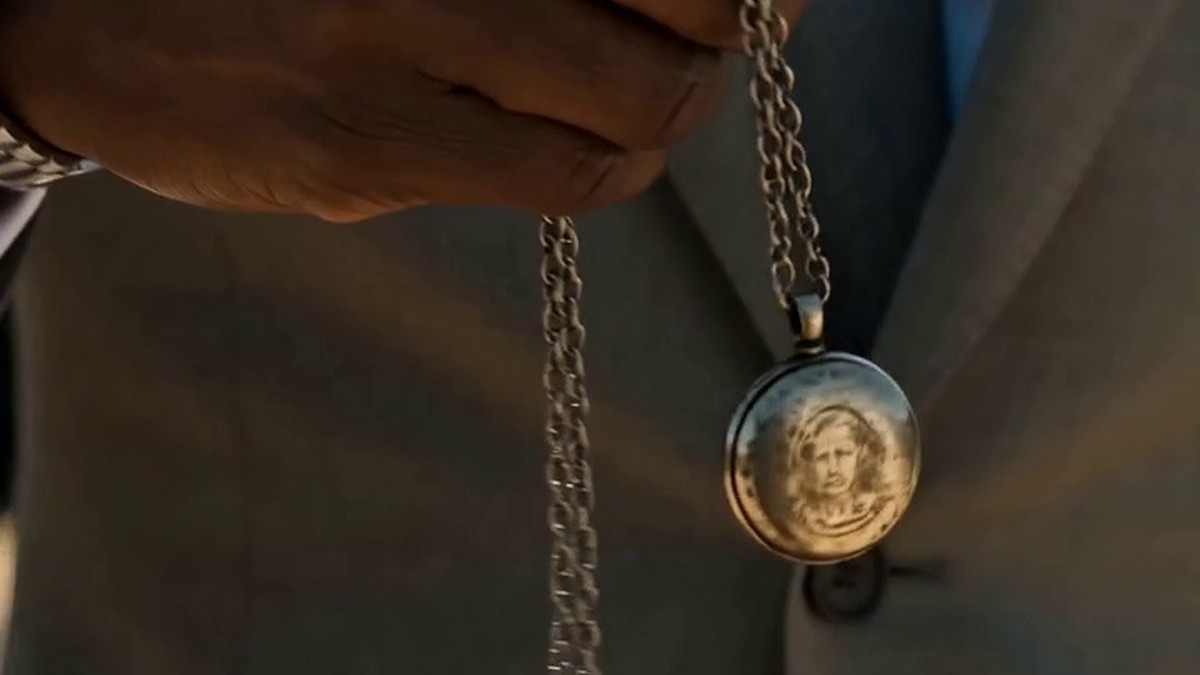
The man with the cufflinks pulled something from his suit jacket—a movement slow, deliberate. The instant the object caught the light, the woman’s whole body locked up, as if someone had pressed a finger against an old wound.
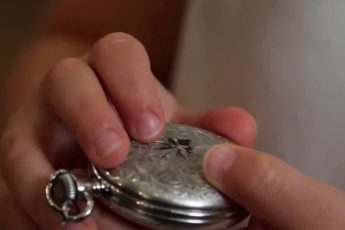
It was a silver locket, oval, small enough to fit in a child’s palm, its chain pooled like liquid in his hand.
She knew every scratch on its surface. She’d worn it against her heart for twenty years before that afternoon.
“That shouldn’t be with you,” she whispered, and the words came out hoarse and jagged, like something she’d swallowed a long time ago and never managed to cough up.
The man didn’t smile. The gravity in his face felt heavier than gratitude. It felt like a reckoning.
Then he spoke: “We found it on the ground the same day you fed us. Right where you dropped it when you ran.”
The other two men shifted, forming a half-circle that felt protective rather than threatening. One of them, the youngest, said, “We tried to catch up with you, but you were gone before we could make a sound.”
The woman’s fingers trembled as she reached for the locket. The man let the chain spill into her cupped palm. She didn’t open it—not yet. She already knew what sat inside: a tiny photograph of her daughter, Josephine, who’d died of pneumonia two months before that day. The locket was all she’d had left.
That afternoon, when she’d returned to the road to find it gone, something had broken inside her. She’d searched the ditch until her hands bled. In the end, she’d told herself it was God’s way of telling her to let go. Instead, it became a phantom weight she felt every time she lifted a spoon.
“We held on to it,” the first man said, his voice thick now, “hoping one day we’d find you. Marcus there became a lawyer. I own a few restaurants. We hired people to look for the woman who gave us more than food.”
He paused, and the afternoon air seemed to hold its breath.
“For three starving boys, that plate meant we didn’t give up. We swore we’d return this to you and say thank you properly.”
The woman’s knees nearly buckled. Her hand closed around the locket so tight the edges bit into her skin. The unfinished thing—the severing, the abandonment she’d never been able to name—suddenly felt stitched back together.
She opened the locket. Josephine’s face, sepia and smiling, now had three men standing behind it.
The youngest man, Andre, cleared his throat and gestured toward the children still clutching their bowls. “We’d like to help with this. Whatever you need. A new kitchen, a bus to bring kids here—just say the word.”
For the first time in almost four decades, the woman didn’t feel alone on that strip of dirt.
She looked up at them, this impossible trio who’d grown from hunger into abundance, and her voice came out steady and strong.
“Then let’s make sure no one else has to sit on this road waiting for leftovers.”
They didn’t just shake hands. They pulled her into an embrace that startled the dust from their tailored sleeves. When they finally released her, she turned back toward the folding table, toward the next plate of red beans and rice, a new locket warm against her collarbone and a knot in her chest finally untied.
And the story didn’t end there.
Three months later, with backing from three boys who’d once been too starved to speak, a community kitchen opened its doors three blocks away. It had a roof, bright yellow stools, and a sign with no name—just a painted silver locket. The woman, Loretta, served the first plate herself.
That evening, as the sunset painted the Mississippi sky orange and pink, a fourth black SUV pulled up outside the new kitchen. It didn’t stop fast. Didn’t roar. It just idled, and from the passenger seat, a small girl in a booster chair waved at the window.
Loretta walked outside, wiping her hands on her apron. The girl’s mother, a young woman with tired eyes, rolled down the window and said, “We drove from two towns over. Someone said you give food for free. Is that true?”
Loretta looked at the child’s face, at the sleepy blink and the half-gnawed cracker in her fist. She thought about the locket, about the boys, about the plate she’d handed out forty years ago on a dirt road.
“It’s true,” she said. “Come on in. There’s plenty.”