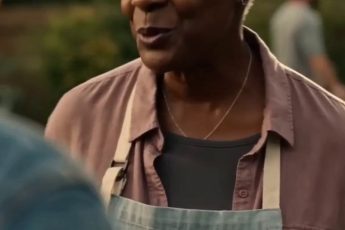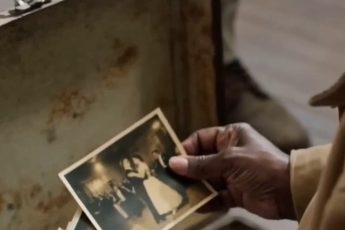
Noon at Stone Hollow Ranch was a dry oven. The August wind kicked up dust between the empty pens and rattled the loose tin on the barn roof, like someone shaking it from the inside. Mr. Everett Cole, once the owner of fifteen hundred acres of good grazing land, watched from behind his desk as clouds of dust swallowed up the fences. Fifty-two years old, broad shoulders bent under the weight of debt, one shot of bourbon at eleven in the morning to steady his pulse.
His daughters sat in the front room. Caroline, twenty-four, pretty as a girl from last year's catalog, ran a finger around the chip in her coffee cup. Miriam, twenty-two, examined her nails and sighed. Outside, between rows of lettuce and tomatoes staked with strips of old bedsheet, Bertie, the youngest, pulled weeds with cracked hands. Bertie was twenty and wore a feed-sack apron patched all over. Nobody marked her birthday, because her mother had died bringing her into the world, and in that house that counted as a debt nobody planned to pay.
"Bertie, water!" Caroline called from the porch, not looking up from a year-old magazine out of Nashville.
"And then come help me with this zipper," Miriam added, as if speaking to the hired help.
Bertie filled a pitcher at the pump behind the house. The water came out lukewarm, tasting of iron. She carried the tray in with both hands raised high and set it on the tin table Everett had welded together two winters back. Nobody thanked her. She went back to the garden, to her rows, to the dirt that gave her something like tenderness in return.
That day Everett couldn't sit still. He broke three matches before he got his cigarette lit. That afternoon Jack Marsh was coming — the owner of Pine Ridge, the biggest spread in the county. Marsh was thirty-five and had the patience of a knife blade. Word was he'd inherited thirty thousand acres from his father and built it up to seventy-five thousand himself. He bought up debt-ridden farms. He collected on notes nobody else could collect. He hadn't shown his face at a single gathering since his wife's funeral, seven years back. He lived alone in the big house at Pine Ridge, cold and enormous, with a foreman who never said two words and a cook who came and went without a sound.
The letter arrived Monday. It wasn't a threat: it was a deadline. Friday, two o'clock. Pay in full or sign over the north section of the ranch, pens included. Everett knew how this worked. Marsh didn't lend on easy terms. He bought up silence, bought up desperation, then collected through the county clerk's office.
"Caroline, Miriam, put on your best!" Everett's voice came out rough, uncertain, almost apologetic. "And you, Bertie — stay in the kitchen. Don't come out. I don't want him seeing you like that."
Bertie didn't answer. She leaned her hoe against the fence rail and wiped her forehead with the back of her hand. Caroline smoothed her faded dress, the only one still fit to be seen in. Miriam colored her lips with a lipstick worn down and cracked in half. Both went to change. Bertie washed up at the sink out back, braided her hair, and came in through the kitchen door.
The clock on the wall struck two. The Hendersons' dog next door started barking before the engine could even be heard. A black car, spotless, without a speck of dust on it, pulled up in front of the house. Out stepped a tall man in a white shirt and polished boots. Marsh didn't wear a hat. He paused a moment on the porch and looked out over the parched fields, the empty water troughs, the windmill standing still for lack of wind. Then he went inside.
Everett received him standing. Caroline and Miriam sat on the sofa, knees together, hands clasped. Marsh nodded briefly. He didn't sit. He set a leather case on the table and looked at Everett the way a man looks at a leaning fence post.
"Ten days, Mr. Cole. The deadline's passed."
"I know it."
"The north section. You signed for it."
"I need more time."
"There isn't more time."
Caroline drew back, as if the words had touched her. Miriam watched the man with a mix of fear and calculation. Marsh didn't turn toward either of them. He opened the case and slid a paper across the table.
"That's your balance. Read it. Then tell me what you choose."
Everett took the paper between two fingers. The figure, in dollars, looked like a cruel joke. Four hundred ten thousand. Interest, late fees, filing costs. All legal, all documented. Mr. Everett Cole, once lord of his own land, now unable to scrape together a tenth of it.
"I don't have that kind of money," he said, and it was the first time in years Bertie had heard his voice without a haze of cigarette smoke behind it.
"Then the north section," Marsh said. "The pens and pasture. Two weeks to clear out."
"That's dry land, Mr. Marsh. You know as well as I do the cattle drop dead of thirst out there come summer."
"I know it," Marsh answered flatly. "But that's not the land I'm after."
Silence fell so complete even the tin roof stopped rattling. Through the cracked kitchen door, Bertie watched the whole scene. She saw her father's bent shoulders, Marsh's profile behind the case, Caroline's hands twisting the ruffle of her dress. And she saw Miriam, who the whole time kept running a finger along the edge of her lipstick, as if counting something.
Bertie remembered exactly what she'd overheard two days before. She'd gone to the henhouse for eggs while her sisters talked on the back porch, thinking they were alone.
"If you marry him," Miriam was saying, "you're done with all this trouble. He's been alone for years. We're not staying in this dump."
"Who told you he's coming here to get married? He's coming to collect a debt."
"You can't see past your own nose, Caroline. That man didn't drive all the way out here for four hundred thousand dollars. He came to see us."
Bertie stood still, a warm egg in her hand. Then she picked up another and walked back slowly, over the dry leaves under the pecan tree.
Now, from the kitchen doorway, Bertie watched Marsh step to the table, lift the case, and pull out a second paper. A map of the county, property lines marked in pencil.
"For two years I've been trying to work something out with the neighbors about water rights on the south side," he said. "Your land to the north is worthless to me, Mr. Cole. But there's something I want more than payment on this debt."
Everett raised his head, not understanding.
"Speak plain."
"On the south boundary of your place, where the woods start — there's a parcel that never went into the mortgage. Ten acres. Recorded, far as I can tell, in your first wife's family name."
The room went quiet in a different way than before — quiet like the moment before an answer nobody wants to be first to give.
Bertie stepped out of the kitchen. Barefoot, in her dirty apron, she walked into the front room. Everyone looked at her. Marsh turned his head and looked at her straight on. He said nothing.
"That's my land," Bertie said. "My mother willed it to me before she died. How do you know about it?"
"Because there's a well on it, Miss Cole. The only one for ten miles that doesn't run dry, even in August. My surveyor found it on the old county records a year ago. I've been looking for the owner ever since."
Everett stared at his daughter as if a piece of furniture had spoken.
"Stay out of this. Go on back inside."
"How much is the debt?" Bertie asked, not moving.
"Four hundred ten thousand," Marsh said.
"How much would you pay for ten acres with a well on it?"
Marsh narrowed his eyes, weighing something.
"More than your father's whole debt put together. That water's worth more to me than the rest of this ranch combined."
"Then buy my land," Bertie said. "Not my father's. Mine."
Caroline stood, indignant, mouth open.
"You've lost your mind. What do you have to sell? You don't have anything."
"I have more than the two of you put together," Bertie answered, calm, though her hands were shaking. "I have something he needs."
She went to the kitchen. She came back with a tin box, the kind cookies used to be sold in. She opened it on the table. Inside were folded papers, a hardbound notebook, and a small brass key.
"My mother wrote down everything about that land in here. A drawing of the well, the boundaries, even the depth her father measured. She told me the water never fails, not even if the whole county dries up."
Marsh took the notebook between two fingers. He paged through it without hurrying. He stopped at a page with a hand-drawn sketch of the well and a signature in small, careful handwriting. Something shifted in his face, like he'd recognized something he hadn't expected.
"That settles it," he said quietly, and closed the notebook. "This land is worth more than your entire debt, Mr. Cole. I'll buy it from you, Miss Bertie, for a sum that covers your father's balance to the dollar. The rest I'll pay you directly, into your own account, not his."
"I'll sell," Bertie said. "I'll pay off my father's debt. And I'm leaving this house."
"You understand that after this, you won't have anywhere to live?" he asked.
"I know I don't have to live here."
"You won't get any other share of the estate. Nothing."
"I haven't gotten anything for twenty years." Bertie looked at Everett. "Not one birthday. Not a seat at the table."
Everett opened his mouth as if to speak, then instead stood up sharply, like the chair beneath him had turned hot. He walked to his daughter, took the tin box from her hands, and for a moment held it, looking down at her mother's notebook, which he'd never once had the nerve to open. Then he handed it back, slowly, with both hands, like something he should have given her long ago.
"Do what you think is right," he said, and his voice was steady at last. "You've earned more than what I gave you."
Marsh watched the exchange without a word. Something in his face eased, as if he'd seen in that kitchen something he hadn't seen in years inside his own cold house.
"Tomorrow, ten o'clock, at the title office in Millbrook," he said. "I'll bring the paperwork."
Caroline let go of Miriam's arm, which she'd grabbed without thinking a moment before.
"Daddy, you can't let her do this — we're your daughters too!"
"It's her land," Everett said quietly. "And her decision. I already lost mine."
Miriam said nothing. She stopped tracing her finger along the edge of her lipstick. Marsh, on his way out, paused beside her for a moment.
"Your sister sold me water, not herself," he said, without raising his voice. "Remember that, next time you start counting."
He left without another word. The black car disappeared down the dusty county road. The Hendersons' dog started up again.
The next morning Bertie rose before dawn. She gathered four eggs from the henhouse and left three wrapped in paper on the kitchen table, for the older woman who helped out on Saturdays. She washed up at the sink, put on a plain dress, and packed the rest of her clothes into a canvas bag. Her mother's notebook went in last, on top, where she could reach it easily.
At the title office in Millbrook, everything was settled in an hour and a half. It was a single transaction: Bertie sold Marsh the ten acres with the well, he paid on the spot — part cash, part wire transfer into an escrow account that automatically cleared her father's debt. The clerk, an older woman with reading glasses on a chain, handed her a glass of water.
"This is what's left to you," she said, and passed her the receipt.
Bertie looked at the number. A hundred and twenty thousand dollars, after the debt and fees. Before she put the receipt away in her bag, Marsh asked for a moment with her out in the hallway.
"That notebook," he said. "The well drawing, the depth measurements — that's better documentation than I've ever gotten from a surveyor. Would you sell it to me? I'll pay separately, outside the sale."
Bertie studied him a long moment, then took from her bag a folded page she'd already torn out of the notebook — the one page, with the sketch of the well and her mother's signature — and handed it to him.
"You can keep this page. I'm taking the rest with me. It's all I have left of her."
Marsh took the page carefully, like it weighed more than paper.
"Thank you," he said. "And — good luck, Miss Cole."
By noon Bertie was back at Stone Hollow. Caroline and Miriam were waiting on the porch. Bertie showed them the receipt. Then she opened the back gate, the one leading into the woods, pressed the bag with the notebook to her chest, and walked off without looking back.
Three days later, at the Pine Ridge house, Marsh found a short letter on his desk. A hired hand had left it at dawn, under the oak front door. It read:
*"The paperwork is settled. Thank you for seeing the value of that land before you saw anything else. I'm not coming back. Don't let anyone come looking for me. Bertie Cole."*
Marsh walked out onto the porch and looked over the clean fields, the sound fences, the windmill turning in the evening wind. Then he folded the letter, put it away in the leather case, and went back inside. That night, so they say, for the first time in seven years he sat down to supper at the long table, with the torn notebook page framed in a thin wooden border beside his plate, and didn't say a single word.