I've worked intake at the Pima County Animal Care shelter in Tucson for nine years, and you learn to read surrender paperwork the way paramedics read vitals. Some forms come in with the "reason" box filled out in shaky cursive, some with the ink smeared where somebody cried, and some get left blank because the person at the counter can't bring themselves to write down whatever happened in that house.
This particular Thursday afternoon, the trailer from South Tucson backed up to our loading dock at quarter to four, and I remember that because my relief wasn't due until five and I'd already clocked nine hours on a pulled pork sandwich and two cups of gas station coffee. I was thinking about the drive home, about whether the piece of junk in my driveway would even start after sitting in June heat all day.
Then the kennel tech opened the first crate, and I stopped thinking about my truck.
The dog came out low to the ground, belly almost dragging the concrete. A shepherd mix, maybe three years old, ribs showing through a coat that hadn't seen a brush in months. But it wasn't the condition of the animal that made me set down my clipboard. It was the thing in his mouth.
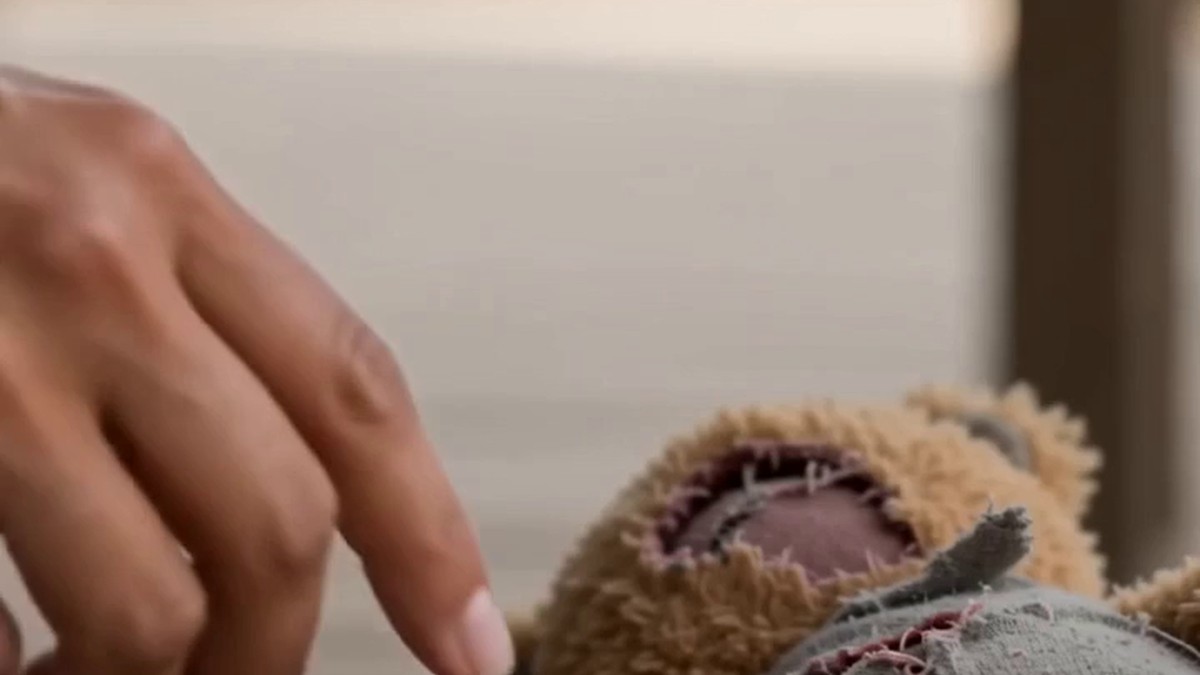
A stuffed bear. One of those cheap carnival prizes with the plastic eyes and the bow tie that used to be red. Now it was gray, missing an ear, with a tear along the seam where white stuffing poked through. The dog carried it like a courier carrying something that couldn't be replaced. Gently. Deliberately. As if the bear were the only object in the world that had ever been his.
The tech reached for the crate latch and the dog flinched. Not a big dramatic cower — just a small tucking of the head, a half-step back. The kind of reaction you see in dogs who've learned that human hands mean one of two things, and neither of them is good.
"Where did he come from?" I asked.
The driver handed me the clipboard without meeting my eyes. The address was off South Twelfth Avenue, a stretch of cinderblock rentals where the AC units hang out of windows and the yards are dirt and chain-link. The box for "reason for surrender" had one word: *moving*.
Nobody moves and leaves their dog at the shelter with his only possession still in his mouth.
I knelt down, keeping my body low, turning sideways so I wasn't looming. The dog watched me, bear clutched in his jaws, and I saw something in his face I've seen maybe a dozen times in nine years. It's not aggression. It's not even exactly fear. It's the look of an animal who got his heart broken so completely that he can't believe anything good will ever happen again, but he's too tired to fight about it.
I didn't try to take the bear. That's the first thing you learn. You don't take the one thing they have left.
—
I stayed past the end of my shift that day. My relief, Dana, showed up at five and found me in Bay Five sitting on the floor with the shepherd, tossing pieces of hot dog underhand so he wouldn't have to come close to take them.
"One of those?" she asked.
I didn't answer. She looked at the bear, looked at me, and put her bag down. "I'll get the mop. You want me to call anybody?"
I had her number in my phone under "Lila, Wednesday intake." The woman who'd brought in a crate of kittens two months back, the one with the quiet voice and the way of holding animals that made them go still. She'd said she wasn't ready for another dog yet. Her old German shepherd, Bear — I remember the name because of the irony — had died in January, and she still had his bowl and his collar sitting on a shelf in her living room.
I called her at six-fifteen that evening.
"I've got a dog here who needs somebody who'll let him keep his stuffed animal," I said. "It's not urgent, I just—"
"What happened to him?"
I told her. The South Twelfth address. The word *moving* on the form. The way he carried the bear. The way he flinched.
She was quiet for a long moment. Then: "I get off work at six tomorrow. Can I come see him?"
—
Lila came the next evening in her nurse's scrubs, still wearing her badge from St. Mary's, and she sat down on the floor of Bay Five without even saying hello to me first. She sat with her side to the dog, not facing him, and she set a piece of string cheese on the concrete near her knee and just waited.
The shepherd watched her from the corner, bear in his mouth, every muscle wired. She didn't reach for him. She didn't make those kissing sounds people make. She just sat there, one hand limp on her knee, and after about ten minutes she started talking to him in a low voice about nothing — about how hot it was, about how her car needed an oil change, about how she'd forgotten to eat lunch because the ER had been a circus.
The dog took the string cheese.
Then he took two more pieces, and the last one he took from her fingers.
"I want to foster him," she said when I walked her out. "Just foster. I'm not ready to— I can't do that again yet."
I put her on the paperwork that night.
—
Three days later she called me. Not about the dog. About the bear.
"He won't let me touch it," she said. "I tried to wash it because it smells like — I don't know what it smells like. He growled at me. Not a mean growl, just… a warning. Like, this is mine and I can't lose it and if you take it I won't have anything left."
"Let it be," I said. "He'll set it down when he's ready."
A week passed. Then two. Lila called every few days with updates, and I could hear the dog in the background sometimes — not barking, just the click of his nails on her kitchen floor.
"He sleeps on the bed now," she said. "Only when I'm in it. He waits until I fall asleep and then he gets up. I wake up and he's up against my legs, still holding the bear."
"That's closeness, Lila. That's him checking that you're still there."
She was quiet. Then: "I know."
—
I went to her house on a Saturday morning in late August, a month after the intake. She lived in a little adobe place out in the foothills, with a gravel yard and a mesquite tree and a low fence that the dog could easily have jumped if he'd wanted to. He didn't want to.
He met me at the door with the bear in his mouth, and when he saw me his tail made one cautious sweep, just once, like he wasn't sure if he was allowed to be glad.
We sat on her back porch, and she poured iced tea from a pitcher beaded with sweat. The dog lay at her feet, the bear between his front paws now instead of in his mouth. Progress. The kind you can't measure on a form.
"Did I tell you about the noise thing?" she asked.
She meant the thunderstorms. In Tucson in August, they roll in off the Catalinas every afternoon, and the dog — she'd named him Manny, after her grandfather who'd been a boxer in the 1940s — couldn't take them. The cracking sound would send him under the kitchen table, shaking, the bear clamped so tight in his jaws that she worried he'd tear it.
"I don't try to trap him anymore," she said. "I just get down on the floor near the table and I stay there. I don't touch him. I just sit with him so he knows he's not alone."
I looked at her. Some people talk a good game about rescue. Lila was sitting on a tile floor at eleven o'clock at night, in her work clothes, waiting out a storm with a frightened dog, and she thought it wasn't worth mentioning because it was just what you did.
—
The last thing I expected was for her to call me in tears in the middle of October.
I answered and for a second I thought it was the dog — that something had happened, that the old fear had turned into a bite, that she'd had to make a horrible choice. But then she got words out between hitches of breath.
"Manny left the bear outside this morning."
"Okay."
"I mean he left it. He put it down by the mesquite tree and he walked away from it and came and got in the truck with me. He got in the truck, and he didn't go back for it. I found it when I got home. It was just lying there in the shade."
She was crying again, the raw kind. I didn't know what to say. I said the only thing that was true: "He didn't need it anymore."
—
That was four years ago.
Manny still has the bear. He carries it out into the yard sometimes and sets it in the sun, and Lila washes it now without any growling — washes it and stitches the torn seam and sews the ear back on, because the bear isn't the thing he can't lose anymore. It's just a toy.
The thing he can't lose is the person who sat with him through the storms.
I don't know what happened in that cinderblock house off South Twelfth Avenue. I don't want to know. What I know is what I saw: a dog who came into my shelter carrying the only thing he had, and a woman who understood that you don't take that thing away. You don't rush it. You sit on the floor. You wait. You let the animal decide when it's safe to set the bear down.
I've processed nine hundred animals at Pima County. I remember maybe twenty of them. Manny is one. Lila is the reason.
She called me last month to make it official — the adoption paperwork, the final signature, the twenty-five dollars that makes him hers in the county's eyes. "I was waiting," she said. "I wanted it to be true before I made it true."
I didn't ask what she meant. I'd seen the dog's face at intake. I'd seen him flinch at a crate latch. I'd seen him carry a broken bear like it was the only thing keeping him alive.
And then I'd watched him walk away from it, into the truck, with a woman who had tears on her face, and I'd understood: some animals don't need you to fix their toys. They need you to show up and stay, until the day they finally believe that home doesn't leave.