I want to say it started in a hospital room in Nashville, but that's not true. It started eleven years before that, at our mother's funeral, when Ryan folded my hand into his at the graveside and didn't let go for two hours. We were twenty-three. Twins. Orphaned in one November evening on I-40.
He was the first person I called when my marriage fell apart in Phoenix three years later. He was the one who booked a flight before I finished asking. He slept on my couch for a week, made pancakes for my son every morning, and never once said *I told you so*.
So when he and Melissa sat me down at a Cracker Barrel in Murfreesboro six years ago and told me they'd been trying for a baby — eight years of trying, three miscarriages Melissa couldn't talk about without her hands shaking, a fertility clinic that had drained their savings down to nothing — I already knew what I was going to say.
They didn't even ask at dinner. They asked two weeks later, on my porch, while my son was at his father's for the weekend.
Ryan held a manila folder against his chest like a shield. Melissa wouldn't sit down. She stood by the porch rail, twisting a hair tie around her fingers until it snapped.
"We have a contract drawn up," Ryan said. "An attorney looked at everything. You wouldn't have to pay a cent — we'd cover every appointment, every vitamin, every parking stub. We just need someone we trust."
The word *trust* landed hard. I thought about my son, about the first time a nurse laid him on my chest in Phoenix. I thought about Ryan at the graveside.
"Yes," I said.
Melissa made a sound I'd never heard a person make — a strangled sob that became a laugh, then a sob again. Ryan sat down on the step and put his head in his hands.
They were at every appointment after that. Every single one. Melissa bought a blue notebook and wrote down the doctor's answers in handwriting so neat it looked printed. Ryan came to my ultrasounds and sat in the corner, his surgical cap on backwards half the time. When the tech said *girl*, Melissa grabbed my hand hard enough to leave marks.
The nursery in their house on Deerfield Drive was finished by my second trimester. Yellow walls. A mobile with wooden stars. A bookshelf full of the same picture books our mother used to read us — Ryan had found them on some vintage book site, spent forty dollars on a copy of *The Giving Tree* with the original jacket.
The name was Sophie. After our grandmother.
Nothing in that room warned me.
—
The labor lasted nineteen hours. My lower back felt like someone had worked a crowbar into it. Ryan gripped my hand through the worst contractions, and Melissa fed me ice chips so small and patient it made me want to cry.
At 3:14 a.m., Sophie came out screaming.
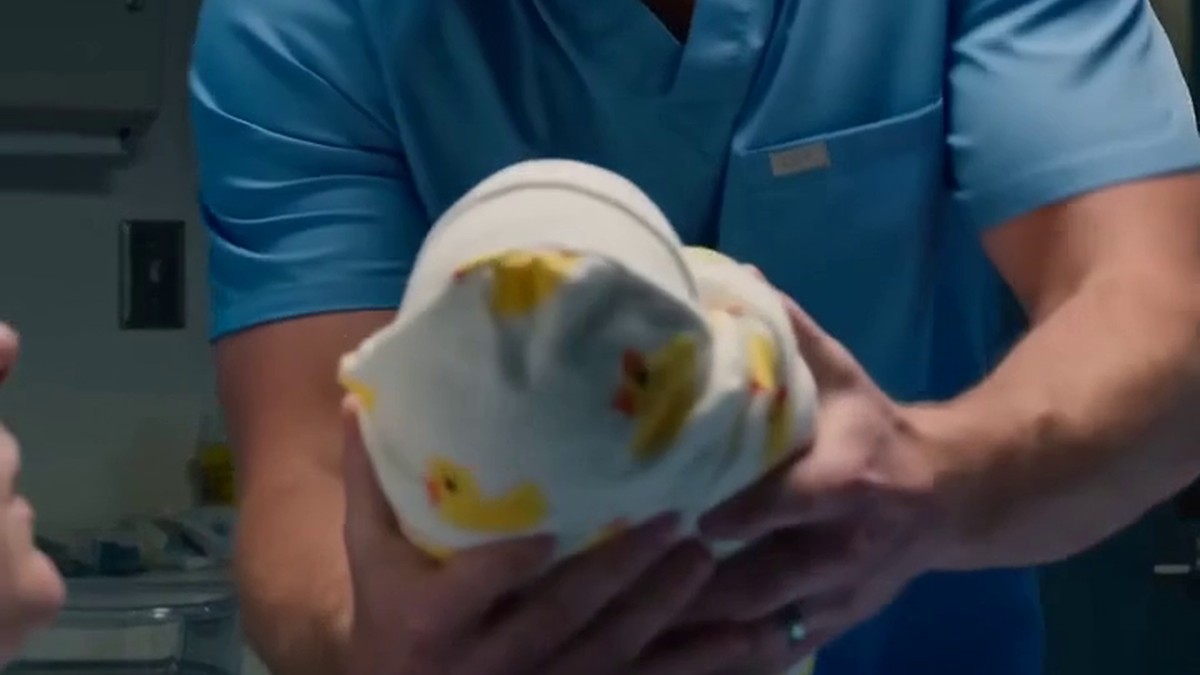
The nurse cleaned her, wrapped her in a blanket with little yellow ducks, and placed her in Ryan's arms. He looked down. His whole face changed in about three seconds flat — first a smile, then something I can only describe as a man watching a car crash from a hundred feet away.
"Ryan?" I said.
He didn't answer.
Melissa moved closer, already reaching for the baby. "Let me see her — Ryan, let me see."
He stepped back. Just one step. But I was watching his hands, and I saw them tighten around the blanket, not with love — with something closer to fear.
"Ryan." Melissa's voice climbed. "What is wrong?"
He turned the baby slightly. Then he said it, so low I almost missed it over the monitors: "I need you to look at her back."
The room went dead silent. Even the machines seemed to pause.
Melissa laughed the way people laugh right before they start screaming. "What are you talking about?"
He walked to my bed and set Sophie in my arms. His hands were cold through the blanket. Then he backed against the wall by the door, like he was already halfway out of the room.
Melissa was crying now, mascara tracking down her face, her chest heaving. "We painted the nursery. We chose her name. We have a crib waiting. What are you saying?"
Ryan closed his eyes. When he opened them, he was looking at me, not her.
"Just look at her back," he said. "Please."
I was shaking when I loosened the blanket. Sophie squirmed, her tiny arms jerking, her mouth working in her sleep. I turned her over.
On her lower back, just above her left hip, was a birthmark.
Dark brown. Shaped like the state of California, ragged at the edges, the way a child draws a map — all the corners slightly wrong.
I stopped breathing.
Because I had seen that mark before. Not on Ryan. On my son. My eleven-year-old son had that exact mark, in that exact spot, and I had never told a living soul what I suspected about where it came from.
Melissa stepped to the bed and looked. Her hand went to her throat. Then she made a high, thin sound — a keening I'd only heard once before, at our mother's funeral — and it broke into a full-throated scream that brought two nurses running.
One of them lifted Sophie away with the careful competence of a woman who has handled a thousand frightened families. "What happened? What's wrong?"
No one answered.
Ryan was still against the wall, his face the color of the hospital sheets.
I couldn't look at the mark. And I couldn't look away.
—
Here is the part I never told anyone. Not Melissa, not my son, not a single living soul since the year it happened.
Eleven years before that night in Nashville, I gave birth to my first child. A boy. It was in Phoenix, at St. Joseph's, on a night so hot the air conditioning had frozen over and the nurses were running space heaters in the hall.
The hospital was understaffed that week. I pushed for three hours. The delivery nurse was maybe twenty-five, her hair in a loose ponytail, her name badge clipped upside down. The doctor came in for the last ten minutes, muttered something about a shoulder, and was gone again before I could ask what he meant.
When they placed my son on my chest, I was so worn down from exhaustion and whatever they'd given me for the pain that I barely registered the shape of his nose. I registered the warmth. The weight. The impossible smallness.
A nurse wheeled him away for some test an hour later. I fell asleep.
When I woke up, a different nurse was holding him. A heavier woman, gray streaking her hair, her badge right-side up. But her eyes kept skipping away from mine.
And the baby she handed back to me had the mark.
A dark brown shape like California, just above his left hip. Ragged at the edges.
I didn't think anything of it. Or rather, I thought about it the way you think about a temperature reading at a checkup — noted, filed, forgotten.
It was only later, after I'd taken him home and the exhaustion thinned out enough to let panic bleed through, that I started to wonder. The boy didn't look like the brief, drugged memory I had of that first moment on the table. But every new mother thinks that. I told myself I was overtired. I told myself memory plays tricks.
I never asked for a test. I never told Ryan. I raised the boy, and I loved him more than I have ever loved anything, and I buried the question so deep that most days I forgot it was even there.
But I didn't forget the mark.
Whatever had happened in that hospital in Phoenix eleven years ago — a mix-up, a mistake, a nurse who'd made a choice and covered it with careful paperwork — my son had come home from that mess marked like a map.
And now Sophie had it too.
The exact same mark.
—
The nurse set Sophie in the bassinet and turned on me with the kind of voice that ended questions, not asked them. "Ma'am, are you all right? Can you tell me what started the screaming?"
I opened my mouth. Nothing came out.
Ryan pushed off the wall. He walked to the bassinet. For a long moment he just stood there, hands dangling, looking at his daughter with an expression I couldn't name. Then he turned to Melissa, and his voice was flat, dead-level.
"That mark," he said, "isn't a family thing. It's not from our side. I've never had it. Neither did our mother. I don't know whose blood carries it. But I know I've seen it exactly once before tonight — on her son." He nodded toward me without looking at me. "The day she brought him home from Phoenix. His blanket slipped and I saw it. I told myself it was nothing. I told myself that for eleven years."
The room didn't move.
Melissa's crying stopped so abruptly it left a hole in the air. "What are you saying?"
"I'm saying there's no way Sophie should have that mark unless it came from him," Ryan said. "And the only way it came from him is if he's her father."
I heard the words from a long way off, like someone talking in the next room. "That's not possible," I said. "He's never met Melissa in his life. He's never donated anything, never—" I stopped. My mouth had gone dry. "The clinic," I said. "The sample."
—
The doctor came back into the room a little after three the next afternoon. He was older, tired-eyed, a wedding ring worn thin at the bottom. He closed the door behind him and stood with his thumbs hooked in his belt, making sure all three of us were looking at him before he spoke.
"I want to be very precise about what I'm going to tell you," he said, "because I've already had to say it twice to people who didn't believe me the first time." He opened a folder. "Your embryo transfer four years ago used a donor sample, since your husband's own sample had motility issues the clinic flagged early on. You were given a profile number and told the donor was anonymous, screened, over eighteen, banked through a reputable agency."
"We know all that," Melissa said. "We picked the profile ourselves."
"You picked a profile," the doctor said. "But there was a cataloging error at the Phoenix facility that supplies several clinics in this region. Two donor vials were mislabeled under adjacent profile numbers in the same freezer rack. It happened eighteen months before your transfer, and it wasn't caught until an unrelated audit last winter — which is also, as it happens, when the affected clinics were supposed to notify patients. Some notification letters went out. Some didn't."
He turned a page.
"The vial you actually received was not the profile you selected. It came from a young donor who had enrolled at a Phoenix sperm bank the year he turned eighteen — a common way for college students to make some money donating throughout their first year or two of eligibility, before a bank stops accepting a given donor. Your donor conceived a child through your transfer four years ago. That donor," he said, "is a twenty-two-year-old man currently living in Smyrna, Tennessee."
Ryan's face had gone the color of the wall behind him.
"He's my nephew," I said. My voice didn't sound like mine. "He's my son."
—
I am not a woman who believes in fate. I don't read horoscopes. I never once bought a lottery ticket in my life. I believe in paperwork. In signatures. In the thing you can prove in court with a blood test and three witnesses.
But sitting in that room, staring at the printed pages that laid it out line by line, I understood something that had nothing to do with courts. My son, at nineteen, had walked into a clinic near his college to make some quick cash between semesters, filled out a form, and left. He had no idea a woman named Melissa existed. He had no idea that three years later, his sample — misfiled between two metal racks in a freezer in Phoenix — would become the reason a little girl was born with his birthmark on her back.
He had become Sophie's father before he ever knew Sophie could exist.
And I had carried her.
—
We didn't make any decisions that day. We couldn't. Melissa kept saying Sophie's name over and over under her breath. Ryan sat in a plastic chair with his head in his hands for a solid forty minutes. At some point a nurse brought three cups of orange Jell-O and set them on the table like some kind of apology.
Sophie slept through all of it.
The confirmatory blood tests took four more days. When they came back, they matched what the clinic records already showed. Ryan looked at the results once and left the room without a word. I found him in the parking garage, sitting on the hood of his car with his phone dead in his hand.
"They're offering a settlement," he said. "For the mix-up. Some number with a lot of zeros and a confidentiality clause."
I sat down beside him on the cold metal.
"Ryan."
"I don't want their money."
"I know."
For a while neither of us spoke. Above us, through the concrete slats of the garage, the sky was that washed-out gray Nashville does in January.
"What are we going to do about Sophie?" I asked.
He was quiet for a long time. Then he turned and looked at me, and there was something in his face I hadn't seen since the day our father died — a rawness, like he'd been peeled back to whatever was underneath.
"She's my daughter," he said. "I don't care whose name is on a lab report. I held her first. I'm raising her."
"And Melissa?"
He looked away.
—
Melissa left three weeks later.
She packed her things in two black garbage bags and a suitcase that had belonged to her mother. She didn't cry. She didn't yell. She stood in the doorway of the nursery — the yellow room, the mobile with wooden stars — and touched each star once with the tip of her finger, like she was counting something she'd never get back.
Then she came into the living room, where I was sitting with Sophie asleep against my shoulder, and she said:
"I can't look at her without seeing him."
She didn't mean Ryan.
She meant my son. The boy who'd fathered Sophie by accident, through a lab's mistake, without knowing, without consenting, without ever having been in the same state as Melissa.
Melissa filed for divorce on a Tuesday. Ryan didn't fight it. He signed the papers at the kitchen table with the same pen he'd used to sign Sophie's birth certificate as the father of record. His hand was perfectly steady the whole time.
I slid a different piece of paper in front of him once the ink was dry.
"What's this?"
"A parenting agreement. Custody, support, medical decisions, spelled out so nobody has to guess. I want Sophie to have two homes, and I want both her fathers named."
"Both?"
"Both."
—
My son found out on his twenty-second birthday.
I told him every single thing, start to finish, not sparing a detail, not trying to make myself sound better than I was. He sat at my kitchen table and listened, his jaw tight, his hands flat on the tabletop. When I finished, he didn't shout. He didn't slam his fist into the wall, though I saw him think about it.
He poured himself a glass of water from the tap and drank it in one go. Then he set the glass down and said:
"Where is she?"
"Sophie? In the other room. Asleep."
"Can I see her?"
I led him in. He stood over the crib and looked down at his daughter for a long time. His daughter. He was twenty-two years old, working at the Nissan plant in Smyrna, driving a 2012 Ford Focus with a cracked taillight, halfway through a business degree he wasn't sure he wanted.
He put one finger into Sophie's open palm. She closed her hand around it.
"I want to be in her life," he said, not looking at me. "I don't know what that looks like. I don't have money for child support. I don't even have a stable shift schedule."
"We'll figure it out."
He shook his head. "No. We won't 'figure it out.' I'm not walking away from this. I'm going to do it right."
—
It took four years.
I wish I could tell you it resolved itself quickly. It didn't. It ground on, week by week, through custody hearings and scheduling conflicts and a co-parenting app that Melissa's lawyer argued about for three months. Sophie's face changed from an infant's blur into a little girl's sharp angles, and through every stage of it, the question stayed the same: whose house would she wake up in, and whose name would be on the check.
Ryan moved into an apartment first, then a house, then back into the house on Deerfield Drive after Melissa decided she wanted out of the state. Alabama. She had family there.
The first time she called to say she wasn't coming back for Sophie's birthday, Ryan made a calendar reminder on his phone for the next eleven years running.
Then, this past spring, a box arrived.
It was addressed to Ryan, no return label. Inside: Sophie's baby book, half-filled, and a letter from Melissa. Three pages, written in blue ink, the same neat handwriting that had once filled the blue notebook at every doctor's appointment.
She was sorry. She'd spent four years angry at the wrong people — at Ryan for not saying anything about the mark sooner, at me for carrying the child, at my son for a lab's mistake he'd known nothing about.
And then one morning in March she'd looked at herself in the mirror of a gas station bathroom outside Montgomery and realized she was still wearing her wedding ring. Not for Ryan. For the grief of losing something that had been hers — the pregnancy, the nursery, the name — before it had ever belonged to anyone else.
She had signed over her parental rights.
—
The final hearing was on a Friday.
I sat in the back of the courtroom in Nashville, on a wooden bench so hard it made my tailbone ache. Ryan sat at one table with his lawyer. My son at the other with his. Sophie was in the judge's chambers with a guardian ad litem, coloring a picture of a horse.
It was a quiet hearing. The papers were in order. The custody arrangement had been agreed on all sides. Ryan testified first, then my son. No one raised their voice.
The judge signed the order at 11:47 a.m.
When the gavel came down, my son turned and looked at Ryan. For a long moment, the two of them just stood there across the room — the man who had raised Sophie, and the man whose blood had made her possible.
Then Ryan crossed the room and put out his hand.
My son shook it.
He's twenty-six now. Sophie is four and a half. She lives with her father in a two-bedroom apartment in Murfreesboro, in a room with yellow walls and a bookshelf full of the same picture books our mother used to read us. Ryan keeps a bed made up for the weekends he has her. I see her twice a month, when my son drops her off at my place with a diaper bag and a plastic container of sliced oranges.
Some Sundays she falls asleep on my couch before he even gets there, one hand curled loose against her cheek, and I sit next to her and check, out of habit I can't quite let go of, that the blanket hasn't slipped from her shoulder.