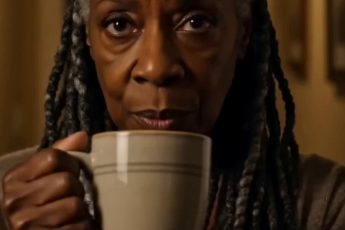
Ruth Callahan kept the letter in a cedar box on her closet shelf in Beaufort, South Carolina, tucked between a Bible with a cracked spine and a photograph of her late husband, Walter, holding their first grandson on the dock behind the house. She'd written it the year Walter died — six years back now — sitting at the kitchen table with a cup of coffee going cold beside her, trying to put down on paper everything she was afraid she'd never get the chance to say out loud.
*My sweet grandchild,* it began. *I promise to love you fiercely, pray for you faithfully, and point you to Jesus every chance I get.*
She meant it for all four of them — Caleb, Mara, Jonah, and little Dessa, who wasn't so little anymore. But it was Caleb, the oldest, who found it.
He was twenty-two that spring, staying with her for two weeks after a bad breakup he wouldn't talk about, sleeping in his father's old room with the model airplanes still hanging from the ceiling. Ruth had asked him to fetch a suitcase down from the closet for her sister's visit, and he'd knocked the cedar box loose instead. It hit the carpet and popped open, and there was the letter, folded in thirds, his grandmother's handwriting slanting across the page like it always did when she wrote in a hurry to get her heart down before it changed its mind.
He read it standing right there in the doorway. Didn't ask permission. Didn't need to — she'd written it for him as much as anyone.
*I promise to remind you that you were created on purpose, loved beyond measure, and never alone.*
He came downstairs holding it, and Ruth saw the paper in his hand before she saw his face, and her stomach dropped the way it does when a secret gets loose before you're ready.
"You wrote this after Grandpa died," he said. Not a question.
"I did."
"You never gave it to us."
"I was waiting," Ruth said, "for the right time."
Caleb sat down across from her at the same kitchen table, the coffee maker gurgling through its last cycle behind him. He picked at the corner of the paper with his thumbnail, not looking up.
"I stopped believing any of this a long time ago, Grandma. I didn't know how to tell you."
Ruth had wondered. She'd noticed the empty seat at Easter service two years running, the way he changed the subject whenever church came up, the small silver bracelet he wore now instead of the cross Walter had given him at confirmation. She'd told herself it was a phase, the kind young men go through and come back from. Hearing him say it plain, at her own table, with her own letter still creased in his fingers — that was different.
"Why didn't you tell me?"
"Because I knew what it would do to you." He set the letter down between them like it was something breakable. "And now I've read this thing where you're promising to raise me up believing something I don't believe anymore, and I feel like I broke a promise I never even agreed to."
"You didn't break anything." Her voice came out sharper than she meant it. "I wrote that letter with your grandfather's ashes not even settled yet. I sat right here and I promised God I'd keep every single one of you close to Him if it was the last thing I did on this earth. And now you're telling me it's over before I even got the chance to try."
"It's not about you trying —"
"Then what is it about, Caleb? Because from where I'm sitting, my grandson just told me the thing I built my whole life around doesn't mean anything to him anymore, and you want me to just — what — nod and pour you more coffee?"
"I want you to not look at me like I died." His voice cracked on the last word. "That's how you're looking at me right now. Like I'm something to grieve."
Out on the porch, the neighbor's old beagle started up his evening barking at nothing, the way he did every night around six. Neither of them moved to shut the window against it. Ruth gripped the edge of the table so hard her knuckles went pale, and for one long moment she thought — clearly, coldly — *if I say the wrong thing right now, I will not see him at this table again.* Not for a year. Maybe longer. She'd watched it happen to other families in the congregation, a hard word at the wrong hour, and then Christmases came and went with an empty chair nobody mentioned.
She let go of the table.
"I'm not grieving you," she said. "I'm scared. There's a difference, and I should've said the second one instead of acting out the first."
Caleb didn't answer right away. He turned his water glass in a slow circle on the table without drinking from it.
"What happened," she asked. "Was it something at school? Somebody hurt you?"
"It wasn't one thing." He kept turning the glass. "It was a hundred small things. Watching people at church say one thing on Sunday and do another thing Monday. Watching Dad and Uncle Ray fight over the store and both of them still taking communion like nothing happened. I kept waiting to feel what you all said I was supposed to feel, and I never did."
Ruth thought of Walter, forty years married, dead of a heart attack in the garden shed with his gloves still on. She thought of the nights after, when she didn't have language for her own grief and had leaned so hard on scripture it was the only thing that kept her upright. She wanted, badly, to hand Caleb that same rope. But he wasn't drowning the way she had been. He was standing on his own ground, just a different patch of it than she'd hoped for.
"I'm not going to argue you into it," she said finally. "I tried that with your Uncle Ray thirty years ago and it did nothing but make him avoid my calls for a decade. I'm not doing that again. Not with you."
Caleb's shoulders came down an inch, like he'd been braced for a fight that had almost happened and then hadn't.
"What I want," Ruth said, "is for you to know the door's open. Always. Whatever you land on, wherever you go. That part of the promise doesn't have an expiration date."
He didn't say much after that. Two days later he packed his bag and drove back to Charleston, and Ruth thought that might be the last real conversation they'd have about any of it — that he'd file it away polite and distant, the way families sometimes do with the things too tender to touch twice.
It wasn't the last conversation. It took four months.
Ruth found out from Dessa, over the phone, that Caleb had started going to some Tuesday night group at a coffee shop near his apartment — not a church exactly, just people his age talking about the questions nobody had let them ask out loud growing up. He didn't tell Ruth himself. She let it be. She'd learned, watching Walter counsel a hundred church members over the years, that the worst thing you can do to somebody circling back toward faith is chase them.
Then, on a Sunday in October, her phone rang while she was drying dishes, and it was Caleb, and he didn't say hello first. He said, "I want to talk about the letter again."
She sat down on the kitchen stool, dish towel still in her hand. "Okay."
"I'm not where you want me to be. I want to say that up front so you're not hoping for something I can't give you yet."
"Alright."
"But I went back and read it again. The part about Jesus loving me more than you do. I used to think that line was just something grandmothers say." He paused, and she could hear him breathing on the other end, some traffic noise behind him like he was walking somewhere. "I don't think that anymore. I don't know what I believe yet. But I don't think it's nothing."
She pressed the dish towel flat against the counter with her free hand, not saying anything for a second.
"That's enough for me, Caleb. That's plenty."
They talked for forty minutes — longer than they had in years, about the coffee-shop group, about a girl named Priya he'd started seeing who asked him hard questions he liked answering, about his father and Uncle Ray finally splitting the store peaceably after all this time. Ordinary things, threaded through with the one thing that mattered.
Before they hung up, Ruth told him she was mailing him the letter — not a copy, the actual page, ink and creases and all. It had spent enough years locked in a box where only she could take it out and read it alone.
It arrived at his apartment on a Thursday. He called her that night.
"I put it on my dresser," he said. "Right next to my keys, so I see it every morning on my way out the door."
Ruth sat down at the kitchen table, the same one, morning light coming in low across the wood the way it always did that time of year. Down the street somebody's screen door banged twice, then went quiet.
"Good," she said. "That's a good place for it."