The clock on the intake monitor read 3:58 when I heard the scuffing sound at the far end of the corridor. I'm Renee Kowalski, forty-one, and I'd worked the overnight admissions desk at St. Agatha Memorial in Toledo for six years. Six years of Red Bull, cold vending-machine coffee, and nothing worse than a drunk college kid vomiting in the waiting room. That night broke the streak.
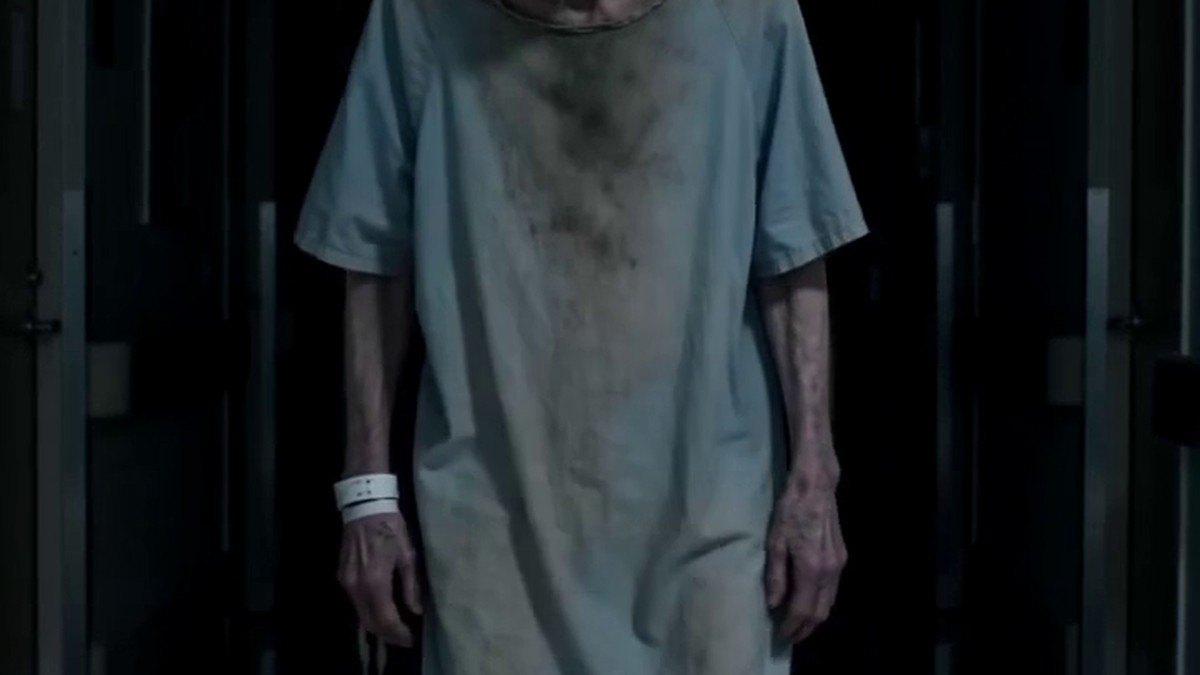
An old man in a faded blue hospital gown was coming down the hallway toward me, one slipper dragging against the linoleum. The overhead lights in that wing buzzed a little — maintenance had been "getting to it" for two months — and under that flicker his face looked wrong, slack on one side, like a man walking in his sleep.
"Sir?" I called out. "Can I help you find your room?"
Nothing. He kept coming, eyes fixed somewhere past my shoulder.
I stood up too fast. My chair rolled back and cracked into the filing cabinet loud enough that I flinched worse than if he'd yelled at me. His hospital wristband had slipped halfway down his forearm, flapping loose with each step. Then he lifted his head and looked right at me, and something about that stare — empty, but aimed — made my whole body decide before my brain did.
I screamed. I dropped below the counter, knees on the tile, one hand slapped over my own mouth, the other groping blind for the desk phone cord. Papers rained down around me — a lab requisition, somebody's insurance printout, my half-eaten granola bar wrapper.
Through the gap under the counter I watched his slippers stop. Just stop, six inches from the base of my desk. I stopped breathing so long my ears rang.
Then a voice, dry as paper: "Two-fourteen."
The slippers turned and shuffled away.
By the time hospital security got there, the hallway was empty. Every patient was accounted for in their own room. No nurse on the floor recognized the man from my description. We went back to the security office and pulled the footage, and there I was on the monitor — screaming, sending the chair into the cabinet, folding myself under the counter like a kid hiding from a thunderstorm.
The guard, a guy named Curtis Boyd who'd been at St. Agatha almost as long as I had, zoomed in on the wristband. He ran the barcode against admissions. A name came up: Walter Doss. Assigned to Room 214.
Walter Doss had been pronounced dead at 11:47 that same night.
Before either of us could say anything, the door opened and the hospital's chief administrator, Gary Petrosky, stepped in. He locked it behind him — I heard the bolt — and stared at the frozen frame on the screen for a long moment.
"Erase that," he said.
Curtis's hand hovered over the keyboard. "Why would I do that?"
Petrosky's voice dropped low. "Because Walter Doss was never supposed to be a patient here."
I'd known Gary Petrosky for four years as a boring, meticulous man who color-coded his own email folders. Watching him sweat in that security office was almost stranger than the man in the hallway.
Curtis pulled his hand back from the keyboard. "I'm not deleting anything, Gary."
"You don't understand what you're looking at."
"I'm looking at a patient walking toward the front desk," I said. "A patient your own system says died six hours ago."
"The record's wrong."
"Then fix it."
He didn't answer that. While Petrosky was still working out what to say next, Curtis quietly copied the footage onto a thumb drive and pocketed it. Then the three of us went back up to the third floor.
The corridor was exactly as I'd left it — my chair still shoved against the cabinet, the granola wrapper still on the floor, a lab form face-down near the baseboard. Seeing it untouched made the whole thing feel worse, somehow, like the hallway itself was holding its breath.
Room 214 was locked. Petrosky badged it — nothing. Curtis tried his master key — nothing. That's when Petrosky admitted, quietly, that the room had been pulled from the electronic access log three days earlier.
"Pulled by who?" I asked.
He looked at the floor instead of answering. A maintenance guy named Freddy showed up ten minutes later with an actual brass key — the kind nobody used anymore — and let us in manually.
The room was stripped. Bed bare, monitor dark, no flowers, no duffel bag, nothing that said a person had spent even one night there. Except a gray wool coat folded neatly over the chair by the window, and on the nightstand, a pair of drugstore reading glasses, an unopened bottle of Aquafina, and a small spiral notebook with a coffee ring on the cover.
Curtis flipped through it. Pages of dates, drug names, room numbers, notes in handwriting that got shakier toward the end. On the last page, one line repeated four times in a hand that looked like it was fighting to stay legible:
My name is not Walter Doss.
Underneath it, a different name: Arthur Kessler.
Petrosky sat down hard on the edge of the stripped mattress and put his face in his hands.
"You knew," I said.
Arthur Kessler, he finally told us, was a seventy-three-year-old retired bookkeeper from Sylvania who'd spent the last year quietly feeding documents to the state insurance fraud unit — records showing patients at St. Agatha billed for procedures that never happened. Two nights before he turned up in my hallway, Arthur had come into the ER weak and disoriented. Someone on staff recognized his name from the complaint file. Instead of admitting him under his own chart, they logged him in under Walter Doss — a man who'd actually died three years earlier at a nursing facility across town, his old chart still sitting dormant in the system.
"Why steal a dead man's file?" Curtis asked.
Petrosky wouldn't look at either of us. "Because a dead patient can't dispute a bill."
The scheme was ugly and simple: reactivate old, closed-out patient identities, stack them with expensive phantom treatments, collect from insurance, then quietly close the file again before anyone asked questions. Arthur had found the pattern. So when he showed up sick and vulnerable, somebody made sure he disappeared into it instead of exposing it — sedated, misfiled as Doss, marked dead on paper before sunrise.
Except he woke up. Around 3:50 by the desk clock, half-drugged, legs barely working, he'd wandered out looking for anyone who'd listen, and the only thing that made it past whatever they'd given him was a room number.
A torn transfer form turned up in the cabinet under the sink — most of it missing, but one line survived: Destination: Maumee Valley Recovery Suites, signed at 4:07 a.m., nineteen minutes after he'd stood at my desk.
We called. The woman on the phone insisted no Doss, no Kessler, had ever been admitted. Curtis asked her to check the log twice. She put us on hold and never came back.
By dawn, the Lucas County Sheriff's office and the Ohio Department of Insurance were both on the phone with the hospital's lawyers. Petrosky handed over internal records in exchange for a deal that kept him out of a cell, at least for now. What investigators found over the following weeks was worse than anyone in that room expected that night: sixty-one falsified patient files, forged physician signatures, and roughly $2.3 million in fraudulent billing going back four years.
Arthur Kessler was found that afternoon, alive, in a private facility thirty-eight miles outside the city, weak but breathing on his own. When detectives showed him a still frame from Room 214, he cried.
"I didn't think anyone actually saw me," he said.
I visited him three days later, brought him a coffee he wasn't allowed to drink and a copy of a crossword puzzle instead. He remembered the hallway. He remembered my face at the desk. He remembered trying to force the number out of his mouth because he was terrified the notebook — his only proof — was still sitting in that room waiting to be thrown out with the trash.
"I scared you pretty bad," he said.
"You did." I didn't pretend otherwise. "I'm sorry I hid."
He shook his head, slow. "I was the one who needed hiding from. Not you."
Gary Petrosky lost his administrator's license in the state review that followed and pleaded to a lesser fraud charge rather than go to trial. The hospital's CFO and two senior billing managers were indicted. Curtis's thumb drive — the footage Petrosky wanted gone before sunrise — became Exhibit 14 in the case file.
I still work the overnight desk. A year out, Arthur sends me a Christmas card every December with a bad pun inside, and last spring he mailed me a printed copy of the state's final audit report with one sentence highlighted in yellow: patient identity theft utilized to conceal billing fraud, discovered following witness report, Room 214. He'd written in the margin, in that same shaky handwriting from the notebook: You saw me before anyone else did. Even under a desk.
I keep it in the drawer under the phone, next to the granola bars.