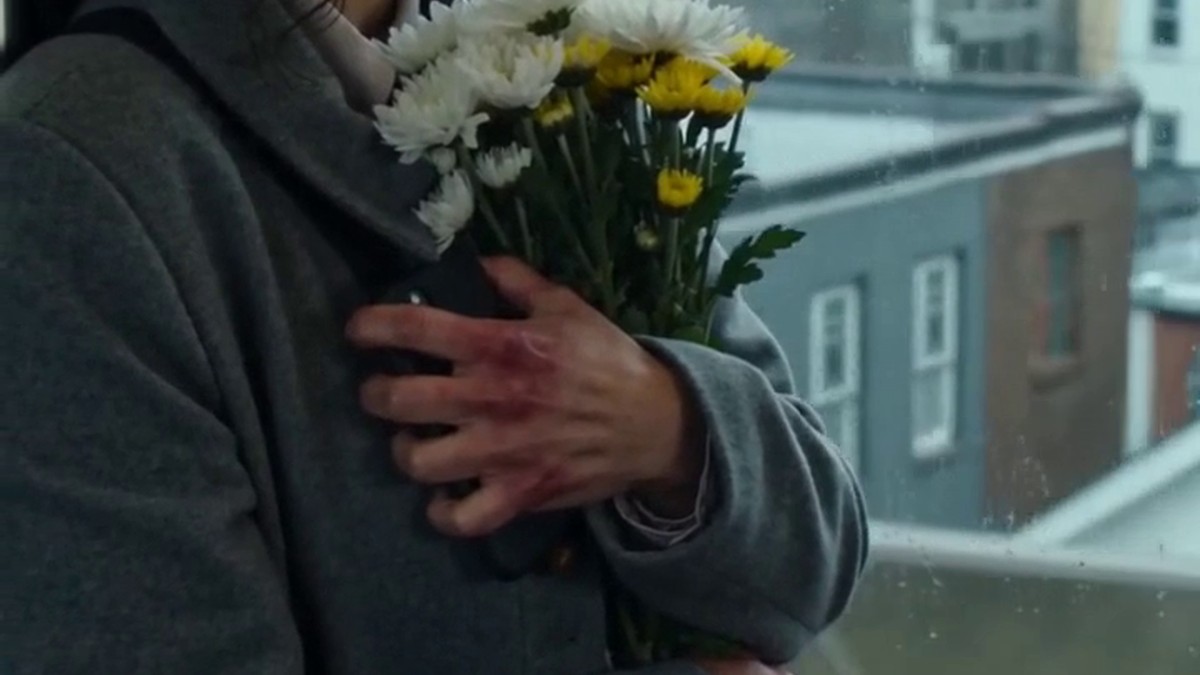
It started with the hallway light burning out on the third floor. You know how it is in these old buildings on the near west side of Cincinnati — technically the HOA is supposed to handle it, technically the super's supposed to handle it, and meanwhile you're walking up the stairs using your phone flashlight like you're lost in the woods. I was coming home from my shift at the clinic, carrying a grocery bag with my mother's prescriptions, when I heard a door slam on the stairs above me. It was Maddie. From apartment fourteen. She cut right in front of me, running down the steps in an unbuttoned coat even though it was already pouring outside. Her hair was damp from the mist, a shopping bag in one hand, her phone in the other. Behind her, through the open door, came the smell of sauerkraut. And her husband's voice:
"Get back here, my mother's about to show up!"
She didn't even look back. Just walked faster. And I thought that the bread she'd left on the counter was definitely going to go cold before anyone in that family said thank you.
I saw her twice that day.
First in the morning, on the number 17 bus, the one that goes out toward Spring Grove Cemetery. I was sitting in the back because the front seats were taken by a guy with a bike and an older woman with a shopping cart. Maddie got on at the Findlay Market stop. She stood by the window, pressing a bundle of chrysanthemums against the glass like she was trying to keep them alive, keep them from freezing. Her fingers were red, her nails bitten down to the skin. She wasn't looking at her phone. She was looking out the window, and in the glass you could see the wet rooftops and gray sky, and probably me too, since I was sitting across from her. She gave me a half-smile with the corner of her mouth. But it wasn't really a smile. It was something people do so they don't fall apart in front of strangers.
She got off at my stop. Went left, down the path near the chapel. I don't know who she was visiting. I don't know who's buried there. But I watched her lay those chrysanthemums on a grave, far from the main gate. The wind caught the hem of her coat and she just stood there, not bothering to fix it. Then she pressed her forehead to the cold stone. She stayed like that for a good while, until a crow shrieked and took off from a nearby tree.
The next time I saw her was back in our building. It was after three. The stairwell smelled like mushroom soup, the kind from a packet, that somebody was cooking on the second floor. I was coming back from the pharmacy with cough syrup and four lemons for my mother. On the mat outside Maddie's door sat a pair of shoes. Women's, wet, with a leaf stuck to the sole. Next to them, men's shoes, toes pointed inward. And from behind the door came the voice of her husband, Derek — I know him because he borrowed our drill twice and never gave back one of the anchor bolts.
"I told you they were coming! What am I supposed to tell them? That my wife went to the cemetery and left an empty pot on the stove?"
Maddie said something back. Quiet. I couldn't make out the words because right then someone downstairs slammed the basement door. Then him again:
"You're gone all day and my family's on their way. What kind of wife are you?"
And that's when, you know, I felt embarrassed standing there listening. I took a step toward my own door. But right then something clattered inside their apartment — a plate, maybe, or a lid. And suddenly she said, loud enough that it echoed through the whole stairwell:
"You've got hands, Derek. Cook it yourself."
Silence fell. Short, but the kind that hangs over the whole building. That's how it always is in these apartment fishbowls — when somebody finally stops playing their part, you hear it through the wall in your own kitchen.
The door opened. Maddie stepped out into the hall. In her hand she carried the basement key, an old one, on a string. She looked at me, and I pretended to be searching for something in my pocket. I couldn't help myself and said:
"Maddie, I've got that watercolor next door — the one you wanted framed. Come by whenever."
"Oh, the one from the farmers market," she said, straightening her collar. "Thank you."
And she went downstairs. The shoes stayed on the mat. Women's and men's, both.
That evening I told my mother how Maddie from unit fourteen hadn't made dinner for her mother-in-law for the first time. My mother, who hasn't gotten out of bed in ten years, raised her eyebrows so high her headscarf slipped back.
"The one whose mother-in-law tells everyone every Sunday her soup's too salty?"
"That's the one," I said, setting a cup of tea in front of her. "I don't think she'll be saying that anymore."
My mother stared at the ceiling for a long time. Then she muttered:
"Wish I'd known how to do that."
The second act of this story didn't happen on our street. Six months later I ran into Maddie at the Kroger on Hopple. She was standing by the bakery case, two rose-filled donuts in her cart, and a small orange juice. Not the big carton — the little single-serve bottle. The kind for one person.
"How are you, Maddie?" I asked, even though I didn't want to pry. But there's a part of me that grew up in a cramped stairwell, the kind of person who figures that once you've traded chrysanthemums and a basement key with somebody, you've earned the right to ask.
"Oh, you know," she said, not looking at me. "Sometimes it's better not to know."
I found out later that Derek had left for his mother's after that fight. For a week. He came back because it got out at work that his shirts weren't ironed, and his mother told him she wasn't running a hotel either. But I found out something else in Maddie's bathroom — because later, in January, she asked me to help hang some shelves in the entryway. Said there was nobody else to ask.
"What about your husband?" I asked, feeling stupid the second it left my mouth.
"He's got free time on weekends. Just not for me."
That's when I noticed the empty mint tea box sitting on her windowsill. Inside were bills. Gas, electric, rent. All addressed to her. And a sticky note on the fridge, held up with a clover magnet: "Don't forget the bills or I'm not paying for the internet."
I don't know why that stuck with me. Maybe because it was the only thing Derek ever put in writing to his wife. Not a love note, not a confession. Just a threat to cut the WiFi.
Things got worst in March. I came home from a night shift, past seven in the morning, slush everywhere on the sidewalks the way Cincinnati can surprise you mid-week. In the hallway stood a woman I didn't know, wearing a fur hat. She was smoking by the stairwell window even though it's against the rules. Flicking ash onto the sill.
"Who are you here to see?" I asked.
"My daughter-in-law," she said, and stubbed the cigarette out on the window frame.
Maddie's mother-in-law. I knew from her voice, from the way she said "my daughter-in-law," like the words tasted bad in her mouth.
She rang the bell. Maddie answered. And that's when I heard something I'll never forget, because it's rare for anybody in a building to raise their voice while the rest of the block is still asleep.
"You think not cooking is going to change anything?" the older woman started in. "Derek's going to leave you and you'll have nothing. That apartment belongs to us, from his father. You'll be out on the street, watch."
Maddie stood in the doorway. She didn't back down. She had on an apron with pockets, a spatula sticking out of one of them. She pulled it out, slow, and set it on the shelf by the door. As calm as if she were putting down a spoon, not a tool that could've been mistaken for something else.
"This apartment," she said quietly, "was bought with my maternity leave savings. But whatever. Come in, eat. Just wash the dishes after."
And she opened the door wider. The mother-in-law walked in, trailing cigarette smoke and lavender perfume. Derek appeared at the end of the hallway in just his socks, wearing the look of a man counting on his mother to handle it so he wouldn't have to.
I don't know what they ate. I know everyone left about an hour later. The older woman passed me on the stairs and said:
"You've got a neighbor dumb as a bag of hammers."
I said, "Well, at least her shoes are on her own mat."
I don't think she got it.
Three days later I ran into Maddie at the bus stop. We were both waiting for the late-night route. She told me she'd found the property deed tucked in a drawer under the comforter. The one Derek claimed was lost. She'd gone to see a lawyer downtown on Vine Street. Found out the apartment really was in Derek's name only. Not through her mother, not through her. Through his father, who'd deeded it to his son ten years back, and she'd signed off on it because she was eight months pregnant and just wanted peace.
"But you know what?" she added, as the bus turned onto Central Parkway. "I don't want to stay with him just because I have somewhere to sleep."
Then she pulled out her phone. Showed me a photo. A small red notebook with a list inside. Eight items. First: "Rent a room in Northside." Second: "Get pay stubs from work." Third: "Open a separate account at the credit union." And so on. I didn't ask about the rest. Not my business.
In April Derek left. No — moved out. His cousins came for him on a Saturday, two guys in black jackets. Carried out the TV, the laptop, an electric razor. Maddie stood on the balcony and watched them load banana boxes into the car. Then she went inside and set his leftover anchor bolts on the windowsill. Knocked on my door.
"These are probably yours," she said.
She held out four anchor bolts and two screws. Set them on my doorstep, the way you'd return a borrowed dish.
"What about the drill?" I asked.
"Never gave it back. Doesn't matter. I'd rather lose a drill than a year."
And she shut her door.
Then a long stretch of nothing. In May I saw her hanging curtains. In June her sister came up from Florida, a thin-lipped woman with a loud laugh. Through the wall I heard them drinking tea and watching game shows. In July Maddie painted the entryway a dove gray. By herself. Stood on a ladder in oversized sweatpants while I held the paint tray so it wouldn't drip on the carpet.
And in September, Derek came back. Not with flowers. Pale-faced, in a wrinkled shirt, dragging a suitcase somebody had packed with nothing but a charging cable. He stood outside apartment fourteen and rang the bell. Maddie didn't answer. He rang again. I stepped into the hall because I was taking the cat out.
"Neighbor," he said to me. "Tell her the apartment's mine."
"Tell her yourself," I said, and called the cat.
He rang a third time. Then Maddie opened the door. She had a key in her hand. A new one, with a lime-green plastic head. Didn't fit the old locks — she'd had them changed in August.
"Your apartment?" she said, and behind her in the hallway sat an empty cardboard box that used to hold mint tea, now labeled "Deed — Filed." "Then go ahead and take it."
She lifted the doormat off the floor. Underneath lay a photocopy of the deed. And on it, in blue ballpoint that had pressed hard enough to leave a groove in the paper, she'd written: "Joint property — improvements paid from personal funds: $14,000. To be reimbursed."
"You have no right!" Derek shouted.
"I do. And I'm using it."
That's when I went back down the stairs. I didn't want to watch his hands shake. But I still heard Maddie say:
"Go to your mother's. She's got a stove too. And hands."
She closed the door. The stairwell smelled like sauerkraut again, but this time nobody was running to beat the guests home.
Now when I see Maddie, I don't think about what she went through. I think about how there aren't any men's shoes on the mat anymore. And on her door hangs a new sign, wooden, that says "My Place." She put it up in November. On what would've been her mother's seventieth birthday, from what I gather. I don't know for sure — I didn't ask. But I was coming back from the cemetery that day and saw Maddie and her sister eating peach cobbler on the balcony. They were talking, laughing, and one of them — Maddie, I think — kicked off her slippers and set her bare feet on the cold railing.
It was past ten at night. The neighborhood smelled like woodsmoke and rain. TVs glowed in the windows up and down the block. And at Maddie's place, on the fourteenth, a small lamp with an amber-colored shade burned by the window.
I wanted to knock on her door. Instead I went inside, took off my shoes, and set the four anchor bolts she'd given me on my windowsill. They sat there another week. Then I threw them out.
I don't know what Maddie paid her lawyer. I don't know what she got in the settlement. But I know that one morning, walking out for bagels, I saw a parking ticket tucked under the wiper of her car — a small red Honda Civic with a dented rear bumper. And under the ticket, somebody had slipped a note. I don't know who. Maybe Derek. Maybe his mother. One word on the paper: "Overplayed it."
Maddie came downstairs in sweats and slippers. Saw the ticket. Saw the note. Then got in her car and drove two blocks to the gas station on Central Parkway. Bought a coffee from the machine, a scratch-off ticket, and a new parking permit. The scratch-off won nothing. But when she came back, there was something on her face I'd never seen before on anyone returning from paying a parking fine.
She drove with her left hand loose on the wheel, her right hand holding the coffee cup. Through the open window the radio played some old rock song. I watched her disappear around the corner and thought that this woman was finally parking wherever she wanted. And that alone was something.
That day, the bread on her counter went cold all the way through. And for the first time, nobody noticed.