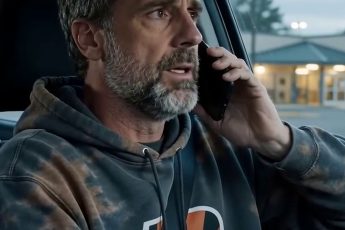
Claire hit the gas a little harder than she meant to on I-5 north of Salem. The speedometer jumped to eighty-two before she eased off. Her sister’s text was still glowing on the passenger seat: *“How’s the surprise going? Send pics!”* Claire hadn’t answered. She’d been driving for four hours now, and the only thing she’d decided was that she wasn’t going to spend another night in Portland. Not in this city. Not after this morning.
It was supposed to be the kind of thing people tell their grandkids. Claire had taken a half day off from the veterinary clinic in Eugene, Saturday shift, Dr. Patel telling her to go, go, the animals would survive one afternoon without their favorite tech. She’d loaded the trunk with a key lime pie from Sweet Life—Melissa’s favorite, the one she always begged Claire to bring when she visited—and a wrapped gift bag with a vintage record she’d found at House of Records: Joni Mitchell’s *Blue*, first pressing. Melissa had talked about that album for years, said it was the only thing that got her through her divorce in 2019. Claire had driven the whole way smiling at the thought of Melissa’s face when she saw her. Melissa, who’d been her roommate at Oregon State, who’d held her hand in the emergency room when Claire’s appendix nearly burst junior year, who’d called her every single Sunday for eleven years no matter what.
She’d pictured it a hundred times: the little bungalow on SE Clinton, the one with the blue porch and the overgrown rose bushes. She’d knock, Melissa would open the door in her paint-splattered overalls, and her glasses would fog up when she started crying, because Melissa always cried, happy or sad, didn’t matter. Claire had her phone camera ready for that moment.
What she got instead was Daniel.
She should have known. The signs were all there, if she’d been willing to look. Daniel said he had a work conference in Seattle. Left Thursday morning, said he’d be back Tuesday. Claire had kissed him at the door and told him to drive safe. She’d even packed his laptop charger in the side pocket of his duffel. He’d texted her from the convention center, sent a photo of a sad-looking hotel conference room with a slide projector and rows of empty chairs. She’d told him she loved him, and he’d written back: *“Miss you already.”* Miss you already. She’d read that text three times, standing in the kitchen with her phone in one hand and a half-eaten yogurt in the other, wondering why it felt like a line he’d used before.
She didn’t knock. She had a key. Melissa had given it to her years ago, when Claire was going through her own rough patch and needed a place to crash for a month. Claire had kept it on her keychain out of habit, next to the key to the clinic and the key to Daniel’s Ford. This morning, she turned it in the lock and pushed open the door, calling out, “Happy birthday, Mel!” in her best singing voice.
The house smelled like coffee and something else. A man’s deodorant. And then Daniel came out of the bedroom. He was wearing the gray Oregon State sweatshirt Claire had bought him for Christmas. His phone was in his hand. He stopped dead in the hallway, and his face did the thing it always did when he was caught—like when she’d found the receipt for the necklace he’d bought her that she wasn’t supposed to see, except this wasn’t a birthday present. His mouth opened, closed, opened again.
“Claire,” he said. Just her name. Like he was reading it off a chart.
Melissa appeared behind him, knotting the belt of a robe Claire had never seen before. Her hair was wet. Her feet were bare. And the sound she made—a tiny, strangled “oh”—was worse than if she’d screamed.
Claire didn’t think. She set the pie down on the entryway table, nice and careful, like it weighed fifty pounds. The gift bag stayed in her hand. She looked at Daniel. She looked at Melissa. Then she looked at the framed photo on the wall behind them: the two of them at graduation, arms around each other, twenty-one and sure the world was theirs.
“How long,” she said. It wasn’t a question. It came out flat, like she was asking a client about their dog’s vaccination history.
Daniel ran a hand through his hair. Melissa opened her mouth.
“How long,” Claire said again, and this time she did look at Melissa.
Melissa’s chin trembled. “Since January.”
January. Claire did the math in her head. Seven months. Seven months of Sunday phone calls, of Melissa asking how Daniel was doing, of Daniel saying he was exhausted from work, of Claire lying in their bed in Eugene thinking she had the most boring, stable, wonderful marriage in the world. Seven months of lies.
She didn’t scream. She didn’t cry. She just said, “Okay,” and turned around and walked out. Daniel called after her, said, “Claire, wait!” and she heard his bare feet on the hardwood behind her, but she didn’t turn. She got in her car and drove.
Now she was halfway back to Eugene, and the radio was playing some song she didn’t recognize, and her coffee was cold in the cup holder. She wanted to cry. She wanted to pull over and beat her hands on the steering wheel. But mostly she wanted to know what she was going to say when she walked into their house—his house, now—and started packing.
Her phone buzzed again. She’d put it on silent after the twentieth call. The screen lit up with a message from Daniel: *“Please come back. We can talk about this.”* She didn’t answer. She’d already decided what she was going to do, and she was going to do it with clean hands and a clear head.
—
The house smelled like him. Like cedar and coffee and the lavender laundry detergent she bought at Bi-Mart. Six years of her life in these walls, and she walked through it like a stranger. The kitchen clock read 6:47. Daniel had left his coffee mug in the sink that morning—he was always in a hurry, always leaving the last inch of coffee to go cold. She used to wash it out without thinking. Now she left it there.
She went to the bedroom and pulled her suitcase down from the top shelf of the closet. It was the one she’d taken on their honeymoon to Cannon Beach, the one with a broken wheel that made it wobble. She dragged it onto the bed and started opening drawers.
She didn’t take everything. Just the things that mattered. Her clothes, her shoes, her mother’s opal ring. Her passport, her Social Security card, the deed to the house—no, wait. The deed was in both their names, wasn’t it? She’d have to deal with that. She’d have to deal with so much. But not tonight. Tonight, she just needed to get out.
The front door opened. She heard it from the bedroom—the creak of the hinges, the jingle of keys, Daniel’s heavy footsteps in the hallway. Her heart did a quick, sharp kick. She kept folding a sweater.
He appeared in the doorway. His face was pale, and his eyes were red, like he’d been crying. Good, she thought. Let him cry.
“Claire,” he said, and his voice cracked. “Please. Just hear me out.”
She didn’t look at him. She folded another sweater, laid it flat in the suitcase, smoothed the fabric twice with her palm. “I’m leaving, Daniel.”
“I know. I know you are. But I need you to understand—” He took a step into the room, and she held up a hand.
“Don’t.”
He stopped. His hands hung at his sides, useless. “It wasn’t supposed to happen. She was just… I was lonely, and she was there, and I know that’s not an excuse, but I never meant to hurt you.”
Claire closed the suitcase. She zipped it up. The zipper caught on a sleeve, and she yanked it harder than she meant to. The sound was loud in the quiet room. “You didn’t mean to hurt me,” she repeated. “You just spent seven months lying to me. About where you were. About who you were with. About Seattle. About everything.”
“I was going to tell you,” he said.
“When?” she asked, and now she did look at him. “On Melissa’s birthday? Or mine? Were you going to send me a card? ‘Sorry I cheated on you with your best friend—happy anniversary.’” Her voice didn’t shake. She was proud of that.
Daniel flinched like she’d thrown something at him. “That’s not fair.”
“Fair?” She laughed, and it was a dry, ugly sound. “You want to talk about fair? I packed your laptop charger. I told you to drive safe. I texted you every night, and you texted back from her house. And you want to talk about fair?”
He opened his mouth, closed it. The clock in the kitchen ticked. Daniel’s phone buzzed in his pocket, and he ignored it. Claire could guess who it was.
She picked up her suitcase. The broken wheel scraped against the hardwood as she dragged it toward the door. Daniel stepped aside, and she walked past him. In the hallway, she stopped at the mirror. She didn’t look away. She looked at her own face—the tired eyes, the unwashed hair, the set of her jaw—and she thought: *You’re not going to fall apart. Not in front of him.*
She turned left at the front door. Daniel followed her, saying her name, saying he loved her, saying they could work it out if she just stayed. She didn’t stop. She walked to her car, popped the trunk, and lifted the suitcase inside with a grunt. Then she walked around to the driver’s side.
“Claire.” He was on the porch now, the porch they’d repainted together two summers ago, the color she’d picked out at Miller Paint: Deep Ocean Blue. “Please. Tell me what I can do.”
She looked at him over the roof of the car. Her keys were in her hand. The one to the house, the one to the clinic, the one to the Ford. She worked the house key off the ring. It took a moment—the metal was cold and slippery—but it came loose. She held it up.
“I’m going to the credit union tomorrow,” she said. “I’m taking my half of the savings. The forty-six thousand. It’s in our joint account, and I have every right to it.”
Daniel’s face went slack. “What?”
“And I’m hiring a lawyer. I’m not going to fight you for the house, but I’m not going to pay your half of the mortgage while you figure out whether you want to be married to me or my best friend.”
She tossed the key. It landed on the porch with a small, bright clink, bouncing once before settling at his feet. He stared at it like it was a live grenade.
“You can have the house,” she said. “I don’t want to live in a place where I was the last one to know.”
She got in the car and started the engine. The radio came on, some song she didn’t know, and she turned it off. Daniel was still standing on the porch, holding his phone in one hand and nothing in the other. She backed out of the driveway, and the last thing she saw in the rearview mirror was him bending down to pick up the key.
—
She drove to her sister’s place in Springfield. Haley answered the door in her bathrobe, her hair in a messy bun, her face bare and soft with sleep. “Claire? What’s wrong?”
Claire stood on the porch, suitcase at her feet, and said, “Daniel’s been sleeping with Melissa.”
Haley’s eyes went wide. Then she pulled Claire into a hug so tight it hurt, and Claire finally let herself cry.
Later, after Haley had made tea and Claire had told her everything, the two of them sat on the couch in the dark. The TV was on with the sound down, some late-night infomercial about a blender that could also make soup. Haley had her feet tucked under her, and Claire was wrapped in a blanket that smelled like their childhood home, like fabric softener and their mother’s perfume.
“What are you going to do?” Haley asked.
Claire took a sip of tea. Her hands were steady now. “I’m going to the credit union at nine. I’m taking my half of the savings. Then I’m calling a lawyer.”
“Good,” Haley said. “And then?”
Claire thought about it. She thought about the little bungalow on SE Clinton, the one with the blue porch. She thought about Joni Mitchell’s *Blue* still sitting in the gift bag on Melissa’s entryway table. She thought about the pie. She wondered if they’d eaten it. She wondered if it was good.
“Then I’m going to find an apartment,” she said. “Somewhere with a view. Somewhere that’s mine.”
Haley reached over and squeezed her hand. “You can stay here as long as you need.”
“I know,” Claire said. “Thank you.”
The next morning, Claire walked into the Oregon Community Credit Union on Coburg Road at 9:04. The teller, a woman in her fifties with reading glasses on a chain, asked if she needed help with anything else. Claire said no, she just needed to close the joint account and open a new one in her name. She filled out the paperwork with a pen that kept running out of ink, and she signed her name seventeen times. When she walked out, she had a cashier’s check for $46,000 folded in her purse.
At 10:32, she called a divorce attorney. The receptionist asked if she had a preference for a male or female attorney. Claire said it didn’t matter, as long as they were good.
At 2:15, she toured a one-bedroom apartment near the university. It had a small balcony and a kitchen with a window over the sink. The landlord said the previous tenant had left behind a plant, a spider plant in a ceramic pot, and Claire said she’d take it. She wrote a check for the deposit. She didn’t even look at the amount.
That evening, her phone rang. She’d taken it off silent, because Haley needed to reach her. The caller ID said Melissa. Claire let it ring. Then she blocked the number. She did the same for Daniel. She didn’t write them a message. She didn’t need to. The lawyer would send the papers soon enough.
She went out to the balcony, where the spider plant was already drooping in the evening sun, and she sat in the one folding chair the previous tenant had left behind. The air smelled like dry grass and car exhaust and the faint, sweet scent of someone’s barbecue. The sound of traffic on Franklin Boulevard was steady, like a heartbeat.
Claire pulled out her phone again, but this time she didn’t look at the blocked calls. She opened her banking app and looked at the balance in her new account. Forty-six thousand dollars. Her mother’s opal ring was in a pouch in her suitcase. Her keys were in her pocket—the one to the clinic, the one to her new apartment, the one to a car that was, for the first time in six years, entirely her own.
She went inside, filled a glass with water at the sink, and watered the plant. Then she turned off the overhead light and went to bed, leaving the blinds open so she could watch the headlights moving along the street below. She didn’t feel brave. She didn’t feel free. She felt like a person who had lost everything and was still standing, which was, she supposed, the same thing.
And she slept.