The permission slip came home on a Tuesday, folded under a half-eaten granola bar at the bottom of Maya’s backpack. I almost missed it.
Cheap copier paper, still warm from riding against her spine all day. I remember that part.
Maya is eleven. Fifth grade. She can tell you the difference between a brachiopod and a clam shell from across a room. She loves trilobites the way other girls love pop stars.
Last year, the class went to the natural history museum in Columbus. Maya spent the day in the school library with a teacher’s aide and a stack of laminated cards about fossils. When she got home, she listened to her best friend Ava describe the dinosaur hall for forty minutes. Maya sat on the couch, feet dangling, face blank.
The year before, the class toured a cave. Maya watched a documentary in the school van.
I know the pattern. I can recognize the way she shuts her face off when she hears the other kids laughing about something she didn’t see.
This year’s trip: Hocking Hills State Park. The gorge trail. Old Man’s Cave, the waterfall, the fossil wall. Her thing.
The note at the bottom of the permission slip said: “The trail is not accessible by wheelchair. Maya is invited to participate in a separate educational program at the nature center with a park naturalist.”
I read that sentence three times. Then I read it again.
I went to the school the next morning. I didn’t call first. I walked into Principal Warren’s office at 7:35, before the buses arrived. I carried a red binder — trail map, the park’s accessibility page, and a printed manual for a hiking child carrier I’d found online.
Ms. Warren started with liability. She always starts with liability.
“I understand,” I said. “I’m not asking the school to pay for anything. I’m asking for one adult to volunteer to carry her.”
“That’s a lot to ask of a staff member, Dani. And if something were to happen—”
The door was half open. I heard the jingle of keys before I saw him. Tomás Garza, the custodian. Nine years at Logan Elementary. I’d seen him fix the handle on Maya’s classroom door. He was in the hall, emptying a trash can. He didn’t knock. He just leaned in.
“Sorry,” he said. “I was, uh—” He cut his eyes toward Ms. Warren. “I heard about the trail thing. I’ve hiked that gorge a hundred times. I was in the Army. I carried heavier than a fifth-grader over worse ground.”
Ms. Warren opened her mouth.
“I’m not her teacher,” Tomás said. “I’ll do it off the clock. Volunteer. My own carrier, my own truck.”
I looked at him. Paint on his boots. A small scrape on his forearm. A key ring the size of a fist.
I said, “Tomás, you don’t have to.”
He said, “Ma’am, I used to carry my own son in one of these after he broke his leg in football. I know the straps.”
The room went still for a second. I could hear the first bus pulling up outside.
That’s when Maya’s voice came back to me. I’d already talked to her about the trip, before I went to the school. She’d said, “I just want to have the same story to tell on Monday.”
The day of the trip: May 16, a Thursday. I woke at 5:20. Biscuit, our beagle, followed me into the kitchen. I packed Maya’s lunch — a turkey sandwich, a green apple, a Sprite. I put a granola bar in her backpack. Then I stood at the sink and pressed my hands flat against the cold edge of the counter.
That’s the only way I know to keep them from shaking.
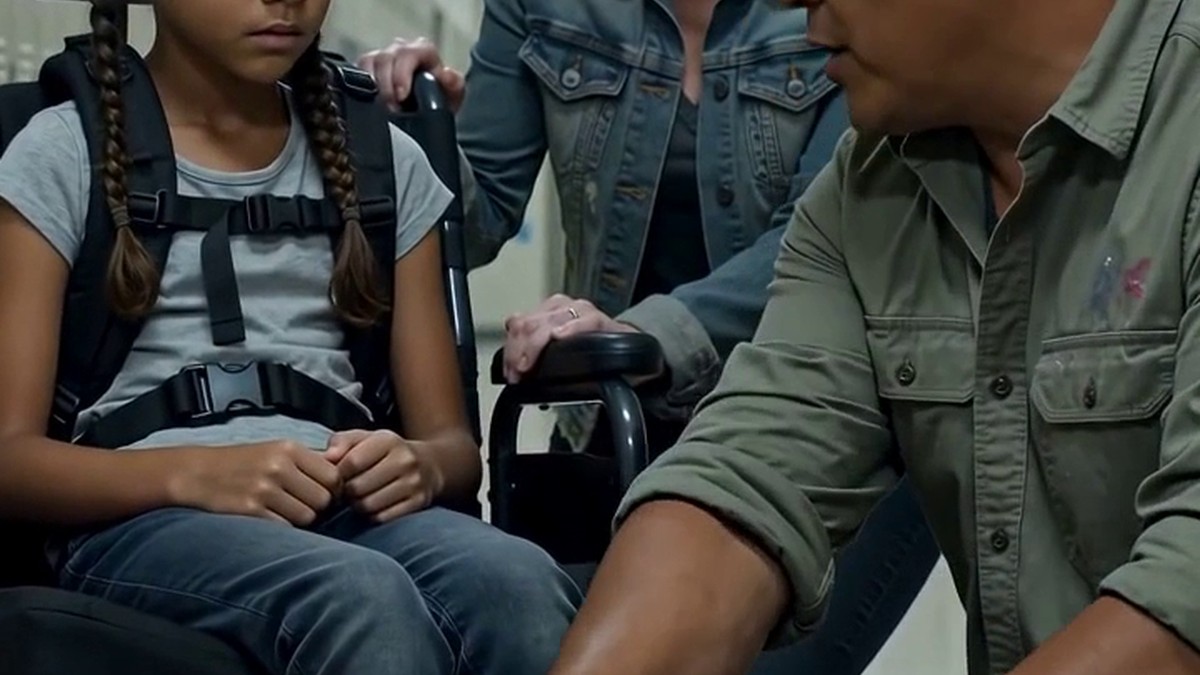
At school, Tomás was already there. The carrier was in the back of his pickup — a black metal frame with a padded seat and a five-point harness. He tested the buckles. He adjusted the straps. Maya wheeled herself over. She looked at the carrier. Then she looked up at me.
I opened my mouth to say something. Be careful. Hold on. Don’t let go.
She said, “Now I’ll have the same story on Monday.”
Tomás lifted her into the carrier. I watched his hands — steady, gentle. He tightened the chest clip.
“You good, kid?”
She said, “Let’s go.”
We drove to the park. My car behind the bus, Tomás’s truck in front. I watched the back of his truck the whole way, watching the carrier bounce. I counted the mile markers on Route 664. There was a sign for a flea market. I thought about how I’d bought Maya a dinosaur toy there when she was five, before the wheelchair.
The trailhead. The air smelled like wet rock and green things. The kids piled off the bus. Tomás was already in the carrier, Maya on his back. The other fifth-graders were chattering, but when they saw her, they stopped for a second. Ava said, “Maya, you’re about to be taller than all of us.” Maya laughed.
We started down into the gorge. The path was narrow, roots and stones. Tomás moved with care, not rushing. I stayed behind, close enough to see the back of Maya’s head. Her braids. Her fingers curled around the carrier’s edge. Her knuckles were white.
At the steep wooden staircase — the one the permission slip warned about — Tomás stopped. The kids had already gone down. They were at the bottom, looking up.
“You hold on to my shoulders, Maya.”
She did. He went one step at a time. His boot scraped the edge of a step. I stopped breathing. My hand went to my phone in my pocket.
Maya said, “I can see the waterfall from here.”
At the bottom, Ava handed Maya a water bottle. The kids all moved toward the rock wall where the fossils were. Maya pointed at an impression in the sandstone.
“That’s a trilobite.”
A boy named Connor took a picture with his phone. The same picture everyone else took.
I stood back, near a fern. The waterfall was loud. I pressed my fingers against a tree trunk to keep them from shaking. I was tired in a way that had nothing to do with the hiking.
On the way back, Maya didn’t talk. Not the shut-down silence. A tired, satisfied silence. She fell asleep in the car on the way home. Her head against the window. Biscuit met us at the door.
Two days later, I went back to the school. I had a check in my pocket. I’d been saving for a specialized wheelchair stroller for Maya — one of the ones that can handle trails. Cost: $2,800. I’d been putting away forty dollars a week.
I walked into Ms. Warren’s office. She looked up from a stack of paperwork. She didn’t say anything.
I wrote the check. $2,800. Memo line: “Hiking carrier for any student who needs one.”
I slid it across the desk.
“Cancel the separate accessible excursion,” I said. “Use this to buy a second carrier. And next year, when another kid can’t walk the trail, find a Tomás.”
Ms. Warren picked up the check. She had it between her fingers, reading the numbers. She opened her mouth. Then she closed it.
I turned and walked out. I didn’t look back.
In the car, I sat in the driver’s seat for a minute, looking at the chip in the windshield. A small star-shaped crack, bottom right. I’d been meaning to fix it for six months.
I started the engine and drove home to my daughter.