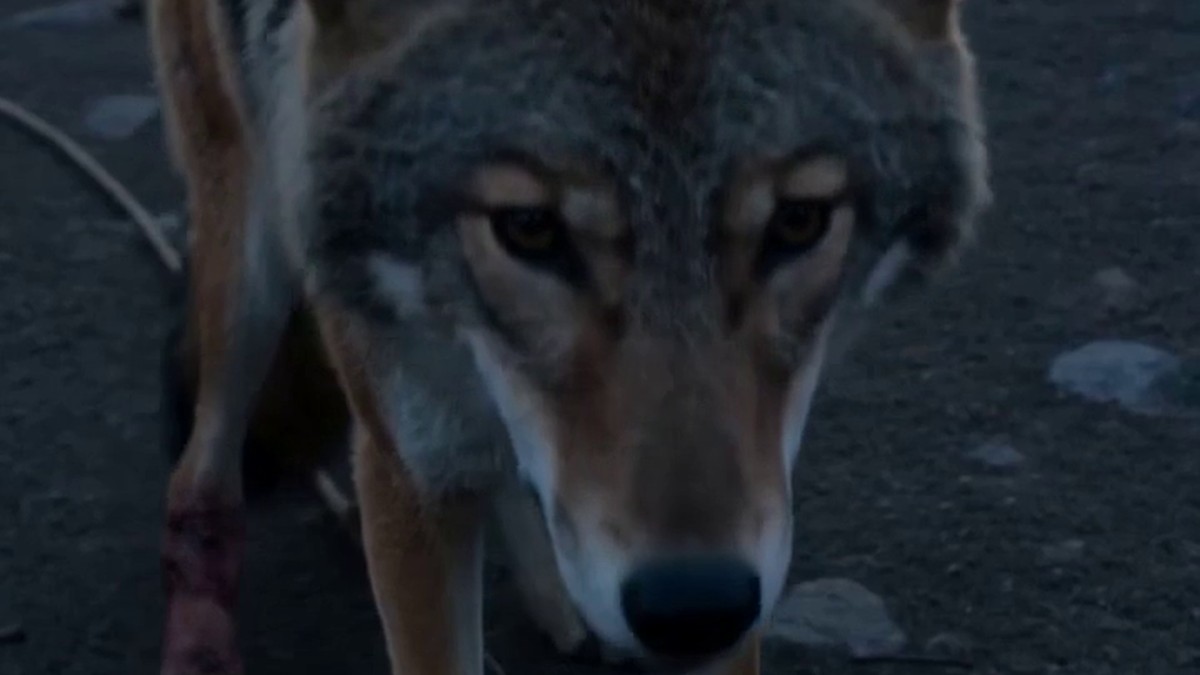
The line bit into my leg a half-mile above the creek. I’d been trying to shake it for two days. A length of neon-orange climbing rope, the kind weekenders leave tangled in the underbrush, had cinched tight around my right foreleg just above the paw. It sawed into the joint with every step, and the paw had swollen to twice its size, the pads cracking. I couldn’t hunt. I’d tried to drink from a seep at dawn, and the weight of my own body had made the leg buckle.
By the third evening, I was moving down toward the valley trail not from any plan—I was too tired for that. Just downhill. Less weight. The air was thick with the smell of my own wound-sweetness, and I remember thinking, *Five more strides, then you can stop for good.* That was the kind of math I was doing, a hollow-belly calculation that had nothing to do with hope.
This particular trail carried a stale human smell, sun-baked gravel and something chemical from the soles of their shoes. Normally I’d arc wide and stay in the shadow line. But the leg dictated the path now, and the path dumped me out twenty yards from a figure stopped dead in the middle of the track.
A female. Stock-still. Both her hands locked on the handle of one of those little rolling nests they push their pups in.
I stopped too. Not because I wanted to. The leg sent a shock of pain up into my shoulder, and I froze in the open. She hadn’t seen me yet; she was stooped over the rolling nest, fussing with the blanket tucked around her pup. Then a gust shifted and underneath the stale shoe-smell something hit me square.
Yellow.
That’s not a thing I can explain to a creature without a nose. It wasn’t the color itself—it was the *memory* of a color, the way a particular shade can live inside a scent and call up a place and a time all at once. The blanket tucked around the pup in that rolling nest was the exact butter-yellow of a scarf I’d encountered years ago. A tiny human, a female pup, had dropped it near a flat rock where her family was eating. I’d crept close out of sheer confusion—what was this small, loud thing doing in my stretch of forest?—and she’d stuck her fingers out toward my nose like I was a dog she expected to lick them.
I’d smelled those fingers. Clean, milk-sweet, the faint salt from whatever she’d been eating. Then the adults had shouted and I’d backed off, but the yellow scarf stayed where it lay. Eventually I carried it off—soft thing, good for nothing but holding a smell—and dropped it near a garden gate I passed on my rounds.
Now here was that smell again. Same yellow. Same milk-sweet warmth radiating from the nest.
I took a step forward. The leg screamed. The female’s head snapped up. I saw the calculation flash through her body—*predator, three-legged, too close*. Her knees started to buckle, then locked, the tendons jumping beneath the skin like startled mice. The handle of the rolling nest groaned under her grip. I could smell the adrenaline pouring off her, sharp as chewing a copper coin, and beneath that a soured note of a mother jammed between fleeing and attacking. She made a sound, a cracked little bleat that was half threat, half plea, and I realized I’d been hearing it for a solid two seconds before my brain caught up.
A lesser creature would’ve taken advantage. I’ve seen coyotes work that math—*if it freezes, it’s food*. But I wasn’t hunting. I was three days hungry on nothing but stream water and a handful of beetle grubs, dragging a useless paw through pine needles with a smell in my nose that belonged to a summer four years gone. The female’s terror was a wall between us, but the yellow scent cut straight through it, and my legs kept going.
She jerked the nest backward. A wheel caught on a root, the whole thing tipped for half a heartbeat before rocking upright, and the pup inside stirred. One tiny arm wormed free of the yellow blanket, fingers curling and uncurling at the cooling evening air.
I put my nose over the edge.
The fingers smelled exactly the way I remembered. Milk, salt, the faint talcum softness humans dust their young with. I inhaled once, slow. The pup’s eyes opened—clear gray, unafraid in that way only the very new can manage—and her mouth stretched into a gummy, spit-shiny grin.
I sat down.
It wasn’t a performance. The leg simply gave out. But sitting next to the nest apparently told the female something, because her breathing, which I’d been tracking in little half-gasps, deepened. She still reeked of fear, but the edges softened, and she stopped making the rabbit-bleat. Her eyes dropped to my leg and widened.
She reached into her pocket and pulled out a tiny metal object—one of those folding tools they use on their claws. A nail file. She set it on the dirt between us and backed away three steps, hands raised and empty.
I understood the offer: *I see the problem. Here’s a sharp edge. Figure it out.*
It took me a minute. A nearby stone had a rough, angular face where the granite split. I dragged the rope across it, bracing the file against the rock. On the fourth pass the nylon frayed. On the seventh, it snapped. Blood surged back into my paw like hot water through a thawing stream, and I shook out the leg, flexing, digging my claws into loam. The joint rolled without a hitch.
The female hadn’t moved. Her shoulders were shaking, and her face was wet, but she stayed planted between me and the nest with her hands still half-raised, trembling. She was making a low keening noise I’d heard from a cornered rabbit, and just like a rabbit, she wouldn’t run. That pulled at something in my chest, a thing I didn’t need to name. I held still and let the wind carry my own scent to her—not the rank of a starving beast, but the dry musk of a creature that had already decided to leave. She didn’t flinch.
I turned and vanished into the tree line, walking on four good legs for the first time in two days.
The next morning, I carried the yellow scarf back.
Not the same scarf—I have no idea what happened to the original. This one belonged to a different pup, a small human I’d watched from a ridge two winters ago, who’d left it draped over a fence post near the ranger station. I’d kept it in a hollow log for reasons I couldn’t name. Maybe I’d always meant to return it. Maybe the scent had just been good company.
I dropped it on the stone path leading to the female’s garden gate. The yellow was faded almost to cream, and my tracks—clear, four-footed, no drag mark—led back up toward the ridge.
A week later, the gate was still. The nest was gone from the trail. But on a morning when the mist hung low and the pine needles were slick with dew, I passed within thirty yards of the garden and caught a shift in the air. The female was there, standing on the path, the old scarf cradled in both hands. She didn’t see me. But her scent had none of the copper-sharp tang it’d carried that evening. It was steady, warm, and threaded through with the same milk-and-talcum note I’d first caught in the rolling nest.
The pup was somewhere nearby. I could hear her making those experimental half-sounds—not crying, just testing the air with her voice, the way pups do when they’re full and dry and safe.
I stayed until the mist burned off. Then I went up to the high ridge where the creek starts, found a patch of sun-warmed granite, and lay down. The leg had healed clean; I stretched it out and pressed my pads flat against the stone, feeling the heat sink into the bone. Below, the wind carried up a thread of that tiny voice, and underneath it, milk and talcum, faint as dust on a dry day. I let my eyes close.