Cassie Nolan hadn’t smelled butter in three years.
Not real butter, anyway—the kind that sizzles in a copper pan and curls into the air thick enough to taste. Her last memory of it was a foster mother’s kitchen in Oakland, right before social services moved her again. She’d been seven. The woman had let her lick the spoon.
Now Cassie stood outside The Golden Fig on Montgomery Street, a restaurant where the lunch special cost what she’d made in two weeks of panhandling near the Embarcadero. Rain matted her hair to her forehead. Her sneakers had split at the toe, and the cardboard sign she’d tucked inside her jacket—*anything helps, god bless*—was soaked through.
She hadn’t eaten since Tuesday. It was Friday.
The maître d’ eyed her through the glass, but Cassie was already slipping past a departing couple in Burberry coats. Warm air wrapped around her like a promise she didn’t trust. Chandeliers dripped light onto white linen, and every fork clink made her stomach contract.
She spotted the woman immediately.
Silver-blonde hair swept into a low twist, a navy blazer that probably cost more than any apartment Cassie had ever slept in, and a plate of pan-seared halibut with roasted asparagus. The fish was half-eaten. Two untouched ciabatta rolls sat beside the butter dish, and the woman was already pushing her chair back.
Cassie crossed the dining room before the shame could catch up.
“Ma’am.”
The woman looked up. Her eyes were the color of a winter sea—gray with just enough blue to hold the light.
“I’m sorry,” Cassie said, and her voice cracked on the last syllable. “I know this is… You’re leaving. The bread and the fish. Could I— I haven’t eaten in three days.”
Silence spread from the nearest tables like a stain.
A waiter froze mid-step. Two women in pearls stopped whispering. Cassie’s face burned.
“Forget it,” she muttered. “Never mind.”
She turned.
A hand clamped around her arm. Not the woman’s—it belonged to a thin, balding man in a suit too tight across the shoulders. Cassie recognized him: Derek Poole, the floor manager. He’d chased her off the patio twice last month.
“Out,” he hissed. “Now.”
“I’m going.”
“You should never have come inside.”
“Let her go.”
The command didn’t rise in volume, but it cut through the room like a blade.
Derek’s grip loosened.
The silver-haired woman had risen from her chair.
“Mrs. St. Clair,” he stammered, “I apologize. This woman has loitered near our property before.”
“She asked for food.”
“She’s harassing our guests.”
“She’s *my* guest.”
Derek blinked. “Excuse me?”
“Bring a chair. And a fresh place setting.”
Cassie swayed. “Ma’am, I only wanted what you were throwing out.”
The woman—Mrs. St. Clair—pulled out the chair herself. “And I’m offering you a meal. Sit.”
The chair arrived. A waiter laid down a linen napkin folded into a fan. Cassie’s hand trembled as she reached for the bread. She tore off a piece, stuffed it into her mouth, and the yeasty warmth hit the back of her throat so hard her eyes watered.
Mrs. St. Clair looked out the window.
“What’s your name?” she asked, after Cassie had swallowed.
“Cassie. Cassie Nolan.”
“How old are you, Cassie Nolan?”
“Twenty-two.”
Mrs. St. Clair’s hand paused over her water glass. Just for a second.
“And you’ve been on the street long?”
“Since I aged out of the system. So almost five years.” Cassie scooped a bite of halibut, trying not to inhale it. “I’m sorry. I know I look like something the rain dragged in.”
“You look like you’re starving.”
“I wasn’t fishing for compliments.”
A small, crooked smile tugged at the older woman’s mouth. “My name is Helena St. Clair.”
Cassie nearly choked on an asparagus spear.
Even someone who’d spent the last four winters sleeping under overpasses knew that name. St. Clair Properties owned half the high-rises in the financial district, plus hotels, shopping centers, and the entire Bay View Marina development. Forbes had run a profile on her the year before: “The Iron Magnolia of Northern California.”
“You’re *that* Helena St. Clair?” Cassie wiped her mouth with the back of her hand.
“Regrettably.”
“Why are you eating alone?”
Helena didn’t answer right away. She pushed her own plate to the side, untouched.
“Some days, company is harder to find than you’d think.”
Cassie studied the room—the businessmen ignoring their partners, the couples glued to phones—and snorted. “Rich people table for one. Tragic.”
Helena laughed. It was a dry, brittle sound, like someone who’d forgotten how.
“You don’t mince words.”
“Starving will do that. Removes the filter.”
Helena signaled the waiter. “Bring her the soup, the steak frites, and the chocolate mousse. Also a glass of orange juice. Make it two.”
“I can’t pay.”
“You don’t need to.”
Cassie didn’t argue. When the steak arrived, she sliced into it like she was sawing through three days of emptiness. Juices ran pink across the plate, and the salt made her scalp prickle.
Helena watched, her expression unreadable.
Then Cassie reached for her glass.
Her sleeve slid back.
Helena’s breathing stopped.
The mark was small—a pale, crescent-shaped scar on the inside of Cassie’s left wrist, barely visible against her wind-chapped skin. But Helena saw it. And Cassie saw her see it.
“What?” Cassie jerked her arm back. “It’s just an old scar. I’ve had it since I was a baby.”
Helena’s voice came out thin. “May I see it?”
Cassie hesitated. Then she extended her wrist.
Helena’s fingers hovered, not quite touching, as if the scar might vanish if she breathed wrong.
“Where did you get this?”
“No idea. Pediatrician told my last foster mom I probably grabbed a hot grate. I was less than a year old.”
Helena’s whole body went still.
“What’s the matter?” Cassie asked.
Helena reached into her collar and pulled out a thin gold chain. A tiny locket dangled from it, no bigger than a thumbnail. She thumbed it open.
Inside, a photograph.
A newborn with a freckle on her left cheek and a bandage wrapped around her tiny wrist.
Cassie stared at the picture. Then at her own wrist.
The scar curved in exactly the same crescent shape as the covered wound in the photo.
“That’s you?” she whispered.
Helena shook her head slowly. “That’s my daughter.”
Her voice splintered.
“She died twenty-two years ago. I buried her.”
The clatter of the restaurant faded to a hum. Cassie’s fork slipped from her fingers.
“I don’t… I don’t understand.”
Helena slipped the chain over her head and placed the locket on the table between them. Her eyes were wet but steady, the Iron Magnolia doing the only thing she’d never managed to do—let the mask fall.
“My husband, Arthur, and I, we spent ten years trying to have a baby. The day Sophie was born, he held her for five minutes before I started hemorrhaging. They rushed me into surgery. When I woke up, Arthur was gone. The nurse said the baby had stopped breathing in the nursery. SIDS.” She pressed her fingers to her temple. “I never got to see her. The funeral director handled everything. I buried a tiny white casket in a cemetery in Marin County. I’ve visited that grave every month for twenty-two years.”
Cassie couldn’t move.
Helena continued. “Last spring, a St. Clair employee was auditing old hospital records from the building we acquired on California Street—the former Pacific Heights Maternity Ward. We were converting it into a corporate wellness center. He found a sealed file.” She reached into her handbag and withdrew a folded photograph. The edges were yellowed. It showed a dark-haired nurse in 1970s scrubs, holding a squirming newborn with a bandaged left wrist. On the back, scribbled in faded ink: *Sophie St. Clair, transferred to NICU Bay 4, Feb 19, 2002.*
Cassie picked it up with shaking hands.
“Transferred?” she breathed. “But you said she died in the nursery.”
“She didn’t die. The same day, a baby in Bay 4 was declared deceased due to a cardiac event. No autopsy. The nurse on duty that night was a woman named Irene Nolan.”
Cassie’s mouth filled with cotton.
*Nolan.*
The name she’d carried through seven foster homes and two juvenile shelters.
Helena’s voice dropped. “The police reopened the case last August. Irene Nolan had a history of miscarriages. That night, she falsified a death certificate and walked out of the hospital with an infant wrapped in a blanket she’d knitted herself. She kept her for eighteen months before she was arrested on an unrelated fraud charge. The child was put into the system under the name she’d given her: Cassandra.”
Cassie’s vision blurred. She gripped the edge of the table, the starched linen bunching in her fist.
The locket. The scar. The photo.
And then, a single, shattering memory she’d buried so deep she hadn’t believed it was real: a dark-haired woman singing a lullaby, a room that smelled of lavender and cough medicine, and a lullaby that ended with *“…my Sophie, my heart.”* The woman had called her Sophie. Not Cassie.
“She called me that,” Cassie said, almost to herself. “In my dreams. I thought I made it up.”
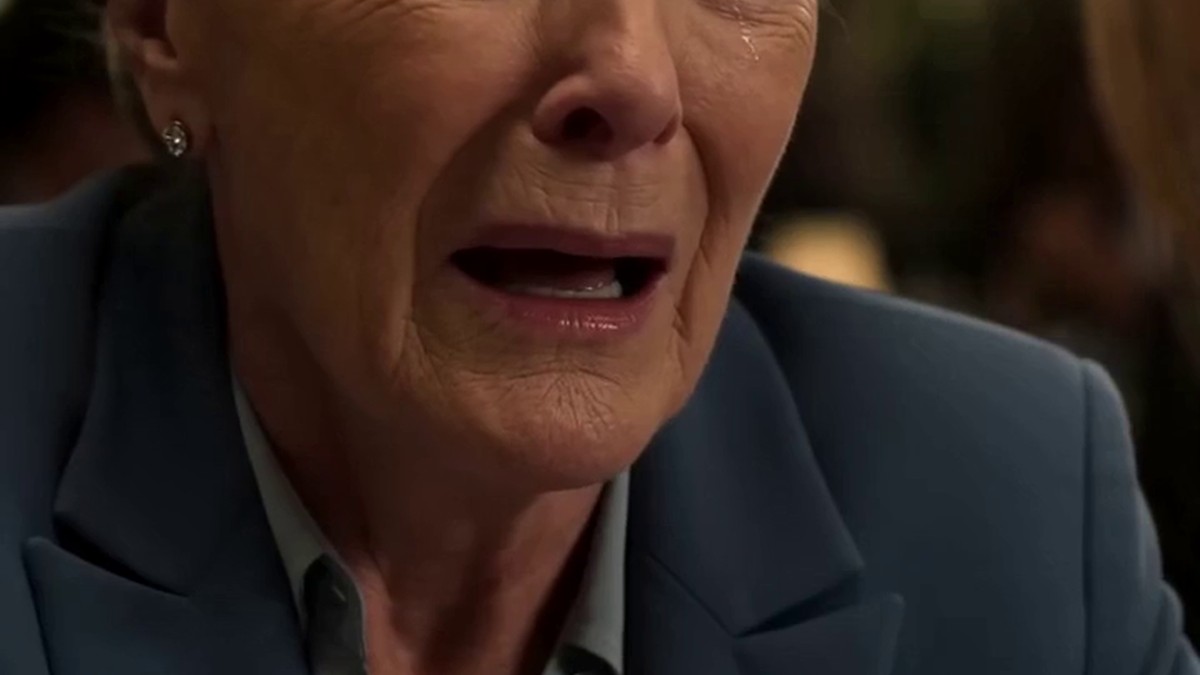
Helena’s composure finally cracked. Tears spilled down her cheeks, silent and fast.
“I thought I’d buried you. For twenty-two years, I thought I’d buried my only daughter.”
Cassie stared at the woman across from her—the mother whose grave she’d never visited because she’d never even known her own birthday. The mother who’d spent every anniversary staring at a cold stone while Cassie panhandled for quarters.
“I don’t know how to do this,” Cassie whispered. “I don’t know how to have a mom.”
Helena reached across the table and took both of Cassie’s hands in hers. The grip was firm and warm, nothing like the hesitant touch from before.
“Neither do I,” she said. “But I would very much like to learn.”
Derek reappeared, probably to ask if they needed anything else. He took one look at their clasped hands, the locket on the table, and the tears streaming down his boss’s face, and retreated without a word.
Through the window, the rain had stopped. A sliver of February sun broke through the fog, and it hit the locket’s gold surface, throwing a tiny pinprick of light onto the ceiling.
Cassie didn’t let go of Helena’s hands.
And for the first time in five years, she didn’t think about her next meal.
She thought about the house in Pacific Heights that Helena had already started describing—the room with east-facing windows, the garden full of roses, the kitchen that always smelled of butter.
And she thought about the breakfast they’d share the next morning, sitting at a table big enough for two, with no leftovers left on either plate.