The call came at 6:47 p.m. on a Thursday.
I was just turning off my laptop, the screen darkening at last after another fourteen-hour blur of spreadsheets and client emails. My tiny studio in Midtown hummed with the sound of the air conditioner. Outside, Manhattan was doing what it does. I was thinking about takeout—maybe Thai—and a glass of cheap wine. Then my phone lit up with a Vermont area code. I almost let it go to voicemail, but something made me swipe.
“Emily? It’s Marge. Next door to your grandma’s.”
A pause. Marge’s voice was low, the way people’s voices get when they’re about to knock your whole world sideways.
“Honey, I’m so sorry. Doris passed away last night. In her sleep. Real peaceful.”
I remember staring at the wall, at a crack in the plaster shaped like Florida. The words didn’t make sense. Grandma Doris. Dead.
“What?” I heard myself say. “No, I just sent her a card last month. She was fine.”
“It just happened, sweetheart. The funeral’s Monday. You can make it if you leave tomorrow.”
I said I would. I hung up. And then I sat on the edge of my bed for a long time, not crying, not moving, just feeling a weight settle in my chest like a cold stone.
My parents died when I was nine. A pileup on I-89 during a snowstorm. Grandma Doris drove all night from her little farm in the Northeast Kingdom to claim me. She showed up at the social worker’s office in a puffy down coat that smelled of woodsmoke, knelt down to my level, and said, “Well, Emmy. Looks like it’s you and me now. Let’s go feed the chickens.”
And that was it. She raised me. In a farmhouse with a sagging porch and a roof that leaked when the wind blew just right. She taught me to drive a tractor before I could legally drive a car. She’d read me old letters from my grandpa, who died in Vietnam before I was born. She made rhubarb pie that could make you weep. She was tough and quiet and she never once made me feel like a burden.
But then I got a scholarship to NYU. Then a job at a consulting firm. Then a better job. Then a promotion. The visits back to Vermont went from once a month to twice a year, then just Christmas. Then it was cards. Birthday cards, Easter cards, a generic “Thinking of You” with a sunflower on it. I always meant to go. I really did. But the city swallowed me whole, and I let it.
Last time I saw her was four years ago. I stayed two nights, spent most of it answering emails on my phone while she sat beside me, shelling peas in silence. I left early on Sunday morning to beat traffic. I didn’t even say goodbye properly. She was still asleep. Or I thought she was.
Now I was booking a flight to Burlington, packing a black dress I never wanted to wear, trying to remember the sound of her voice.
I flew out Friday morning. Red-eye, middle seat, somewhere over Pennsylvania I finally let myself cry. Then I rented a Subaru and drove north on winding two-lane roads, past stands of sugar maples and old stone walls. I’d forgotten how quiet it got up here. How the mountains just stand there, not caring about anything.
The farmhouse came into view around noon. Smoke rose from the chimney. The yard was muddy, dotted with chickens scratching in the dirt. For a second I thought, who’s feeding the chickens? And then I saw her.
She was on the front porch, in her old rocker, a metal bowl of potatoes on her lap. Faded flannel shirt. Jeans held up with a piece of twine. Her white hair pulled back in a clip. She was peeling a potato, the knife moving slow and steady. Alive.
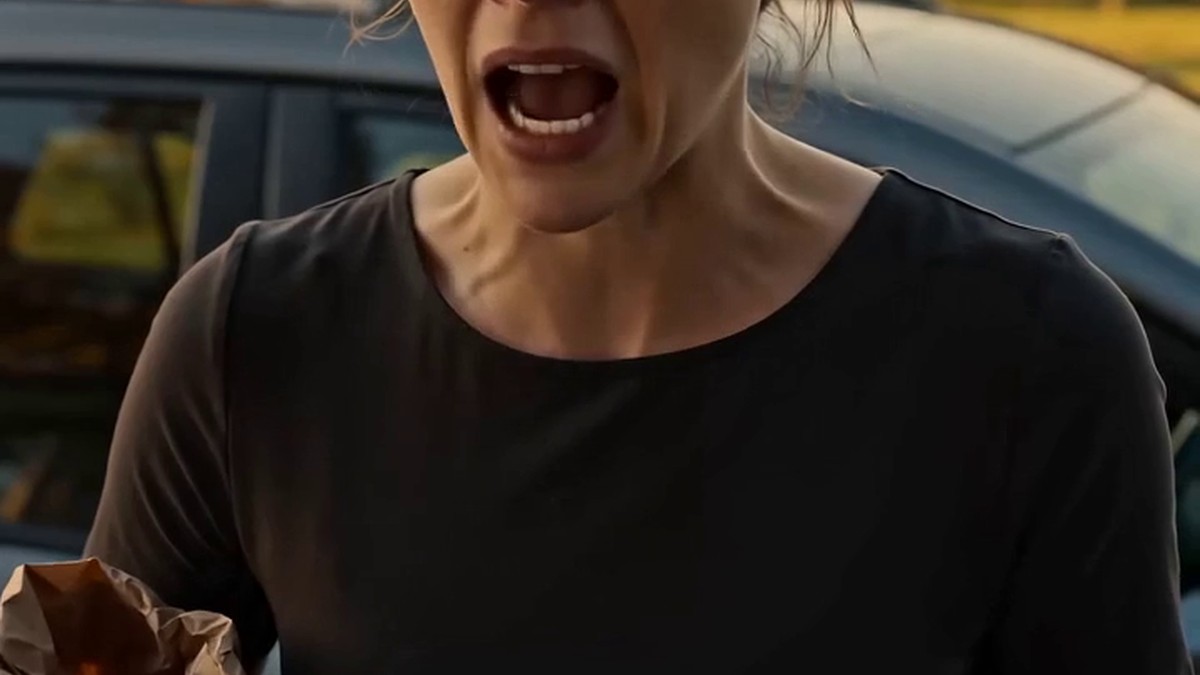
I slammed the brake. The engine died. I stumbled out of the car, my purse dropping into a puddle, the paper bag of chocolates I’d grabbed at the airport splitting open. Truffles rolled across the gravel. The chickens went nuts.
She looked up, squinted into the sun, and then a slow smile cracked her face.
“Well, look who decided to show up.”
My mouth opened. Nothing came out. She was there. Breathing. Peeling a potato.
“You—” I finally managed. “You’re supposed to be dead.”
Grandma Doris set down the potato. “Marge called you, I take it.”
“Yes! She said you died! I flew across half the country, I took bereavement leave, I’ve been crying my eyes out for two days and you’re here making dinner!”
She wiped her hands on her jeans, stood up slow. “I asked her to say that.”
I felt the ground shift. “What?”
“I asked Marge to tell you I’d passed. Figured it was the only way you’d set foot on this farm again.” Her voice was calm, but there was a tremor in it I’d never heard before. “Was I wrong?”
I just stood there, my throat closing. Because I knew the answer. If she’d called and said, “Emmy, I miss you, could you come up?” I’d have said sure, Grandma, as soon as this project wraps up. And then another project would come. And another. And she’d still be waiting.
“I’m eighty-two years old,” she said. “I ain’t got a lot of autumns left. And I didn’t want to die without seeing your face one more time. Not a picture on your Instagram or a card in the mail. Your real face.”
She stepped off the porch, her boots squelching in the mud, and stood right in front of me. Up close, I could see the changes. The shake in her hands. The deep hollows under her eyes. The way her back curved when she stood.
“I’m sorry,” I whispered. “I’m so sorry.”
She pulled me into a hug so tight I could feel the buttons on her shirt press into my cheek. She smelled like woodsmoke and lye soap. “Hush now. You’re here. That’s what matters.”
Inside, the house was exactly as I remembered. The old woodstove crackling. The linoleum floor worn thin in front of the sink. A jar of wildflowers on the windowsill. She made chicken and dumplings, the same recipe she’d taught me when I was ten and still needed a stepstool to reach the counter. We ate out of chipped ceramic bowls. She told me about the bear that got into the hives last spring, about the town clerk who ran off with a tractor salesman, about how the river near flooded the lower pasture in June.
I mostly listened. I watched her hands tremble as she lifted her glass of sweet tea. I saw the stack of unopened mail on the hutch—utility bills, seed catalogs, and all my stupid greeting cards, tied together with a piece of yarn.
That night I slept in my old room, under the quilt she’d stitched from my mother’s baby clothes. I cried into the pillow, not from guilt this time, but from something heavier. The knowledge that I’d almost missed this. That I’d almost let her die without ever really saying hello again.
The next morning I called my boss and told him I needed more time. Then I called my landlord and put my apartment on hold. I walked out to the porch, where Grandma was already rocking, a mug of coffee in one hand.
“Grandma,” I said, “how would you feel if I stayed a while? Not just a week. My job’s remote now. I could work from here. Fix up the shed with some Wi-Fi.”
Her rocking stopped. She stared out at the mountains, her jaw working like she was chewing on the words. When she turned, her eyes were wet.
“I was hoping you’d say that. I was just too chicken to ask.”
I laughed, a wet, broken laugh. “You faked your own death, but asking me to move in is scary?”
“Death’s easy,” she said. “Asking for things you want—that’s the hard part.”
I left again, briefly, to pack up my city life. Three weeks later, the shed was my office, and my paintings covered the walls of the upstairs hallway. I woke every morning to roosters and the smell of bacon frying. She taught me how to can peaches again. I taught her how to use a tablet so she could video call Marge without walking next door.
One morning, about a month into my stay, I found her on the porch, tears sliding down the creases of her face. I rushed over, afraid something had happened. “Grandma? What’s wrong?”
She shook her head. “Nothing’s wrong, Em. I’m just glad.” She wiped her nose with a handkerchief. “I never thought I’d have this. You. Here. I was so sure I’d be buried under that oak tree before you got the chance to really come back.”
I sat down on the rocker next to her, took her hand. The bones felt light as bird bones. “I’m not going anywhere. You’re stuck with me.”
We sat like that until the sun burned off the morning mist and the chickens started squabbling over a beetle. The funeral that never happened had given us something a phone call never could: a real do-over, salty and messy and alive.
And I never let another card do the talking for me again.