I wasn’t supposed to hear any of it. The dressing room at St. Helena’s Chapel was tucked behind the sacristy, and the ancient heating grate carried every word from the groom’s preparation room like a tinny confessional.
Liam Caldwell’s voice, dripping with the kind of lazy arrogance men reserve for when they think they’re alone, cut right through me.
“Look, Eric, this isn’t a Disney movie. It’s a transaction. Five years, I humor her, and the controlling shares in Caldwell Tech are mine. My grandfather’s insane clause gets satisfied, I become a billionaire, and she gets… whatever her father’s paying her.”
I pressed my palm flat against the cold stone wall. My veil, yards of white Italian tulle, hung limp from my fingers. I’d spent the last half hour perfecting my hair, lining my lips in a shade called “Rouge Vengeance,” and silently thanking every therapist who’d pried Julian out of my soul. Now I was just trying to breathe.
Eric, the best man I’d met exactly once, made some vague noise of assent. Liam kept going.
“I’ve seen the photographs. Old society page clippings. Isabel Hart. Reclusive little mouse. Plain as dry toast. Probably grateful someone fit like me would even glance her way.” He laughed, and it was a dark, intimate sound. “Five years of faking it. Hell, I’ll just picture the interns from the marketing department and she’ll never know.”
The words landed in my chest and stayed there, sharp and familiar. Ugly. Invisible. Boring.
I’d heard them all before, three years ago, right before I threw Julian Okafor’s designer luggage onto the Brooklyn sidewalk. I’d promised myself no man would ever reduce me to that again. Yet here I was, about to marry one who’d already dismissed me without a single glance.
My father, Richard Hart, had orchestrated this entire charade. “Protection,” he’d called it. A merger cloaked in holy matrimony. Liam’s grandfather, Thomas Caldwell, had been my dad’s college roommate. They’d cooked up this arrangement after Julian’s final drunken tirade nearly put me in the hospital. My father meant well—he wanted me tucked somewhere safe and rich, far from the tabloids—but he’d forgotten to ask whether his daughter wanted to be a bargaining chip.
Still, I’d said yes. Not because I was weak, but because I was tired of being the sad, broken Hart heiress. I’d spent three years rebuilding myself: hours at a discreet private gym, a stylist who taught me how to dress the body I’d sculpted, a voice coach who taught me how to command a room. I’d emerged on the other side as someone I actually liked. My father didn’t recognize me half the time. No recent pictures existed; on paper, I was still the drab figure from Julian’s old Instagram.
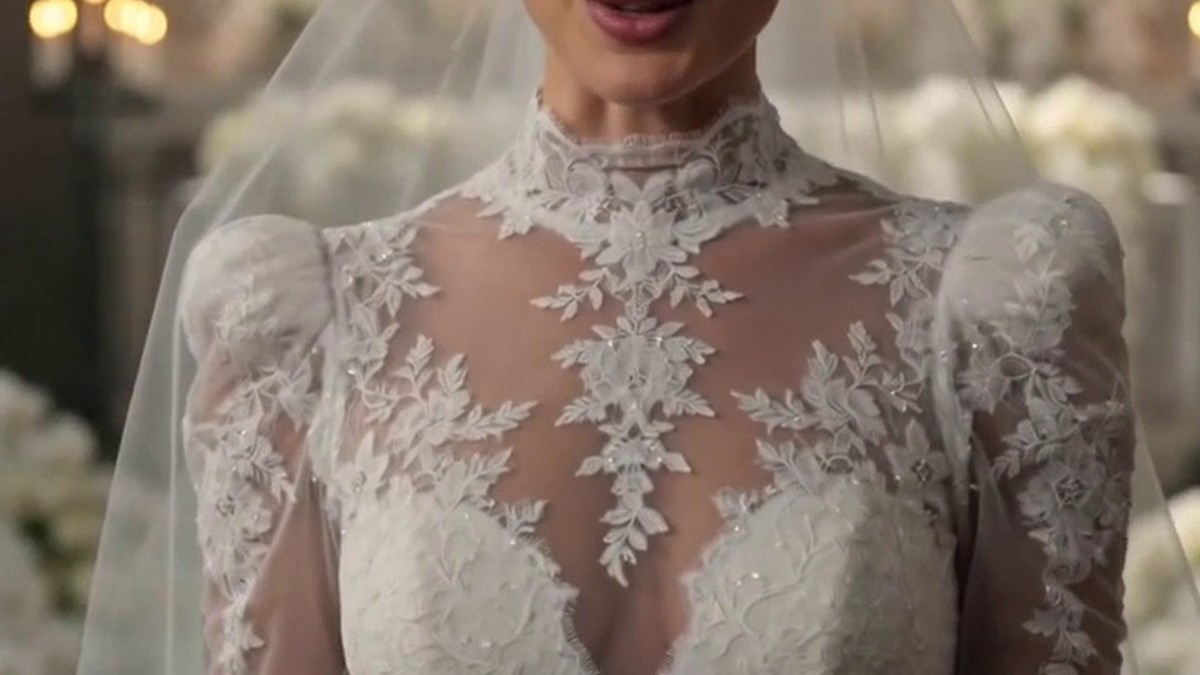
The coordinator stuck her head in and whispered it was time. I pulled the veil over my face and straightened my spine. The ivory silk-crepe gown, made by a Lebanese designer who owed my mother a favor, suddenly felt like armor.
The organ struck up some insipid Bach, and the chapel doors swung open. Two hundred of San Francisco’s elite turned to rubberneck. I walked alone, because my father was already seated in the front pew, dabbing his eyes like he hadn’t sold his daughter’s future for stock options. The aisle was an eternity of white orchids and judgmental stares.
Through the haze of the veil, I saw Liam. Tall, dark-haired, square-jawed in that aggressively symmetrical way that tech heirs were genetically engineered for. His posture at the altar screamed boredom. He was adjusting his cufflinks, for God’s sake. Eric, rigid beside him, looked like he might throw up.
When I stopped in front of him, the priest smiled with the bland serenity of a man who’d seen a thousand loveless unions.
“You may lift the veil.”
My hands were steady. I’d waited for this like a master chess player holding back the queen. I lifted the layers of tulle in one smooth motion, letting them fall around my shoulders.
The silence that followed was so absolute I could hear a distant dove cooing outside the stained-glass windows.
Liam’s face went through a rapid, delicious metamorphosis. Boredom flickered into confusion, confusion into shock, and shock into something that landed squarely between awe and sheer panic. His eyes, a deep whiskey brown, swept from my emerald gaze to the curve of my mouth, to the defiant angle of my chin. He opened his lips, closed them again.
I let a slow, feline smile touch the corners of my lips, the one my voice coach had called my “boardroom killer.”
“Surprised?” I murmured, quiet enough that only he and maybe the priest caught it. “I heard everything through the vent. Every single word.” I let the smile cool. “Relax. I’m not pining for you, either. We’ll stick to the contract. Five years, nothing more.”
His jaw tightened. A dull flush crept up from his starched collar. He looked like a CEO who’d just been informed his company was bankrupt.
“Isabel, I—”
The priest, looking slightly panicked, cleared his throat. “Shall we begin?”
“Yes,” Liam managed, his voice roughened.
The ceremony was absurd theater. We exchanged vows about cherishing and honoring while I mentally calculated how many days remained in a half-decade. When the priest declared us man and wife, Liam leaned in for the required kiss. I expected a dry peck, the kind you give a distant aunt. Instead, the moment our lips touched, a jolt blazed through me—electric, searing, completely unwanted. His eyes flew wide open. Mine probably matched.
We broke apart quickly, but something had shifted. The air around us crackled as we walked back down the aisle, my hand resting on his arm. I felt his muscles bunch.
“We need to talk,” he said under his breath, a muscle ticking in his cheek.
“No,” I replied, smile fixed for the photographers. “We really don’t.”
—
The reception was held at a winery tucked into a Sonoma hillside, all candlelit terraces and the scent of crushed grapes. Liam and I sat at a sky-high table like monarchs observing a court of sycophants. We barely spoke. He made two more attempts to corner me near the champagne tower; I sidestepped him each time with surgical precision. My father kept shooting me apologetic glances. Eric got entirely too drunk.
That night, when we were finally alone in the honeymoon suite of a private Napa villa—a place so opulent it had its own helipad—I locked the bedroom door and left Liam to the sofa. I wasn’t cruel, just practical.
The following morning, we flew to a tiny Caribbean island for a mandatory two-week “honeymoon.” A chartered plane, a staff of six, a beach house with floor-to-ceiling windows overlooking turquoise water. It would’ve been paradise if my husband weren’t a man who’d planned to mentally replace me with interns.
For the first three days, we orbited each other like hostile planets. He swam laps in the infinity pool; I read on the deck. He tried small talk over grilled lobster; I deflected. On the fourth night, a tropical storm knocked out the power, and the house plunged into darkness. We ended up huddled in the living room by a battery-powered lantern, drinking rum from the same bottle because neither of us wanted to navigate to the kitchen in the dark.
Half a bottle in, the cracks started to show.
“I was an idiot,” Liam said abruptly, staring into the flickering lantern light. “The way I talked—it was foul. I thought I was being funny, impressing Eric. I didn’t know… I didn’t know you.”
“You didn’t want to know,” I said. “Men like you never do.”
“Men like me?” He looked at me then, the shadows making his face younger, less guarded. “You don’t know the first thing about me, Isabel.”
So I dared him. “Then tell me.”
He did. He told me about his father dying when he was twelve, leaving him with a ruthless mother who measured love in quarterly profits. About Thomas Caldwell’s archaic clause: marry before thirty, stay married five years, or the company would be carved up by a board that would’ve destroyed his father’s legacy. About the pressure to be perfect, to never need anyone.
I told him about Julian. The loud arguments I’d learned to absorb like blows. The way he’d call me “plain,” “lucky I was rich,” “damaged goods” from a congenital hip issue he’d weaponized. How I’d believed every syllable until the night he shoved me into a mirrored wardrobe and I watched my own terrified face shatter into a spiderweb of cracks.
The rum grew warm, and the storm howled, and somewhere around two a.m., Liam reached across the gap between us and took my hand. I didn’t pull away.
“I’d like to start over,” he said quietly. “If you’d let me.”
“You can’t erase a contract, Liam.”
“I’m not asking to. I’m asking for a chance to show you I’m not the man at that vent.”
I looked at his fingers, strong and calloused despite the wealth, and felt something dangerous unfurl in my chest. Hope.
—
The year that followed was something out of a fever dream. We returned to San Francisco and moved into his glass-walled penthouse, and slowly, the barriers crumbled. We began eating breakfast together—he made terrible scrambled eggs, I introduced him to my grandmother’s migas recipe. We talked into the night about everything from fiscal policy to his secret love of bad science fiction novels. He came to my art therapy fundraiser, and I attended his shareholder meetings, watching him command a boardroom with the same intensity he’d once reserved for dismissing me.
The first time we made love, it wasn’t dutiful or transactional. It was a revelation. He whispered my name like a prayer, and afterward, lying in the tangle of sheets with the Bay Bridge lights painting the ceiling, he said, “I’m falling for you, Isabel. For real.”
I should’ve said it back. I was too afraid.
Then Julian came crashing back into my life. He appeared at a charity gala I’d organized, his smile as slick as ever, wearing a rented tux and a rumor that he’d “reformed.” He cornered me near the restrooms, his breath sour with champagne.
“Enjoying the charade, Belle? I know all about the contract. I have contacts. Imagine the headlines: ‘Tech Heir’s Sham Marriage Exposed.’” His fingers grazed my elbow. “Unless you’d like to make a little arrangement of our own.”
I felt the familiar cold terror, the ghost of my old self curling inward. Before I could respond, Liam materialized at my side. He didn’t say a word. He simply looked at Julian the way one might regard a cockroach on a dinner plate.
“Mr. Okafor,” Liam said, his tone pure subzero boardroom, “my security team has your image flagged. You’re trespassing. They’ll escort you out. And if you ever contact my wife again, I will dismantle your entire life with the same precision I use on hostile takeovers. Understood?”
Julian sputtered, but two large men in suits were already flanking him. He was gone in seconds.
I was shaking. Liam pulled me into a private corridor, his hands gentle on my shoulders. “You’re safe,” he said. “You’ll always be safe with me.”
That was the night I accused him of it. “You’re just protecting your investment. The contract’s not up for another four years. Is this all about the company?”
His face went white. For the first time, Liam Caldwell looked genuinely wounded. He let go of me, stepped back, and raked a hand through his hair. Then he walked to his study without a word.
I stood there, heart hammering, telling myself I was right to doubt. But the look in his eyes had been devastation, not guilt.
—
I didn’t sleep. At dawn, I found him on the rooftop terrace, staring at the water. He was holding the leather portfolio that contained our marriage contract—the neat, cold clauses signed by my father, his grandfather, and us.
When I approached, he turned to me, and his eyes were red-rimmed.
“You think I care about the company?” His voice cracked. “I’d burn Caldwell Tech to the ground before I’d let you think this is still a transaction.” He opened the portfolio, and I watched him methodically tear out every single signed page. He ripped them once, twice, until they were a drift of paper shards at his feet.
“There’s no contract anymore,” he said. “No five years. No contingency. I’m staying because I love you, Isabel. Because you make me want to be the man you deserved from the first moment. If you want to walk away, I won’t stop you. But I’ll spend the rest of my life trying to earn your trust if you’ll let me.”
The sun was rising, turning the bay to hammered gold. I closed the distance between us and kissed him. Not the sparking, accidental kiss of our wedding day, but a hungry, certain, fearless kiss that said what I hadn’t been brave enough to voice.
When we broke apart, I pressed my forehead to his. “I love you, too. For real.”
He laughed, a wet, relieved sound. “For real.”
—
We never told our families the contract was void. Let them imagine whatever they wanted. Two years later, on the same Sonoma hillside where we’d once sat in icy silence, Liam and I stood under a simple oak arch, exchanging vows we’d written ourselves. No four hundred guests, no hidden agendas. Just us, a cantankerous old priest, and a handful of people who mattered.
When the priest said, “You may kiss your bride,” Liam cupped my face in his hands and murmured, “This time, I mean every syllable.”
And he did.