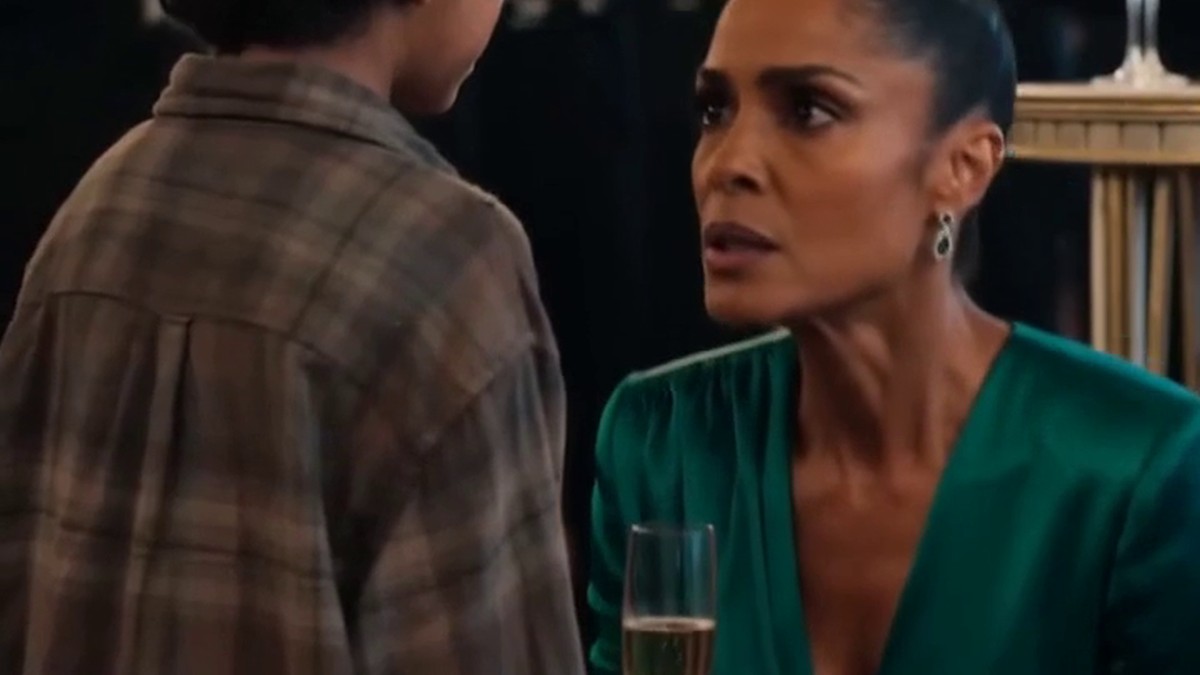
The Windy City Hope Ball was the kind of event where champagne cost more than a nurse’s weekly pay, but nobody ever mentioned that. Charity was the theme, but opulence was the dress code. Crystal chandeliers dripped light over a sea of black tuxedos and jewel-toned gowns, laughter bouncing off marble columns draped in cream silk.
Victoria Chase, thirty years old and already a legend in Chicago, stood at the center of it all, smiling the exhausted smile of a woman who had raised sixty million dollars before dessert. Her emerald gown caught the light as she turned to laugh at something her CFO said, a practiced, graceful motion that held the room’s attention.
Then the ballroom doors swung open.
No photographer. No late-arriving billionaire. Just a teenager.
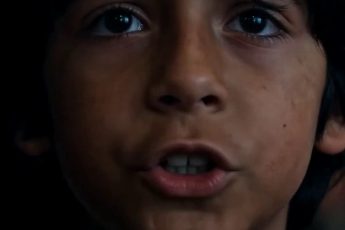
He couldn’t have been more than fifteen. Barefoot. Dirt smeared across his cheeks, a man’s faded flannel shirt hanging past his knees and held together by a single safety pin. His hair was a mess of dark curls, and his eyes darted around the room like a trapped bird’s.
The murmurs started instantly. A woman near the door recoiled. A man in a bow tie muttered, “What the hell?” Security guards near the entrance were already moving, earpieces crackling.
The boy ignored all of it. He walked straight through the center aisle, past tables of Chicago’s elite, past the bronze statue of the Hope Ball’s founder. No one stopped him. Maybe they were too stunned.
Victoria didn’t see him until she felt a small, cold hand brush against the nape of her neck, fingers tangling briefly in her loose chignon.
She spun around.
The boy stood inches from her, eyes wide and unblinking. The room seemed to freeze, a hundred breaths held at once. Two guards were three feet away now, hands hovering near their belts.
Victoria felt her heart slam against her ribs. “Who are you?”
The boy swallowed so hard his whole throat moved. “My mom said you’d know.”
A nasal laugh burst from a table nearby. Someone else said, “Is this a bit?” Victoria didn’t look at them. She crouched, the silk of her dress pooling on the floor, bringing herself to his eye level.
“Know what?” Her voice was steadier than she felt.
He reached into the pocket of his tattered shorts. The guards tensed. Victoria held up one finger without glancing their way. Stop. They stopped.
The boy pulled out a silver locket the size of a quarter, tarnished nearly black. It was dented on one side, hanging from a broken chain. He held it toward her like an offering.
Victoria’s hand froze. The champagne flute she’d been twirling tipped, spilling a thin line of gold across the tablecloth. She didn’t notice.
She knew that locket. She’d last seen it fifteen years ago, on the night of the fire that had taken everything. It had been her mother’s, given to her on her sixteenth birthday—a simple oval with a tiny crescent moon etched on the front. She had placed it around her baby son’s neck the afternoon before the blaze, tucking it beneath his onesie to calm him. The locket had been lost in the inferno, along with her husband and, she had believed, her child.
Now here it was, in the dirty palm of a stranger.
Before she could speak, the boy untangled a frayed blue thread from around the safety pin holding his shirt. A second object slipped free. A man’s signet ring, heavy gold, an eagle crest engraved deep into the face. Victoria’s grandfather’s ring. The ring her husband, Thomas, had worn every day of his life from the moment she’d put it on his finger. She’d last seen it on his hand the morning of the fire; she’d assumed it had melted into slag. But here it was.
The room had gone absolutely silent, the kind of silence that has weight.
The boy looked directly into her eyes. Then he whispered the words that scraped her heart raw.
“My mom said this proves who my dad really was.”
Victoria’s gaze dropped to his neck. The too-big shirt collar had fallen open when he reached for the ring. Just above his collarbone, pale against his skin, was a small crescent-shaped birthmark—a mirror image of the moon on the locket. The exact same mark. She had traced it with her fingertip a hundred times during late-night feedings, marveling at its perfect curve. The coroner’s report had claimed the remains were unidentifiable, relying solely on DNA—a test that took three agonizing days. Now, staring at that living mark, a cold realization settled in her gut: that test, that closed-casket funeral—all of it had been fabricated.
The world tilted. She grabbed the edge of the table to steady herself. “Where is your mother?” she managed to say, though the words felt like glass in her throat.
The boy’s face crumpled. “She’s sick. Real sick. She said I had to come before…” He didn’t finish.
Victoria didn’t need him to. She straightened, pulled her phone from her clutch, ignored the eruption of questions around her—cameras flashing, a reporter somewhere shouting—and called her driver. Then she took the boy’s hand, that small, cold hand, and walked out of the gala without a word.
—
The ride to Aurora was forty-five minutes on empty highways, but it felt like five. The boy sat in the back of the Maybach, silent, staring out the tinted window at the night lights of the western suburbs. He’d given his name as Leo, but nothing else. Victoria couldn’t stop looking at the locket resting in his palm, the ring now on his thumb. Her brain was a storm of impossible fragments: the fire, the closed-casket funeral, the DNA test that had confirmed a lie. All of it, dismantled.
They arrived at a small hospice facility tucked behind a strip mall, a beige building with a flickering sign. Victoria left her bodyguards in the car. She walked in with Leo, still holding his hand, her emerald gown a jarring contrast to the dim fluorescent light. The night nurse opened her mouth to protest, took one look at Victoria’s face, and stepped aside.
Room 14. The door was open a crack.
Inside, a woman lay in a hospital bed, oxygen tubes looping under her nose, her skin the color of old paper. Her hair was thin and gray, and when she turned her head, the effort seemed to drain her. Her eyes landed on Victoria first, then on Leo, and tears slid down her cheeks immediately.
“You came,” the woman whispered, her voice barely a rasp.
Victoria stood at the foot of the bed, hands trembling. She didn’t sit. “Who are you?”
The woman—the woman who had raised her son for fifteen years—took a ragged breath. “My name is Deirdre. I was your nanny.”
The name hit Victoria like a physical blow. Deirdre, the young Irish woman with the nervous smile who had started two weeks before the fire. She’d been background-checked, vetted, liked. And after the tragedy, she had simply vanished. Staff came and went; no one thought anything of it.
“You took him,” Victoria said. It wasn’t a question.
Deirdre nodded, a sob cracking through her chest. “I had to. Your uncle Richard… he paid the cook to start the fire. He wanted Thomas dead and the baby too, so he could claim the family trust. I overheard him that night, just hours before. I ran—grabbed Leo from his crib and fled through the garden. As I passed your bedroom door, I snatched Thomas’s ring from the nightstand. It was the only proof I could think of, in case we ever got to you. I didn’t have time to save him. I’m so sorry.”
She was crying openly, words tumbling in a feverish rush. “I wanted to bring him back, but they would have killed us both. Richard had money, influence. He could’ve made anything look like an accident. So I ran. I changed our names, moved six times, worked under the table. I told Leo his father was a soldier who died overseas. I couldn’t risk contacting you. Not until I saw in the news that Richard had a stroke—moved into a nursing home under a fake name. He can’t hurt anyone now. That’s when I knew it was safe. But I…” A deep, wet cough shook her frame. “The cancer’s in my lungs now. I’ve got days, maybe. Leo needed to know the truth. You needed to know.”
Victoria’s legs gave out. She sank onto the edge of the bed, silk crumpling around her. Leo moved to Deirdre’s side without a word, sitting on the mattress and taking her hand in both of his. He didn’t cry. He just rested his head on her shoulder, eyes closing.
Victoria watched them, the locket now in her own palm, the ring cold against her fingers. Fifteen years of building an empire to outrun grief, of therapy sessions and an untouched nursery, of birthdays spent walking alone along Lake Michigan. She felt the hot twist of fury in her stomach—at Richard, at the lies, at the stolen time. Her jaw clamped so tight it ached. But then she looked at Leo, his head against the dying woman, and her teeth unclenched. Breath came out in a shudder. For now, there was only the impossible fact of her child breathing quietly in the dim light.
Deirdre reached out a trembling hand. Victoria took it.
“He’s a good boy,” Deirdre whispered. “Kind. Smart. He’ll need someone to teach him how to be in the world now. Please… I know I have no right to ask…”
Victoria squeezed her fingers, tears sliding down her own cheeks for the first time in years. “You saved his life. You’ll always be his mother.”
She meant it. She wasn’t sure she could, but she meant it.
Deirdre died three days later. Victoria was there, in the same chair she’d pulled up to the bed, Leo beside her, dry-eyed but holding Deirdre’s hand until it went slack. They buried her in a small cemetery under a maple tree, with a headstone that read *Loving Mother*. Leo picked the words.
Victoria didn’t wait long. She’d already hired a private investigator the morning after Deirdre’s confession. Within a week, they’d unearthed a stash of letters from Richard to the cook, a canceled check, and a diary Deirdre had kept in a safety deposit box—names, dates, threats all written in her neat hand. Richard was arrested at the nursing home before the month was out. The media called it the Chase Arson Conspiracy. Victoria sat in the front row of the preliminary hearing, Leo’s locket tucked beneath her blouse, and didn’t flinch when they led her uncle in.
—
Six months later, Victoria watches her son run barefoot across the lawn of the Chase estate, chasing a golden retriever puppy she’d brought home last week. He’s laughing, a sound she’s still learning, cataloging its pitches and pauses. The locket hangs from a new chain around his neck, and the ring sits in a velvet box on her dresser, waiting for the day she’ll tell him the whole story.
Tonight there’s another charity dinner in the city. She’ll go, because that’s what she does. But she’ll leave early. She’ll come home, kick off her heels, and sit on the floor of his room while he tells her about the dinosaur he drew in art class. And she’ll hang on every word, not thinking about the years she missed, just this one.