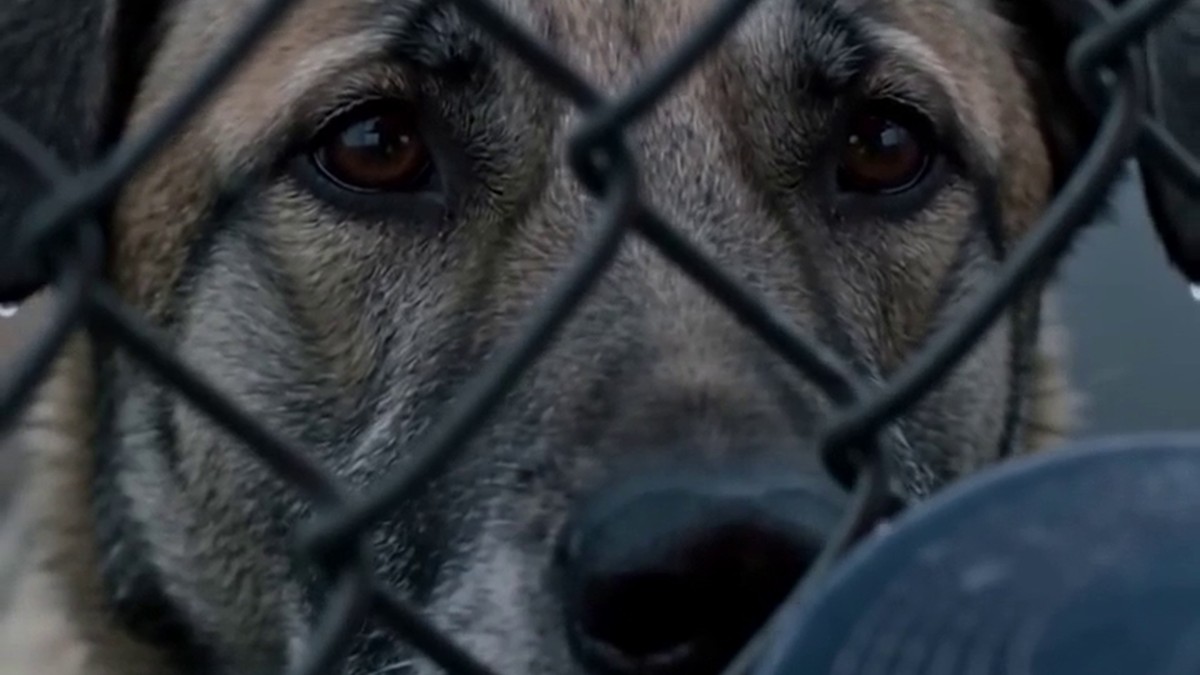
Duke knew the sound of Eddie’s truck before it turned onto Cottonwood Lane. Not the grinding whine of the hydraulics—every garbage truck in Jefferson County made that same mechanical groan—but the two-note whistle that cut through the air about a hundred yards from the gate. Tuesday mornings, Thursday afternoons, like clockwork. Duke would be dozing in his usual spot by the maple tree, and that whistle would snap his head up, his ears swiveling forward, his whole body coiled.
He was a Lab-shepherd mix with a graying muzzle and a right ear that never quite stood all the way up. Ten years old, give or take, and he’d been waiting at that chain-link gate since he was a puppy, long before the maple tree’s roots started buckling the sidewalk. Eddie’s truck always slowed just enough for the driver’s side window to roll down. A thick-gloved hand would toss something over the gate—half a Milk-Bone, a broken piece of Beggin’ Strip, once even a chunk of leftover brisket wrapped in foil. Duke would snatch it out of the air and then press his nose against the fence while Eddie idled for three seconds, not much longer, because the route was tight and his supervisor rode him about the schedule.
“See you Thursday, Duke!” Eddie would call, and the truck would lurch off toward the next block, leaving the faint smell of diesel and something warm and biscuity hanging in the air.
It was a small ritual in a small town, the kind of thing nobody thought would end.
Then one Tuesday in late October, the truck didn’t come.
Duke paced along the fence line, waiting. He heard it at first—or thought he did. A distant engine, the groan of a compactor. He stood up, tail wagging low, and watched the corner where the yellow sanitation truck usually appeared. A different truck rolled past, a brown one with a different logo, heading toward the industrial park on the other side of town. Duke’s tail stopped mid-swing. He sat down.
An hour later, my neighbor Chloe texted me at work: “Your dog’s been at the gate since noon. Not barking, just staring at the street.”
I came home early. Duke was still there, lying down now, his chin resting on his front paws. I sat with him, rubbed the spot behind his good ear, the one that stood up. “He’ll be back Thursday, buddy,” I said, because that’s what you tell a dog who doesn’t understand days of the week.
Thursday came. Still no Eddie.
The truck that eventually rolled down Cottonwood that afternoon was a smaller model, white with green lettering, and a woman was driving. She wore a lime-green safety vest and pulled her dark hair back with a bandana. Duke loped to the gate, his tail starting up, but the whistle was wrong. A different rhythm, a different pitch. She didn’t slow for the house. Duke barked once, then sat back down, his eyes tracking the truck until it disappeared around the bend.
That was Maya.
She’d been on the job three years, but this was a new route for her. The company didn’t say much when they reassigned her, just that the previous driver had passed a few weeks back and they needed someone reliable to take over the residential loop. They handed her a clipboard with a list of stops and a couple of notes, including one about a dog on Cottonwood Lane who had been a “customer favorite.” She didn’t think much of it until her second week.
Every Tuesday and Thursday, that same gray-faced dog would be at the gate. He’d perk up when her truck turned onto the street, then deflate the second he saw her face. He would watch her hands as she grabbed the bins, his eyes searching for something she wasn’t holding. It took three stops like this before Maya called her dispatch and asked, “The driver who had this route before me—Eddie, right? Did he carry treats for a dog on Cottonwood? Big shepherd mix?”
“Lab-shepherd,” the dispatcher corrected. “Name’s Duke. Eddie talked about him all the time. Bought biscuits in bulk. Said the dog never missed a pickup day, even in the rain.”
Maya started carrying a bag of Milk-Bones in the cab after that.
The next Thursday, she stopped the truck right at Duke’s gate. The dog was already standing there, his head tilted. She climbed out, held up a biscuit, and gave it a soft toss over the chain-link. It landed in the grass near his paws. Duke sniffed it, then looked past her, toward the corner where Eddie’s truck used to appear. He didn’t eat it.
Maya crouched down. “I know, sweetheart,” she said quietly. “I miss him too.”
Duke’s ears flickered at her voice. He came a step closer, his nose working the air, taking in the scent of her work gloves, the hint of laundry detergent, something else he couldn’t place. Maya didn’t try to pet him. She just stayed there for a minute, then stood up and climbed back into the truck.
That winter, the ritual changed, but only just barely. Duke still went to the gate every Tuesday and Thursday, but now he’d perk up when he heard the specific rattle of Maya’s engine—not the whistle he waited for, but something close. She would toss a biscuit, and sometimes he would eat it. Sometimes he’d just let it lie there until the crows got it. She never forced it. She never tried to replace Eddie with false cheer or extra treats. She just showed up.
Then one January afternoon, it rained hard enough to flood the gutters. I was home, watching through the window, and I saw Maya’s truck pull up. Duke got to his feet, but instead of waiting at the gate, he pushed through the side door I’d left cracked open and ran down to the fence. Maya was already out of the truck, a red umbrella in one hand. She had something else in her hand—an old denim baseball cap, faded and sweat-stained, with a sanitation department logo on the front.
“They found this in the truck after Eddie passed,” Maya said, holding it close to the fence where Duke could sniff it. “I thought maybe he’d want it back.”
Duke pressed his nose hard against the chain-link. He inhaled deeply, his whole body trembling, and then he let out a soft, low whine. It was the first time I’d seen his tail wag for her—a slow, cautious sweep, but a wag nonetheless.
Maya didn’t try to hand him a biscuit that day. She hung the cap on the fence post, and Duke spent the next hour lying beside it, his muzzle resting against the worn brim. After that, something shifted. He still watched the road, still lifted his head at every distant engine, but the vigil had softened around the edges.
Weeks later, I came home to find Maya’s truck idling at the curb and Duke actually inside the cab. She had one arm around him, rubbing his chest, while he tried to lick her chin. She laughed and nudged him back toward the gate. “He’s a good boy,” she told me. “Eddie was right about him.”
Now, if you drive down Cottonwood Lane on a Tuesday morning, you might see a big gray dog sitting by the gate, an old denim cap still hanging on the fence post above him. But when the green-and-white garbage truck rumbles around the bend, his tail starts beating the air, and he runs to meet it halfway, snatching his biscuit out of the air before the truck even fully stops.
Maya still doesn’t whistle like Eddie did. She doesn’t have to.