“What for, Mom?”
The first time my daughter said it, I was cutting fresh peonies from the garden of the home I’d paid for. I’d just returned from twenty years in New York, my hands still smelling of other people’s laundry and the lavender sachets I used to tuck into clean sheets for Mrs. Rutherford on the Upper East Side. I thought it was a fluke. A one-off. Maybe Rebecca was just tired, or worried I was overexerting myself after the move.
But the phrase stuck. It crept into our mornings over coffee on the flagstone patio, into phone calls, into the air of the new life I was trying to build in Prescott, Arizona. "What for, Mom?" A soft, smiling little question that wasn't a question at all. It was a verdict. A quiet, unspoken belief that my own life was already wrapped up, and my job now was to sit quietly in the background of their family portrait.
I was a widow at thirty-three, with a seven-year-old daughter and a mortgage on a double-wide that felt like a thousand tons. The teaching jobs in our small town paid in peanuts and promises. So I did what I had to do. I answered an ad for a live-in caregiver in New York, kissed Becca’s forehead, and promised I’d be back. The years stretched. Twenty of them. I raised other people’s aging parents while mine became a voice on a weekly phone call. I learned to navigate the subway, to haggle for produce in Spanish Harlem, and to sit quietly with grief when my own mother passed while I was on a 12-hour shift and couldn’t get to the phone.
I never remarried, but I found a kind of partnership with a man named Leo, a super at a building on West End Avenue. It was companionship, a warm body next to mine, a shared plate of pasta on a Sunday afternoon. Nothing shameful, just life. When he died, his pension went to his sister, and I felt a door close. My mission was over. It was time to go home, to the wide-open sky and the daughter I’d sacrificed everything for.
Over two decades, I’d wired enough money to pay for her college, her wedding, a down payment on a beautiful Spanish-style house with a view of Thumb Butte. I bought her husband, Craig, a new Silverado for his contracting business, and set up a college fund for their twin boys. Any time their roof leaked, or they wanted to take the boys to Disney World, I didn't ask, “What for?” I just went to the Western Union on Broadway and sent the money. My calloused hands and aching back were transformed into their comfort. I was happy to do it. It was the whole point.
I’m sixty-eight now. I feel fifty. In New York, women my age weren't invisible. They wore bright lipstick, went to lectures at the Met, and laughed loudly in wine bars. I wasn’t ready for a rocking chair and a television set.
The first real crack happened on a crisp morning in early April. We were sitting on her patio, the smell of juniper in the air. I poured myself a second cup of coffee and made my announcement.
“Becca, I’ve been thinking. I’m going to sign up for a pottery class. The one over at the art center on Iron Springs.”
She was texting and didn’t look up. “What for, Mom? That place is full of aging hippies. Clay gets everywhere. It’s a mess.”
“Because I want to. I’ve always liked working with my hands.”
Now she looked up, a tired, patient smile on her face. “Mom, you need to relax. You’ve been working your whole life. Just sit, enjoy the view, read a book. We can get you a jigsaw puzzle. Why would you want to put yourself through the stress of driving into town for a class? If you need something to do, the boys have a fundraiser car wash at the school next week. They could use an extra set of hands.”
I let it go. The words she used—"stress," "why," "just sit"—they burrowed under my skin like splinters. I thought of my friend Tanya, a woman I’d met in line at Trader Joe’s who, at seventy-two, had just taken up landscape painting. But I told myself Becca was just being practical.
A few weeks later, my neighbor, Shirley, a retired nurse with a spirit as bright as the turquoise jewelry she always wore, rapped on my front door. Her eyes were dancing.
“Evelyn! My daughter and son-in-law got me a long weekend at a spa resort in Sedona for my birthday! A whole place with the red rocks, meditation gardens, the works. They can’t go anymore, so there’s a free spot. Come with me! We’ll drink fancy cucumber water, get our chakras aligned, and hike around like a couple of spring chickens.”
My soul actually took flight. A trip. Not work, not a family obligation. A real, honest-to-goodness getaway. The scenery I’d only ever seen on postcards.
“Shirley, that’s a wonderful idea,” I said, my heart hammering with excitement. “Let me just check with Becca, but I’m ninety-nine percent sure I’m in!”
That evening, Becca stopped by to drop off a casserole. I told her the news, waiting for her to share my joy. She slid the glass dish onto my counter with a dull thud.
“Sedona?” she said, her brow furrowing. “A spa? Mom, what for? That’s a four-hour round trip. All that woo-woo crystal stuff is a tourist trap. It’s just overpriced massages and rocks. You’d just be wasting your money.”
“My money,” I said, the words coming out sharper than I intended. “It’s my money, Becca. And it’s not a waste. It’s a little adventure.”
“Well, Craig and I were thinking of finally building that deck in the back. You know, the one we’ve been talking about? We were hoping you could pitch in a little instead of us taking out a loan. You know how interest rates are. But if you’re off spending it on mud baths and vortexes…”
The casserole felt like a bribe in retrospect. I looked at her, at this woman I’d raised from a scrap of a thing, and I didn’t know her. Shirley, who lived on a fixed nurse’s pension, was being celebrated by her kids. I, who had funded a whole lifestyle, was being asked to skip a trip to pay for a deck.
I told Shirley my sciatica was acting up. I made a lie about a pinched nerve and spent the weekend the family was hiking among the red rocks in my backyard, pulling weeds and feeling the weight of a future I hadn’t agreed to pressing down on me.
The dam broke on a Saturday in Phoenix. We’d taken the boys to the Science Center and stopped at a huge outdoor artisan market in Scottsdale on the way back. The air smelled of roasting green chiles and sunscreen. Hundreds of booths full of pottery, paintings, and leatherwork.
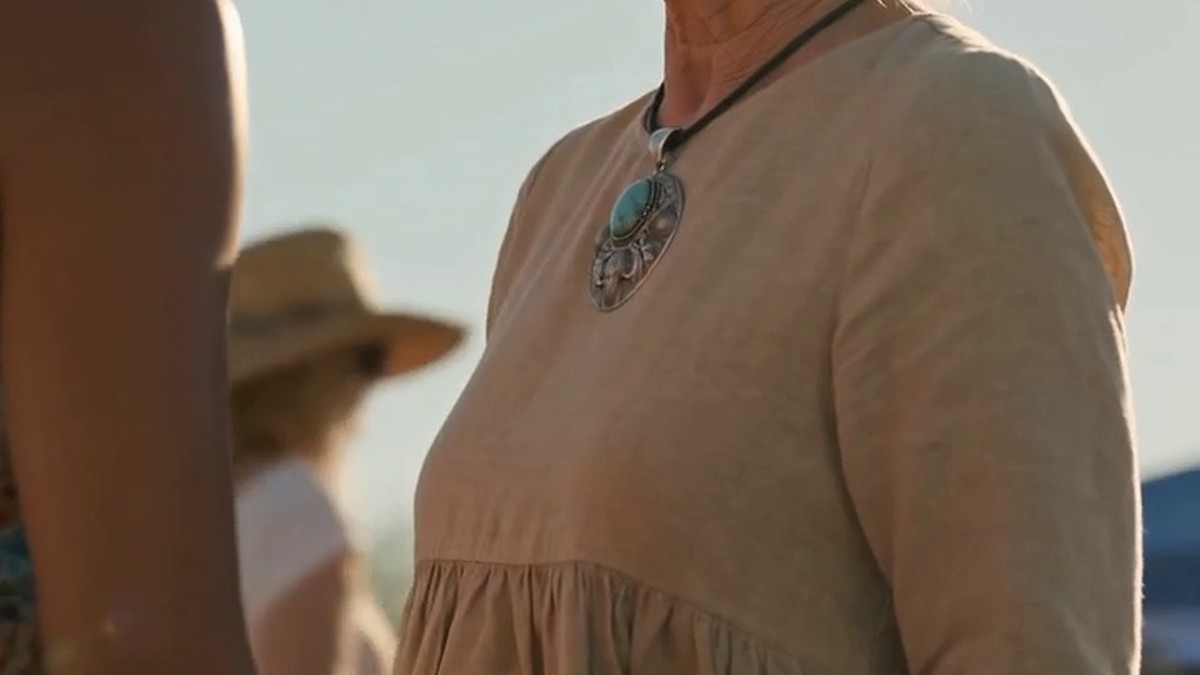
And then I saw it. A necklace, hanging in a jeweler’s booth. A single, spectacular piece of Sleeping Beauty turquoise, veined with deep black matrix, set in a heavy, hand-forged silver pendant. It was the color of a piece of the Arizona sky held in your hand. The silver was textured, organic, clearly made by an artist and not a machine. It was the most beautiful piece of jewelry I had ever seen.
“Becca, look at this,” I breathed, already knowing I was lost.
“It’s pretty, Mom. Let’s go find a place that sells pretzels for the boys.”
“No, I want to try it on.”
The jeweler, a calm man with silver hair and turquoise dust under his nails, smiled and lifted the necklace from the velvet bust. He placed it around my neck. The silver was cool against my skin. I turned to the small mirror propped on the table. The stone sat just above my heart, and my entire face came alive. My eyes looked brighter, the lines around them a map of experience instead of a sign of decay. I felt beautiful. Powerful. Seen.
“How much?” I asked, my voice steady.
“Nineteen hundred dollars,” he said. “One of a kind.”
Nineteen hundred dollars. Pocket change compared to the down payment on the Silverado. A careful, meaningful splurge from my savings.
I was already reaching for my checkbook when Becca’s hand clamped down on my arm. She pulled me a few feet away, her whisper a furious hiss.
“Mom, are you insane? Two thousand dollars for a rock? What for? Where are you ever going to wear it—to bingo at the senior center? It’s a total extravagance! There’s a stall right over there selling knock-offs for twenty bucks. They look exactly the same. Same color, same size.”
“They are not the same,” I said, my voice dangerously quiet.
“It’s the principle of the thing! You don’t just throw money away on… on a trinket for yourself! Think about how much that could help with the boys’ summer camp fund.”
She tried to steer me away. The old, practiced motion. And in that moment, standing under the unforgiving Arizona sun, I watched her do it. She was re-directing my life, my wants, my very identity, back into the channel of being a silent service provider. A human ATM who had no business printing receipts for herself.
I planted my feet. I didn't move an inch. I looked down at her hand on my arm and then back at her face. “Rebecca. Let go of me.”
Surprise flickered in her eyes. Her hand dropped.
I walked back to the jeweler. “I’ll take it.”
The silence on the two-hour drive back to Prescott was so thick you could choke on it. She stared out the passenger window, her jaw tight. She didn’t speak to me for three days. Over a necklace. A piece of crafted silver and stone that cost less than the heated leather seats in Craig’s truck. And I sat in my beautiful, empty, five-bedroom house, the house my aching feet had built, and the lightning bolt finally struck.
For twenty years, I had never said “what for?” Not when Becca wanted to study art history, a degree with no clear job path. Not when Craig needed a brand-new truck instead of a used one. Not when they wanted a Sub-Zero refrigerator or a backyard fire pit with custom-built seating. Their dreams were valid. Their lives were important. So why, when I finally came home with the spoils of a lifetime of labor, was I being told to sit in the corner and not touch anything?
They were used to me as a funnel, not a person. A source, not a soul. I had become a grandmother-ATM who was expected to quietly depreciate, recycling my pension into their needs until the account closed for good.
I didn’t wait for permission the next morning. I got in my small, sensible Honda—the car I’d bought myself—and drove straight back to Scottsdale. I found Shirley’s phone number and called her.
“Shirley? I’m booking a suite at that Sedona resort. The one with the red rock view and the outdoor soaking tub. I’m going for a whole week. Are you in?”
She whooped so loudly I had to hold the phone away from my ear.
Two days later, I was packing my suitcase. I was gently folding a beautiful, forest-green linen blouse when Becca walked in without knocking. She saw the open suitcase and the travel bag of toiletries. The question was already forming on her lips—the same damn question, the million-dollar question I was done answering.
“Mom? What are you doing now? What for—?”
I held up a single hand. The gesture was so abrupt, so final, that she stopped mid-syllable, her mouth still open. The silver pendant, that glorious piece of sky, was hanging around my neck for all the world to see. I could feel its weight, solid and unapologetic.
“Because it's my life, Becca,” I said, my voice clear and hard as a diamond. “And I’m finally going to start living it for me.”
I zipped the suitcase with a single, satisfying rasp of metal. I didn’t look back to see the confusion, the shock, or maybe the first flicker of understanding on my daughter’s face. I just picked up my bag, walked out into the dry, high-desert air, and pointed my little Honda toward the red rocks and a future that, for the first time in decades, was entirely my own.