The rain had just stopped, leaving that slick, oily sheen on the back road into town. Emma was pushing her ancient Honda Civic through the last bend before the old railroad crossing when something moved in the high weeds. Not a deer. Something smaller, stumbling. She slowed, squinting through the bug-splattered windshield. At first she thought it was a crumpled plastic bag, the way it dragged itself along the gravel. Then she saw a tail twitch.
She pulled over so hard the tires skidded.
Up close, her throat closed. It was a cat. Or what was left of one. The animal was so coated in mud and dried blood that his actual color was a mystery. Worst of all, his head was jammed inside a clear plastic protein-shake cup. Somebody had forced it on—the rim was cutting into the fur behind his ears, and every breath came out as a wet, whistling wheeze. He couldn’t see. He couldn’t drink. He was barely standing.
“Easy, easy,” Emma whispered. She knelt in the wet gravel, not caring about her jeans. The cat tried to lurch away, but his legs gave out and he sagged against a rock. She scooped him up. He weighed nothing. Just a bag of bones and wet fur.
She had one hand free and her phone autodialed before she even thought about it. He picked up on the second ring.
“Kev. It’s bad. I’m five minutes from the clinic. Meet me at the back door.”
Kevin didn’t ask questions. He never did.
The next two hours passed in that gray waiting room with the torn vinyl chairs and the fish tank that always needed cleaning. Emma just sat, still in her mud-caked sneakers, staring at the poster about heartworm prevention until the words stopped meaning anything. When Kevin finally came out, his scrubs were wet and he smelled like antiseptic.
“He’s stable.” Kevin dropped into the chair next to her. “Barely. Someone put that cup on him and let it stay there. Days, probably. He was dehydrated enough to crash. If you’d been five minutes later…”
Emma pressed her forehead against his shoulder and let the tears come. She didn’t cry for herself. She cried for the cruelty of it, for the tiny broken body back there on a metal table. Kevin just rested his chin on top of her head the way he’d done since they were kids fighting bullies on the playground.
“He’s a fighter, Em. He’s gonna need a name when he wakes up.”
She sniffled. “What color is he, anyway?”
“Orange. Kind of a burnt orange. With white socks.”
“Churro,” she said. “He looks like a dusty churro.”
Kevin laughed. It was a tired laugh, but it was real.
—
They’d been neighbors on Gladiola Street in Mesa, Arizona, since Emma was six and Kevin was nine. Her mom, Debra, had already started drinking hard after Emma’s dad walked out, and by the time her dad actually died of a liver thing two years ago, Debra had moved from wine coolers to cheap tequila that left rings on every surface. Kevin’s family never called social services. They just left their back door unlocked, and Emma knew there was always a plate in the fridge and a sleeping bag on Kevin’s floor.
He’d protected her from everything: from mean girls who mocked her thrift-store clothes, from the repo men pounding on their trailer door, from the nights when Debra’s boyfriend-of-the-month got too loud. And when Kevin graduated from the University of Arizona’s vet school and got a job at Cactus Veterinary Clinic, he said it was Emma’s doing—she’d spent so many hours with him in the library, quizzing him with index cards, that he owed her half his diploma.
Now Emma was finishing her own degree in Spanish-English translation at ASU’s downtown campus, paying for it with early-morning shifts delivering packages for a courier service. The Civic had 190,000 miles on it and a brake light that flickered like a drunk’s eyelid, but it ran.
So did Kevin. He ran toward her every time she hit a wall.
Churro stayed at the clinic for ten days. He learned to trust—barely. When Emma visited, he’d press his scarred forehead against the bars of the cage and let out this rusty, crackly purr that sounded like an old lawnmower trying to start. Kevin said the cat’s heart was enlarged, probably from chronic stress and malnutrition. Too much excitement could kill him. Flying was out of the question.
“Good thing we can’t afford a trip to Paris,” Emma joked.
Kevin didn’t joke back. He just watched her with something unreadable in his eyes.
—
The job that changed everything came on a Tuesday in August. Emma had a delivery to the eleventh floor of a glass high-rise in downtown Phoenix—a manila envelope for some financial firm. The receptionist took it, and Emma was already pivoting toward the elevators when a side door burst open and a man in a thousand-dollar suit strode out, phone clamped to his ear.
“I don’t care who’s available, Marta, I need someone now. The call with the Mexico City office starts in eight minutes and my interpreter just bailed. Eight minutes!”
He was tall, mid-thirties, with the kind of restless energy that made the air feel charged. His eyes landed on Emma. “You. You look like a student. Do you speak Spanish?”
She had exactly two seconds to decide. “Sí, señor. Fluently.”
The receptionist’s jaw dropped. Emma walked into that conference room, sat beside Adrian Reyes, CEO of Reyes Global Logistics, and interpreted a fifty-minute negotiation without a single stumble—including the part where she had to translate a joke about a donkey and a tax auditor. When the call ended, Adrian leaned back in his chair and studied her like she was a puzzle he’d just solved.
“Where have you been hiding?” he said.
She started as his personal interpreter the following week. The courier job and the Civic with the bad brake light became a memory. Adrian was charming in the way that people with private planes are charming: effortless, confident, generous in a way that never felt patronizing because he genuinely didn’t notice the gap between her world and his. He sent her home in black cars. He bought her a coat that cost more than her last semester’s tuition. He said things like “you’re wasted on this town” and meant it as a compliment.
By October they were together. By November she’d stopped correcting him when he called her his girlfriend. By December he’d told her about the new European headquarters opening in Barcelona, and the corner office with her name already on the plaque, and the apartment in the Gothic Quarter with a terrace and a view of the cathedral.
“I want you there,” he said. “But the cat can’t come. My lungs would shut down in a week. I’ve got a prescription, but it’s not a long-term solution.”
She’d known about the allergy. She’d just been shoving it to the back of her mind.
—
Kevin’s birthday was two weeks before the flight. As she’d done every year since eighth grade, Emma showed up at his apartment door with a homemade tres leches cake, the one his abuela had taught her to make before she passed. They sat at his tiny kitchen table, and she noticed he was quieter than usual, stirring his coffee like he was trying to dissolve something that wouldn’t go away.
“You’ve been weird all night,” she said. “Spill.”
He set the spoon down. “Em, I’ve been meaning to tell you something. For a while now, actually. And I know you’re leaving, but I—”
“Oh my God, me too!” She grabbed his wrist. “I’ve been dying to talk to you about this. You know Adrian—well, he’s taking me with him to Barcelona. Can you believe it? I’m actually getting out of here. But Kev, there’s a problem.”
She didn’t notice the way his expression cracked, just slightly, before he reassembled it. She was already launching into the thing about Churro. How the cat couldn’t fly, how her mom couldn’t be trusted to feed a cactus let alone an animal with a heart condition, how every shelter was full and Churro was too skittish to rehome to strangers anyway.
“So I was hoping you could take him,” she finished. “You’re the only person in the world he trusts besides me. And you know his medical stuff. Please?”
Kevin looked at her for a long moment. The kitchen light buzzed. From the corner, Churro lifted his orange head and blinked slow, golden eyes.
“Yeah,” Kevin said. “Of course. I’ll take him.” He picked up his fork and carved a huge bite of cake. “What were you going to say earlier?” Emma asked. “The thing you wanted to tell me?”
He smiled. It almost reached his eyes. “Just that they’re promoting me to head vet. Big news.”
She threw her arms around him and squealed, and he patted her back, and Churro meowed at their feet. She didn’t see him wipe his eyes when he pulled away to get more napkins.
—
The morning of the flight, she stood on his doorstep with a carrier in one hand and her heart in her throat. Churro was pacing inside, tail puffed, sensing something wrong. Kevin took the carrier gently.
“He’ll be okay,” he said. “I’ll send you updates. You go live your life, Em.”
“You’re the best friend I’ve ever had,” she whispered.
He pulled her into a hug, and she felt his whole body tense like he was holding back a flood. “Just promise me you’ll be happy,” he said into her hair. Then, quieter, almost to himself: “I won’t forget a single thing about you.”
She kissed his cheek and hurried to the car before she could fall apart.
—
At Sky Harbor Airport, the line for security snaked back and forth. Adrian was already through, waiting at the gate with coffee. Emma stood in the queue, clutching her passport, watching strangers hug goodbye.
*I won’t forget a single thing about you.*
She heard it again, Kevin’s voice, the way it had cracked. She saw his face at the birthday dinner when she’d bulldozed over whatever he’d tried to say. She saw him at twelve years old standing between her and a kid twice her size. At sixteen, helping her study for the SATs with flashcards he’d made himself. At twenty-two, pulling an all-nighter to save a cat who wasn’t anyone’s.
The line moved. She didn’t.
A TSA agent said something. Emma’s vision blurred. She stepped out of the queue, walked against the current of passengers, and didn’t stop until she was outside in the hot desert sun, gasping. Her phone was in her hand. She dialed Kevin’s number, but he didn’t pick up. Straight to voicemail.
She took a taxi back to Gladiola Street.
—
He opened the door in sweatpants and a faded clinic T-shirt, barefoot, eyes red. Churro was right behind him, already weaving between Kevin’s ankles. For a second nobody spoke.
“My flight left ten minutes ago,” Emma said.
Kevin just stared at her.
“On your birthday,” she said, voice wobbling, “you were going to tell me something. And I was too stupid and too caught up in my own fairy tale to listen. So I’m asking you now. What did you want to say?”
He stepped forward. The distance between them closed. His hands came up to cup her face, thumbs brushing away the tears she didn’t know she’d started.
“That I’ve been in love with you since we were fourteen years old. That the thought of you getting on that plane was slowly killing me. That Churro isn’t the only one who needs you to breathe.”
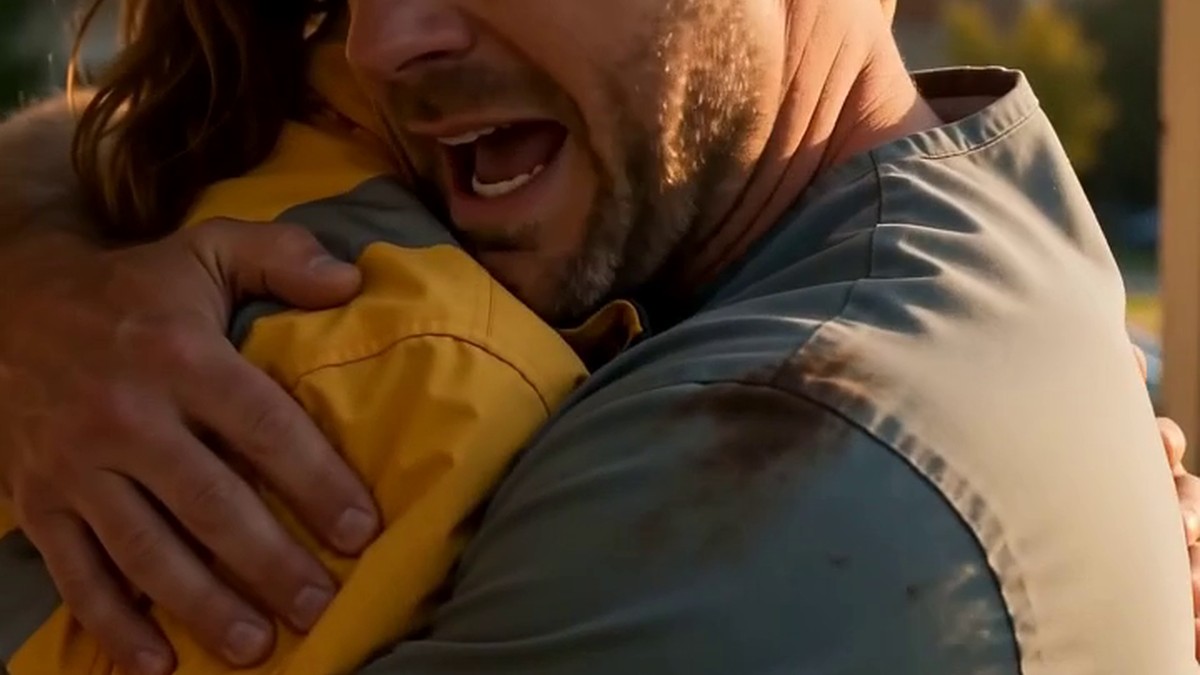
She grabbed a fistful of his shirt and buried her face in his chest. Churro let out a loud, indignant meow and head-butted her shin, demanding to be included. Kevin laughed—a wet, shaky laugh—and pulled her inside, and the three of them stood there in the messy hallway, half laughing, half crying, the luggage forgotten on the porch.
“You owe me a cake,” Kevin said.
“I’ll bake you a hundred cakes,” she said. “But first, I’m telling Adrian the job is off. And then I’m helping Churro steal all your socks.”
She looked down at the cat, who had already flopped onto Kevin’s sneakers, purring like a broken engine. Some things, she thought, were worth staying for.