Harrison Grant’s estate in the Marin County hills was the kind of place where every surface gleamed and nobody raised their voice. Infinity pool. Floor-to-ceiling glass. A kitchen that belonged in a magazine spread. Silence draped the hallways like a second layer of insulation, the staff trained to move without a sound.
Silence was the one luxury Harrison couldn’t afford.
His son Leo was four, all dark curls and hollow cheeks, with eyes that wandered somewhere beyond the walls. He hadn’t spoken since his mother died in a car accident eight months earlier. Not a word. Not a cry. At night he’d sit bolt upright in bed, trembling, soaked in sweat, but he wouldn’t scream. The baby monitor would just show a tiny ghost shaking in the dark, fists clamped around his blanket, weathering terror like a silent storm.
Harrison did what he always did: he threw money at the problem. Specialists flew in from Chicago. Sensory tools and weighted blankets arrived in unmarked boxes. A speech therapist visited twice a week. He installed better blackout shades, softer carpet, a sound machine that mimicked rainfall. Each new protocol was printed, laminated, pinned to the fridge.
Leo only retreated further.
And Sabrina—Harrison’s polished girlfriend who had seamlessly moved into the role of lady of the house—had her own theories. The child needed structure, she said. Limits. He was being coddled into silence. No treats outside scheduled snack times. No sitting on the floor. No “babying” after lights out. She managed the household with the same crisp authority she brought to her charity boards, and every rule she enforced seemed to erase a little more of Leo from the room.
Maya came on a trial week after a preschool teacher who’d watched Leo for months said, very softly, “He doesn’t need another expert. He needs someone who knows how to wait.”
She was twenty-four. She wore sneakers from a drugstore and twisted her hair back with a plain elastic band. No pressed blouse, no leather binder full of credentials, no polished elevator pitch about her philosophy of care. Sabrina looked her up and down on the doorstep like someone had delivered a mislabeled package.
By the third day, Maya had noticed something every other adult had steamrolled right past. Leo flinched at abrupt loudness, but he would still his whole body when a sound repeated in a gentle rhythm. A teaspoon clinking the rim of a ceramic mug. Fingers drumming softly on the counter’s edge. A wooden spoon tapping the bottom of a metal mixing bowl.
So that afternoon, while the estate staff rushed around preparing for the next day’s meticulously curated garden tea—a fundraiser Sabrina was hosting for the local art museum—Maya sat on the kitchen floor near the pantry, Leo a few feet away.
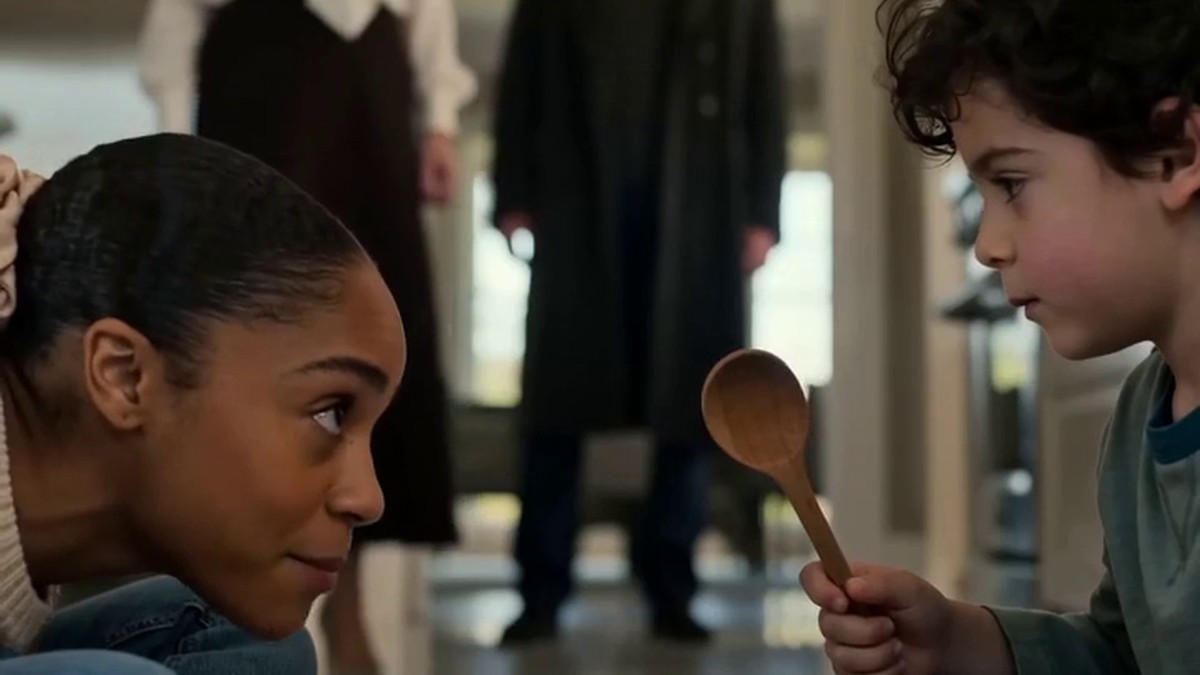
She picked up a wooden spoon. Tap on the bowl. Tap-tap on the tile. Pause.
She rolled the spoon toward him but didn’t push. “Your turn, if you want.”
Nothing.
Another pattern, slower this time. Tap. Tap-tap. Pause.
Leo looked at the spoon. His small fingers uncurled and curled again. Maya didn’t reach for him. She just rested one palm flat on the heated floor, her whole posture saying she had nowhere else in the world to be.
He reached out and picked the spoon up.
One clumsy tap.
Maya’s smile stayed in her eyes. “I heard that.”
She answered his one tap with one of her own. Then two. Then the pause.
That was when Harrison walked in early from a conference call and stopped dead in the doorway. A CEO in a cashmere coat, struck motionless by the sight of his mute son cross-legged on the kitchen floor beside a young nanny, tapping dents into Sabrina’s good mixing bowl like it was the most important conversation on earth.
Leo lifted the spoon again.
Tap.
Then, without glancing at his father, he pushed the bowl toward Maya.
Sabrina appeared behind Harrison and her face went the color of old milk. “What on earth is this? He should not be playing on the kitchen floor.”
Maya kept her voice even. “He’s responding.”
“It’s senseless noise,” Sabrina snapped, stepping forward. “And tomorrow we need him composed, not wound up. This is exactly the kind of chaos that sets him off.”
Harrison didn’t move. He just watched.
Maya gave the side of the bowl one light knock and waited.
Leo swallowed, grabbed the spoon with both hands, and for the first time since his mother’s casket was lowered into the ground, he leaned toward another human being with purpose.
Not toward his father.
Not toward Sabrina.
Toward the stranger on the floor.
And in a voice scraped thin from months of disuse, he said a single word.
“More.”
Sabrina’s lips pressed into a bloodless line. Harrison’s face cracked open into something raw and unreadable. The old order of the house wobbled on its axis. A silent boy had spoken. The girl who didn’t belong had been the one to hear him. And everybody in that kitchen knew, just then, that this wasn’t a small miracle. It was a declaration of war.
—
The garden tea was supposed to be Sabrina’s triumph. By ten a.m., white tents dotted the east lawn like enormous petals, tables dressed in linen and silver, caterers gliding between guests with trays of champagne and miniature pastries. Fifty of Marin County’s most influential names mingled under a flawless blue sky. Sabrina circulated like a queen, her dress a shade of pearl that matched the roses.
Maya had been instructed to keep Leo in the east wing nursery, out of sight. “Today is not about him,” Sabrina had said that morning, her tone brooking no discussion. “One outburst in front of these people and the Lunenvale donation is dead. You understand?”
Maya understood exactly what Sabrina was afraid of. Not a disruption. A revelation.
She dressed Leo in soft gray trousers and a tiny white shirt, then sat him by the nursery window that overlooked the garden. Together they tapped patterns on the sill: tap-tap, pause, tap. Leo’s replies were stronger now, more intentional. He’d added a second word last night—“again”—and Maya had filed the sound away like a treasure.
Around noon, the door swung open without a knock. Sabrina stood there, a flute of champagne in one hand, her smile tight as elastic stretched to breaking. “The photographer from Marin Living is here. I want Leo in the rose garden for one family portrait. Make sure he’s clean and quiet. Two minutes, in and out.”
“He’s not an accessory,” Maya said softly.
Sabrina’s eyes flickered. “Today he is. This is how we survive in this world, sweetheart. By showing people what they want to see.”
Before Maya could argue, Sabrina had already swept back down the hall.
She took Leo’s hand. “We’re going to the garden. You stay with me, okay? Tap if you need a break.”
He blinked, and his small fingers closed around hers.
The moment they stepped onto the clipped grass, the chatter of voices hit Leo like a physical blow. He flinched, his whole body going rigid. Maya crouched and tapped three times on her knee, slow. Tap. Tap. Tap. His breathing steadied. They walked forward together, a tiny island of calm in a sea of polished strangers.
Sabrina stood posed beside a trellis of climbing roses, Harrison at her elbow, both of them wearing practiced smiles for the camera. She gestured sharply for Maya to place Leo between them. “Stand right here, sweetheart,” Sabrina cooed, her public voice dripping honey. “Smile for the nice man.”
Leo’s face was blank. The photographer raised his lens. “Okay, everyone look this way. One, two—”
Leo broke away.
He didn’t run. He walked. Straight to the caterer’s table, where a stack of silver serving spoons lay beside a tray of chocolate-dipped strawberries. The crowd’s murmur dipped. Sabrina’s smile froze. Harrison started forward, but Maya put a hand up and shook her head once.
Leo picked up a spoon.
He turned to face the fifty guests, his father, Sabrina, the photographer, the whole performative machinery of his father’s world. Then he dropped to his knees on the grass, ignoring the dirt that would stain his trousers, and began to tap the spoon against the metal leg of the catering table.
Tap. Tap-tap. Pause.
Tap. Tap-tap. Pause.
The garden fell silent.
Sabrina’s voice cut through. “Leo, stop that this instant. Harrison, do something.”
Harrison didn’t move. His face had gone unreadable again, but his jaw was tight.
Leo kept tapping, his rhythm growing stronger. Then, looking not at Sabrina or the guests but straight at his father, he spoke. A full, halting sentence, the words scraped up from the bottom of a very deep well.
“Mama… tapped. Before… sleep.”
The silence that followed wasn’t the sleek, curated silence of the house. It was the thunderous quiet of a truth landing.
Sabrina laughed, brittle and ugly. “He’s confused. The heat. Someone get him some water.”
But Harrison had already paled. He knelt down in the grass, his expensive trousers be damned, until his eyes were level with his son’s. “What did you say, Leo?”
The boy’s lip trembled. He tapped the spoon one final time against the table leg, then dropped it and pressed his hand to his father’s cheek. “Mama tapped. Here. Goodnight tap.”
Harrison’s composure shattered. His wife had had a habit, something she did every night when putting Leo to bed: she’d tap three times on his nightstand, then press her hand to his cheek. Tap-tap-tap. A little ritual he’d completely forgotten until this instant. He hadn’t been in the room for bedtime in months. Sabrina had taken over the routine, and she’d stripped away every trace of the mother’s presence.
Now, in front of fifty witnesses, the mute boy wasn’t acting out. He was grieving out loud for the first time. And every tap of that spoon was a language Sabrina had tried to silence.
Harrison pulled Leo into his arms and held him, right there on the grass, the caterers frozen mid-step, the guests unsure where to look. Sabrina’s face twisted through several ugly expressions before she landed on pure fury. Without a word, she set her champagne glass down on a nearby table with a definitive click, then turned and strode back toward the house, her heels punching holes in the lawn.
Maya stayed where she was, a few steps back, giving the father and son their space. A couple of women from the art museum board started murmuring about the Lunenvale donation; someone else hushed them.
After a long moment, Harrison stood up, Leo still pressed to his chest. He scanned the crowd and found Maya. His eyes were red. “You knew he was remembering something.”
“I guessed,” Maya said. “But he had to be the one to say it.”
“She would have fired you,” he said, his voice thick. “This morning. She handed me a list of new nanny candidates. Top-tier agencies. I almost signed it.”
Maya said nothing.
Harrison shifted Leo’s weight to his hip, the way he hadn’t held the boy in nearly a year. “I’m not signing that list. And I need you to stay. Not just for Leo.” He paused. “The house has been too quiet for a long time. I think I forgot how to listen.”
Leo, face buried against his father’s neck, began to tap gently on Harrison’s shoulder. Tap. Tap-tap. Pause.
Harrison closed his eyes, and for the first time since the funeral, he tapped back.
—
Sabrina left the estate that evening, her belongings packed by a hired team before sundown. She made a few calls attempting to salvage her reputation, but the scene at the garden tea had already spread through the county faster than any fundraiser could have. The Lunenvale donation went elsewhere, and Sabrina’s name quietly vanished from several charity boards by the end of the month.
Maya stayed. Not as a trial, but as Leo’s primary caregiver, on the sole condition that Harrison stop outsourcing his son to specialists and spend time in the messy, unscripted spaces where Leo actually lived. The kitchen floor became their headquarters. Harrison learned the tapping language, learned to wait, learned that healing didn’t come with a laminated protocol.
Leo’s words returned in fragments, then sentences, then the kind of endless questions that four-year-olds are meant to ask. He still woke sometimes in the dark, but now when he did, he called out. And someone always answered.
The house on the Marin County hill remained beautiful, but it was no longer a museum. There were scuffed floors now, wooden spoons in every drawer, and a small dent in the side of a metal mixing bowl that nobody ever tried to fix.