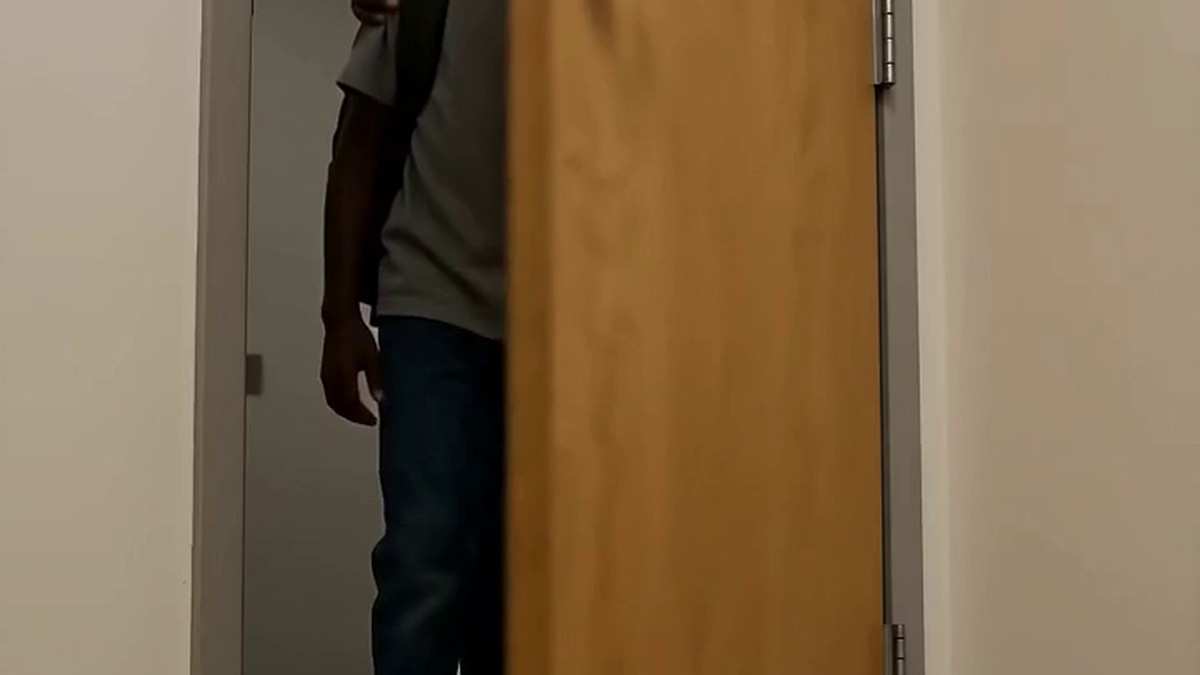
The Day He Stuffed the Cat into a Burlap Sack, the Boy Next Door Knew He Had to Stop Him
Earl Hawkins hadn’t fixed his gate since the previous spring, when the iron latch snapped while he was wrestling two heavy buckets onto the porch. One hinge held on by rust and habit, letting the gate sag open just enough for the wind to slam it at night—a sharp, lonely crack that cut through the dark like a door nobody ever stepped through. Earl got used to it the way he’d gotten used to everything else: the silence his wife left behind three years ago, the once-a-month Sunday phone calls from a son in Phoenix that never lasted longer than four minutes, the vegetable patch slowly surrendering to crabgrass because bending over meant admitting his back was shot and paying for help felt like surrender.
The cat showed up in September. She was a scrawny gray thing with a white splotch on her chest and a notched ear that looked like a can opener had gotten the better of her. She didn’t meow or rub against his leg. She parked herself on the bottom step, squared her shoulders, and stared at the front door like a customer who’d arrived early for a meeting. Earl came out, took one look at her, and said, “I got nothing for you. Barely got enough for myself.”
She didn’t budge.
He went back inside, found a heel of baked cod in the fridge, laid it on a folded newspaper, and set it on the porch. She ate with slow, deliberate care, licked her paws clean, and settled back onto the same step. “Suit yourself,” he muttered.
By October she was sleeping on his doormat. He never invited her in—he just woke up one morning and found her curled inside the mudroom, her side rising and falling like a tiny bellows. He didn’t know how she’d gotten in until he noticed the kitchen window hadn’t latched right since forever. He didn’t fix it. He bought a bag of dry cat food from the Dollar General and called it good.
Nine-year-old Cole Tucker cut past Earl’s house every afternoon on his way home from school. The shortcut took him through a gravel alley and right past that broken gate, which stood directly between him and his mom’s casserole on the counter. Cole always glanced into the yard—not because he was nosy, but because Earl had an old apple tree behind the shed, and even the wormy, puckered-up drops tasted better than nothing. By February the apples were long gone, but the habit stuck.
On a Thursday with a bruised gray sky, Cole saw Earl on the porch with a burlap sack in his hands. The sack was thrashing. Something inside scrabbled against the coarse fabric, a muffled, desperate sound, like fingernails on drywall. Cole froze at the gate. Earl didn’t see him. He walked to his beat-up Ford pickup, laid the sack on the passenger seat with a gentleness that seemed backwards, and went back inside. A minute later he reappeared carrying a cardboard box, which he wedged beside the sack and covered with a towel. The truck coughed, rumbled to life, and rolled out of the driveway, passing so close that Cole could smell the exhaust and hear the pitiful mewl that leaked through the burlap.
Heart hammering, Cole sprinted the last two blocks, crashed through his back door, and found his mother, Maggie, dicing onions at the kitchen counter. Tears sheeting down her face from the sting, not from sadness.
“Mom! Mr. Hawkins put the cat in a sack! The gray one with the white spot! He threw her in his truck and drove off!”
Maggie set the knife down. “Slow down, Cole. What cat?”
“The stray that lives with him! I saw her! The sack was moving, Mom. She was scratching to get out. He’s gonna dump her somewhere—or drown her at Crowley Lake, the way Old Man Graves used to with the kittens. You told me!”
Maggie’s jaw tightened. She’d told him that story exactly once, thinking it was a harmless piece of local color. She hadn’t realized he’d tucked it away like evidence.
“We don’t know that’s what he’s doing. Maybe he’s taking her to a vet.”
“In a sack? Nobody takes a cat to the vet in a sack! They use a carrier!”
He was right, and Maggie knew it. She also knew Earl Hawkins: a retired diesel mechanic, widower, the quietest neighbor on Maple Street. He’d fixed her garbage disposal last Thanksgiving and refused to take a dime. He never drank, never yelled, never did anything louder than nod hello. The idea of him drowning an animal felt like a piece that wouldn’t fit any puzzle she could picture. But her son’s voice was cracking at the edges, and the image of that writhing sack had already burrowed into his head.
“Get your coat,” she said.
She didn’t know where they were going. The truck could have turned toward the lake, or the highway, or one of the old logging roads that spidered into the woods. Cole said, “Crowley Lake. That’s where they always did it.”
It wasn’t much of a plan, but Maggie turned the wheel toward the lake. They drove through the flat brown fields, past the abandoned grain elevator, down the rutted road that dead-ended at the water. No truck. The lake’s surface was cold and flat, choked with gray reeds that shivered in the wind. Cole pressed his forehead to the window and didn’t say a word the whole ride back. Maggie’s hands were tight on the wheel.
“We’ll check the vet in Lindale,” she said, pulling onto the county road. “It’s the only one for twenty miles.”
The Lindale Animal Clinic sat at the edge of town, a low cinderblock building with a faded sign. Earl’s pickup was parked crookedly out front, a cardboard box visible through the rear window. Maggie’s heart did something complicated—relief and embarrassment tangling together. She parked and looked at Cole.
“Stay in the car.”
“No.”
She didn’t fight it. They walked in together, the antiseptic smell hitting them like a wall. A receptionist glanced up, but Maggie was already moving toward the cracked door of Exam Room One, where a voice rumbled low and familiar. Earl. She’d know that gravel tone anywhere.
Through the gap, they could see him hunched on a stool, his cap crushed in his hands. The gray cat lay stretched on a steel table, utterly calm on a blue towel, while a young vet with a blonde ponytail pressed gently along her swollen belly. A burlap sack with holes punched through it sat folded on the floor, a worn flannel shirt draped inside.
“When did you notice the change?” the vet asked.
“Three days. She quit eatin’. Started hidin’ under the shed. Wouldn’t come out for nothin’. I had to crawl under and drag her, and she was yowlin’ somethin’ awful. I thought… I thought she was dyin’.” Earl’s voice cracked on the last word.
The vet smiled softly. “She’s not dying, Mr. Hawkins. She’s pregnant. I’m feeling three, maybe four kittens. She’s healthy. Another week, give or take.”
Earl’s cap fell to the floor. He didn’t pick it up. He just stared at the cat, and the cat blinked back at him with slow, amber-eyed disdain, as if to say, _Took you long enough._ He reached out and stroked her between the ears, and the purr that rumbled through the steel table vibrated right through the door.
Cole stepped forward, and the hinge squeaked. Earl spun around. His face, already raw with emotion, crumpled further when he saw the boy and his mother standing in the hallway.
“Maggie? Cole? What in the—?”
Maggie opened her mouth and found nothing adequate. But Cole stepped into the room, his voice thin but steady. “I saw you put her in the sack. I thought you were gonna… like they used to, at the lake. I made Mom drive everywhere to find you.”
Earl’s eyes widened, then closed for a long, slow blink. When he opened them, he slid off the stool, knees popping like firecrackers, and crouched to Cole’s level. His hand settled on the boy’s shoulder—heavy, rough with calluses, and impossibly warm.
“You thought I was gonna hurt her.” It wasn’t a question.
Cole nodded, his chin trembling.
“I never would, son. Not ever. That sack’s the only thing I had. She won’t let me carry her, scratches to high heaven. But in the sack, in the dark with my old shirt, she calms right down. I poked holes so she could breathe. I bought a cardboard carrier online, but it won’t be here till Monday. She couldn’t wait till Monday.”
Cole looked at the sack on the floor, at the shirt with its faded logo, at the holes punched neatly along the seam. Then at the cardboard box by the door—inside, a clean towel, a sealed bag of premium kitten food from the feed store, and a tiny water dish sealed with plastic wrap.
“I was scared,” Cole whispered.
Earl squeezed his shoulder. “Good. That’s good. Means you care enough to do somethin’ about it. If I really had been the kind of man who’d do a thing like that, you and your mom would’ve stopped me. You drove clear to Lindale for a cat that ain’t even yours.”
“She’s yours, though,” Cole said.
Earl glanced at the cat, then back at the boy. “Yeah,” he said, his voice gravelly but soft. “I guess she is.”
Maggie leaned against the doorframe, blinking fast. The vet quietly excused herself to get some documents, and the room fell into a strange, fragile peace.
The kittens were born eleven days later, in the middle of a warm March night, on a pile of Earl’s old work shirts in the mudroom. Four of them: three slate-gray miniatures of their mother, and one creamy white with a dark splotch on his back that looked exactly like a thumbprint. Cole came over the next afternoon and sat cross-legged on the floor, not moving or speaking for half an hour, as the tiny creatures wobbled and mewed. The white one crawled right up his pant leg and fell asleep in the crook of his knee.
“That one’s trouble,” Earl said from his armchair. “Matches you.”
“He’s just sleeping.”
“Wait.”
Maggie brought over a casserole, and for the first time, Earl didn’t say “You shouldn’t have.” He just held the dish and nodded, his eyes crinkling at the corners. The gate got fixed that weekend. Cole held the drill, handed over the screwdriver, and watched Earl secure the new latch his mother had bought at the hardware store. When the gate clicked shut with a solid, final sound, Cole grinned.
“Now nobody’s gonna sneak in,” he said.
“Nobody who ain’t invited,” Earl agreed.
The white kitten went home with Cole when he was old enough, a tiny purring furnace in a proper carrier. Cole named him Blizzard, and every afternoon he’d carry him to the window so they could watch for Earl’s truck rumbling back from the grocery store. The gray cat—Earl had started calling her Missy—kept her spot on the sunny patch of the porch, supervising the neighborhood, her torn ear twitching at every sound. Sometimes in the evening, when the air smelled of fresh-cut grass, Earl would walk over and stand at the Tuckers’ gate, a bag of kitten treats in his hand, and he wouldn’t have to say a word before the door swung open. She hadn’t just dragged home kittens that spring. She’d dragged home a whole circle of people who’d finally learned to look past the broken latch and see the man on the other side.