I still remember the shape of the phone in my hand when my mother told me about the money.
It was April in Pittsburgh, the kind of wet spring afternoon where the clouds hang so low you can smell the steel dust and rain mixed together. I had just gotten off a double shift at the diner, and my feet were throbbing inside shoes I'd bought at Goodwill three months ago. The apartment was cold because I hadn't paid the gas bill yet. Again.
"Sixteen thousand dollars," my mother said. Her voice crackled through the burner phone I'd been using since my last one got shut off. "That's what your father and I have saved for you. For your green card. For the lawyer."
I sat down on the edge of the bathtub, the only place in that studio where you could sit without the neighbors hearing you breathe. Sixteen thousand dollars. I hadn't seen that much money in one place since I'd left Lviv with a suitcase and a prayer.
"When?" I asked.
"As soon as you come home. We want to give it to you in person."
I looked at the cracked ceiling tile above the tub, the one that had been leaking since November. Water stain in the shape of Ohio. I'd been in Pittsburgh for three years, working three jobs, sending every spare dollar back home, and my immigration case was still parked somewhere in the depths of the system. The lawyer I'd consulted had told me it could take another two years, maybe four. Maybe never.
Sixteen thousand could change the math.
A week later, I was on a train from New York to Chicago, a route I'd taken a dozen times but never with this feeling in my chest. I watched the flat Ohio farmland scroll past the window and thought about the look on my father's face when he'd first told me about the savings account. He was a man who measured love in silent acts, and this was the loudest thing he'd ever done.
The house in Cleveland's Ukrainian Village still smelled like cabbage and old wood when I walked in. My mother hugged me so hard I heard her wedding ring click against the back of my skull. My father stood in the kitchen doorway, arms crossed, the same way he'd stood when I left.
"Sixteen thousand," he said, as if the number itself was a welcome mat.
They gave it to me in an envelope, the paper so thick with use it felt soft, almost like fabric. They'd been collecting it in a coffee can under the sink for eleven years. My father had never once mentioned it. Neither had my mother. They'd just kept folding twenties into that can like they were planting a field they'd never live to harvest.
The first crack appeared two days later.
"You'll stay, of course," my mother said, setting a plate of varenyky in front of me. It wasn't a question.
"I have to go back to Pittsburgh. My job—"
"Your job is in a diner, Nadiya. Eleven dollars an hour. You can find eleven dollars an hour here."
"Mom—"
But my father was already sitting down across from me, and I could see it in his face, the way his jaw tightened the same way it did when he was about to announce a decision that was never up for discussion.
"We didn't save this money so you could waste it on a lawyer who'll just take you in circles," he said. "We saved it so you could come home and buy a house."
The word hung in the air like a bribe. A house. In Cleveland. Three blocks from them. Probably with a garden my mother would plant and a garage my father would fill with tools I didn't know how to use.
I stared at my plate. The varenyky were getting cold.
"That's not what you said on the phone," I whispered.
"I said we saved it for you. For your life." He leaned forward, forearms on the table, and I noticed for the first time how thin his wrists had become. "Your life is here, Nadiya. You were born here. Your grandmother is buried in the cemetery on State Road. America was never the plan. America was a detour."
"America was my choice."
"America was your escape." He said it the way he said everything, like it was already true.
The second crack came the next morning, when I went to the kitchen and found the envelope gone.
"Where is it, Dad?"
"Safe."
"Safe where?"
"I put it in the house." He didn't look up from his newspaper, the Ukrainian-language weekly printed in Chicago that he'd been reading for forty years. "I made an appointment with the realtor for Friday."
I had not agreed to a realtor. I had not agreed to a house. But I could feel the walls of that kitchen closing in, the same way they'd closed in when I was seventeen and he'd told me I wasn't allowed to apply to colleges out of state. The same way they'd closed in when I'd told him I was leaving for Pittsburgh and he'd said over my dead body.
This was the pattern of my whole life: he made a decision, and I was supposed to fall in line, and when I didn't, the money disappeared, the door locked, the phone went silent.
But I was not seventeen anymore. I was twenty-nine, and I had gone to America, and I had made a life there on my own terms, thin and hungry as that life sometimes was. I'd worked the graveyard shift at a gas station in McKees Rocks where a man once pulled a knife on me, and I'd kept working. I'd slept in my car for three weeks when I first got to Pittsburgh, and I'd kept going. I didn't come all this way to be managed like a child again.
Friday came. My mother put on her good blue dress with the small floral print. My father wore his brown suit, the one that still smelled faintly of mothballs. They spoke to me in Ukrainian, gently, the way you speak to a horse you're trying to load into a trailer.
The realtor's name was Donna, a tall woman with copper hair and the kind of professional smile that somehow made her look even less trustworthy. She shook my hand too firmly and said, "So exciting! Your first house in America!"
We drove in her car, a pearl-white Cadillac with buttery leather seats that my mother kept touching when she thought no one was looking. The house was on a street called Carpathia Avenue, which felt like a joke the universe was playing just for me. It was a bungalow with peeling white paint, a sagging porch, and a yard that was mostly dandelions. The listing price was one hundred and forty thousand dollars.
"Sixteen thousand will cover the down payment," Donna said brightly, "with a little help from an FHA loan."
My father nodded like she'd just read scripture.
And that was when I saw it. Taped to the inside of the front window, faded yellow and peeling at the corners. A drawing. A child's drawing of a house with a sun in the corner and three stick figures standing outside, all holding hands.
One of the stick figures was taller than the other two. And underneath, in painstaking cursive, someone had written a name.
*Nadiya.*
I turned to my father. "Did you tell her to do that?"
He wouldn't meet my eyes. My mother was suddenly very interested in the baseboard.
"This house belonged to a family named Kovalenko," Donna said, oblivious. "They moved out in March. The grandmother passed away and the children—"
"I know whose house this is." My voice came out sharper than I intended. "My grandmother lived two blocks that way. We walked past this house every Sunday on the way to church. I used to draw on the sidewalk outside it."
The chalk drawing had washed away years ago. But here it was again, reproduced by someone else's hands. Someone who knew exactly what she was doing.
I didn't scream. I didn't cry. I walked back to Donna's Cadillac and sat in the backseat with my hands in my lap, listening to my father talk about interest rates and property taxes, the words flowing over me like water over stone. My mother kept glancing at me in the rearview mirror, her blue dress matching the upholstery in a way that made her look like a piece of furniture.
That night, I waited until both of them were asleep. I found the envelope in forty minutes.
It was in my father's toolbox, the red Craftsman one with the dented corner from when he'd dropped it off the garage shelf in 2007. He'd tucked the money under a false bottom he'd built himself, a piece of plywood cut to fit so precisely you'd never know it was there unless you'd spent your whole childhood watching him work.
I knew that toolbox. I knew every drawer in that house. I knew my father's hiding places the way other people know their own reflection.
I took the envelope.
I didn't touch the rest of the money. I didn't take a single other thing, not even the photograph of my grandmother that I'd been eyeing since I arrived. Just the envelope, sixteen thousand dollars, the price my father had decided to put on my life.
I left a note on the kitchen table, held down by the salt shaker, the one with the rooster painted on it that my mother had bought at a church bazaar in 1998.
*I never said I was staying. You never asked if I'd take it.*
*I'm going back to Pittsburgh. I'm taking the money. This wasn't a gift — it was a leash.*
*I'll pay it back, every penny, with interest. But with a lawyer, not a realtor.*
*I love you.*
*Nadiya*
The train left Union Station at 6:20 in the morning, the same train that had brought me in. I sat in a window seat with my backpack pressed against my ribs and the envelope in my coat pocket, close to my heart.
At the Pittsburgh station, I called the immigration lawyer. The one who'd told me it could take years. I gave them four hundred dollars and a copy of my case file. The rest of the money went into an escrow account in my name, earmarked for this thing and nothing else.
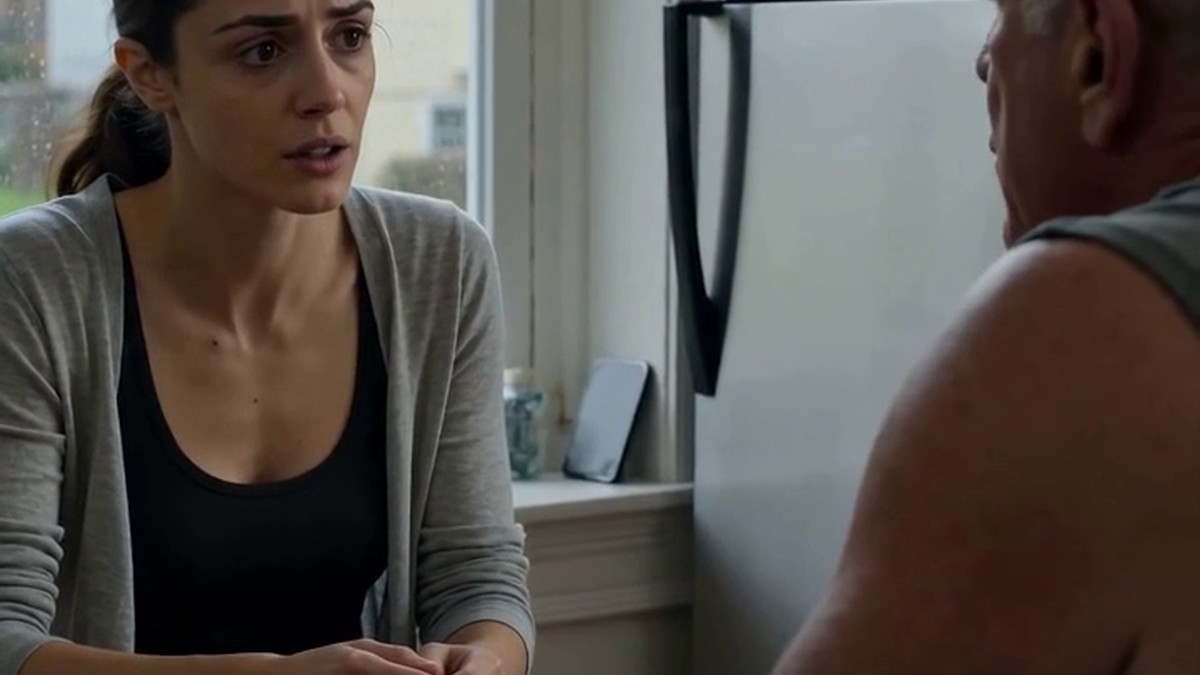
Two weeks later, my father called. He didn't yell, didn't demand, didn't threaten. His voice was quiet in a way that scared me more than any shouting ever could.
"It wasn't a leash," he said.
"Then what was it?"
A long pause, heavy with the sound of his breathing. I could hear my mother in the background, the clatter of pans, the old refrigerator humming.
"Your mother cried for three days," he said.
"Did you?"
Another pause. Outside my window, a bus went by, spraying gray slush onto the sidewalk. It had snowed again, a late April storm nobody'd predicted.
"I sold the car," he said.
"What car?"
"The Chrysler. I sold it. To a man in Parma. Got four hundred and ninety dollars for it."
I sat down on the edge of the bathtub again, the cracked tile above me still shaped like Ohio.
"Why?"
"Because you'll need it," he said, and hung up.
They never sent another envelope. I didn't ask them to. The escrow account sat in my name, and every month I added whatever I could spare, twenty dollars here, forty there, a hundred after a good week. I kept a ledger on the back of an envelope, my own version of the coffee can.
Ten months later, my case moved forward. There's a hearing in September.
I'm still not sure I'll ever be able to explain to my father that the house on Carpathia Avenue was never going to hold me, that the drawing in the window felt less like love and more like an anchor. Maybe I'll try when I go home again. Maybe I'll just leave it.
But I'll tell you one thing. When the lawyer called me in November, a clipped, efficient voice saying *status updated, next step scheduled*, I pulled out my phone to make a call. Not to my parents. To Dave, the manager at the diner, to tell him I needed a shift covered.
I worked a double that day. Eleven hours. The whole time I kept thinking about a blue dress, a false-bottom toolbox, and a coffee can under a sink.
Sixteen thousand dollars. It was all I needed to start. And it was the cheapest thing my father ever tried to sell me.