I run the front desk at a rock-art tour outfit outside Willcox, Arizona — twenty-two years now, ever since my husband and I bought out the old owner. Mostly I book petroglyph hikes for retirees from Phoenix and school groups that show up smelling like sunscreen and bus exhaust. I'm not an archaeologist. I just answer phones and hand out water bottles. But I was there the day Marisol Fenn walked in with a folder under her arm, and I've thought about that folder more than I've thought about almost anything else in this job.
Marisol taught geology at the community college in Tucson. She'd been coming through our canyon for six years, cataloging the panels on the sandstone bluffs — the ones tourists photograph and forget. That October afternoon, a Tuesday, slow season, she asked if she could see the panel we don't put on the map. The one behind the locked gate past the wash, the one we only show researchers with a signed waiver. My husband was at the dentist. I made the call myself, because Marisol had never once left a gate unlatched or a boot print where it shouldn't be.
We hiked in a little after two. It gets to a hundred degrees some Octobers out there, but that day it was maybe eighty-five, dry as a cracker, the kind of heat that doesn't feel like anything until you notice your water bottle's already half gone. There's a raven that lives near that gate — I don't know if it's the same one every year, but I like to think so — and it followed us the whole quarter mile, hopping branch to branch, complaining the entire time like we owed it something.
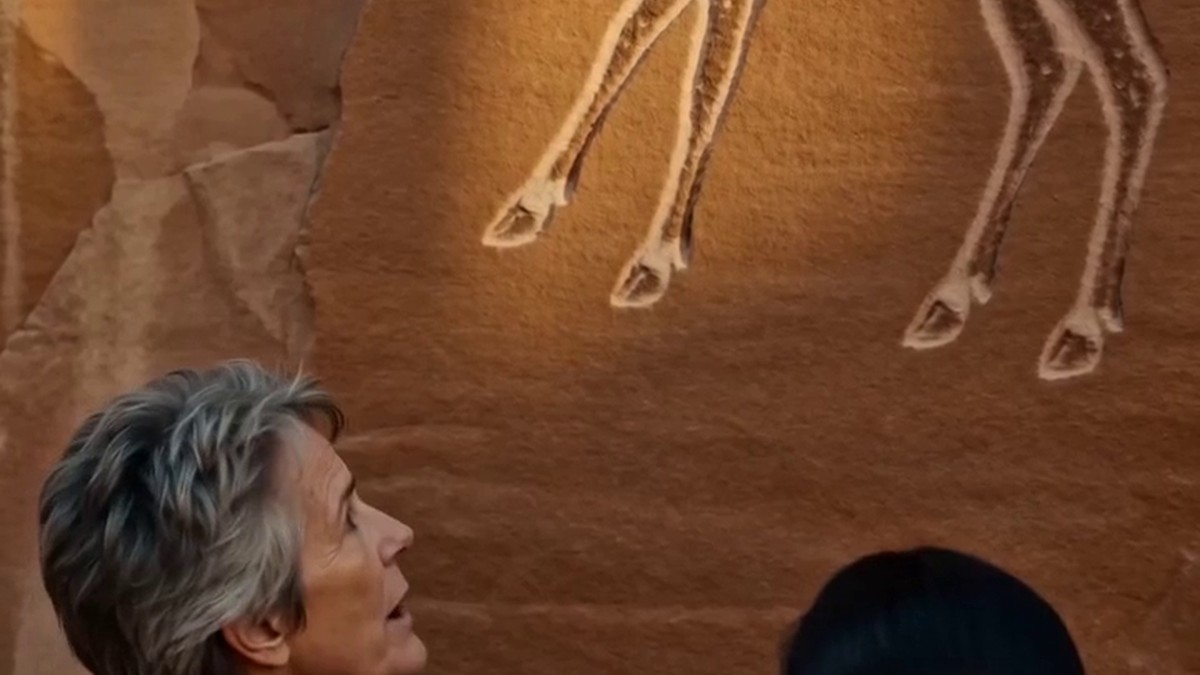
The panel is on a slab of desert-varnished sandstone maybe eighteen feet up a low bluff, sheltered under an overhang so it doesn't take direct sun. Carved into it: a pronghorn antelope, nearly life-sized, with a spotting pattern along its flank that doesn't look like any brushstroke a person would improvise. Marisol had photographed it a dozen times before. This time she'd brought calipers, a laser measure, and printouts of pronghorn coat-pattern studies from three different wildlife biology journals.
She spent maybe forty minutes just standing there with her neck craned, comparing the printouts against the rock, moving her flashlight at a low angle to catch the pecked grooves in shadow. I sat on a boulder and drank my water and watched the raven watch her. At one point she said, mostly to herself, "That's not a pronghorn." I asked what she meant. She said the spot pattern didn't match any subspecies on record — not the Sonoran, not the Chihuahuan, none of them. She said it three times, like she was trying to talk herself out of it.
I didn't think much of it in the moment. I had a tour group coming at four and a squeaky hinge on the gate that had been bothering me all week. But she asked if she could come back Thursday with a colleague from the university, and I said sure, so long as they signed the book.
They came back Thursday, and then again the following month, and by December there were four of them out there with a drone and a soil corer, mapping the wash and pulling pollen samples from a cutbank thirty yards downstream. My husband started grumbling about liability — said if somebody twisted an ankle on university business, our insurance wouldn't touch it, and he wasn't wrong to worry. I told him I'd rather carry the risk than turn away the first person in six years who'd looked at that rock and seen something worth arguing with.
What Marisol eventually told me — over coffee at the diner on Railroad Avenue, the one with the pie case that never has enough pie by two in the afternoon — was that the carving had probably been made somewhere between five and seven thousand years ago, when that stretch of desert was grassland, before the water table dropped and the mesquite took over. The pollen samples showed grasses and even willow, which don't grow anywhere near there now. And the pronghorn on the rock, she said, might not be a pronghorn at all. Might be something extinct, something with no bones ever found, no name in any collection anywhere. She'd started calling it, half as a joke and half not, Antilocapra fenn, after herself, which made her laugh and then look a little embarrassed, like she'd said something out loud that was supposed to stay private.
She also found something she hadn't expected: scratched into the rock near the antelope's hind leg were nine tally marks, worn smoother than the main carving, like someone had come back to that same spot generations later and left their own mark on top of the old one. She thought it might've been Apache, added long after the original artist was gone — meaning that rock had mattered to people for thousands of years running, not just once.
I didn't hear from her for a while after that. Grant money dries up, semesters get busy, and I had a business to run — bookings, a broken water heater, my husband's knee surgery that laid him up for six weeks. Then in March she called, and her voice had a pitch to it I hadn't heard before, tight and fast. The university's vertebrate paleontology department had reviewed her photographs and measurements. They wanted to publish, but not the way she'd hoped. Their read was that the spot pattern was real erosion damage layered over an ordinary pronghorn carving — weathering that had eaten into the pecked lines over thousands of years and left a pattern that only looked deliberate. No new species. No Antilocapra fenn. Just an old antelope and a lot of wind.
She asked if she could bring a film crew from the university's outreach program to document the panel one last time before the department published its finding, and could we keep the site closed to regular tours for that one day. I said fine, and charged them the same day rate I'd charge anybody, because that's the arrangement we have with researchers — no favors, no exceptions, that's how you keep a research site from turning into a souvenir stand. She didn't argue about the fee. She didn't argue about much of anything that call.
The day they filmed, I walked out with them to open the gate and then left them to it, because I had a busload of eighth graders from Douglas showing up an hour later and needed to count clipboards. But I saw the setup before I left: Marisol standing in front of the panel with a printed transparency overlay in one hand, showing exactly how the spot pattern on the rock lined up with nothing alive today — the same overlay, I realized, that the department was about to use to prove her wrong. She wasn't performing for the camera. She had the look of somebody defending a position she already knew she'd lost.
Before I left, I asked her straight out whether she still believed it — that this was some animal nobody living had ever seen, carved by someone with nothing but a sharp rock and a lot of patience, on a slab that would still be standing when every one of us was gone. She ran her thumb along the edge of one groove, the way you'd check a blade for sharpness, and said the rock wasn't going to change its mind no matter what the department decided to call it. Then she said the paper would run under a different name — just Antilocapra americana, ordinary and correct — and that Antilocapra fenn would live on exactly nowhere except her own notebooks and maybe a line in my logbook, if I felt like keeping it. I told her I would.
The crew got their footage and packed up by four, right as my bus from Douglas rattled into the lot spitting gravel. I counted clipboards, twenty-six of them, herded the kids past the gate, and didn't think about the panel again until closing, when I drove back out alone to relatch it for the night.
I climbed up to the overhang with my flashlight, the same low angle Marisol always used, and ran my own thumb along the nine tally marks near the antelope's hind leg — the ones nobody was ever going to publish a paper about, the ones that didn't need a species name to mean something. Somebody had come back to this rock once, a long time after the first carver was gone, and added their count to it anyway. I didn't know what they'd been counting. Nobody ever would. But they'd thought it was worth marking, and the marking had outlasted every guess anyone made about it since.
I latched the gate, and the raven complained at me the whole walk back, same as always.