The kitchen on Tillman Street always smelled like coffee and cinnamon, even at nine in the morning when the rest of the world had already rushed off to work. I had set the box of pastries on the table between us like a peace offering, the pink bakery string still tied in a careful bow. My husband Marcus reached over and squeezed my shoulder. That three-second squeeze held everything: three years of no vacations, no new phones, no weekend trips. Just spreadsheets on the dining table and the same beige walls of our rental in Tulsa, watching a savings account tick upward toward one impossible number.
“We could book the flights right now,” I said. “Direct to San Diego. I checked the rates this morning.”
My mother set her mug down and the sound it made was wrong. A hard porcelain click, like a judge’s gavel coming down before the verdict.
“What is wrong with you?” she said. Her voice came out flat and dry. No heat, no volume. Just steel with skin on it. “Your sister is drowning.”
I watched Marcus’s hand fall away from my shoulder. The air in the room changed, the way it always did when my sister’s name entered a sentence. Some family arguments have a geography. This one had a map, and every road on it led to Trina’s mistakes.
“She’s got two credit cards in collections,” my mother went on. “The interest is eating her alive. She can’t sleep. She can’t eat. And you two are sitting here pricing beach hotel rooms like the world isn’t on fire.”
She wasn’t wrong about the fire. Trina had been burning through money since she was nineteen, lighting little fires everywhere she went: a car loan she couldn’t carry, a beauty school certificate she never used, a boyfriend with a gambling habit she thought she could love into submission. By thirty-one, my sister had turned debt into a lifestyle.
But the fire wasn’t mine to put out. Not anymore.
“Mom,” I said. “We’ve been saving for three years. You knew that. Everyone knew that.”
“She’s your blood!”
“And Marcus is my husband.” I tapped the airline app on my phone. “Those things get to exist at the same time.”
My mother’s mouth tightened. She had been expecting tears, maybe, or shouting. The two of us had fought in every key available to a mother and daughter since I was fourteen. What she was not expecting was what I did next.
I walked to the hallway closet, pulled a manila folder from the shelf, and set it on the table next to the untouched pastries. The folder had a printed label on the tab: *Family Commitments, FY 2024.*
“You want us to make a serious offer,” I said. “Fine. Let’s treat it like a serious transaction.”
I opened the folder. Loose scraps of paper, old receipts, a handful of bank statements with coffee stains on the corners. I had been collecting all of it for years without knowing exactly why. Every time my mother asked for money for Trina’s “emergency,” I wrote it down. Every time I said yes. Every time I said no.
“Total family loans to Trina since 2019,” I said, scanning the top sheet. “Fourteen thousand six hundred eighty dollars. Of that, she has repaid zero.”
My mother blinked. “That’s not what this is about.”
“That’s exactly what this is about.” I turned the sheet around so she could read it. “You want us to postpone the first real vacation we’ve ever taken because Trina made more bad choices. But I’ve been paying for Trina’s choices since I got my first tax refund, and the debt only grows in one direction.”
“You don’t understand pressure until you’ve watched your own child sink.”
“I understand pressure,” I said. “I understand that every single dollar in our savings account had a job. Do you know what three years of landscaping work does to a man’s back? Marcus has a compression brace in the closet from last May. He didn’t take a week off. Not one. And you’re asking us to hand that over to Trina, who gets her nails done every two weeks and posts it on Instagram from her leased Acura.”
The kitchen went silent. Somewhere outside, the neighbor’s beagle started barking at the mail truck, a sound so ordinary it felt like betrayal.
My mother touched the edge of the folder, then pulled her hand back as if the paper was hot. “Your sister made mistakes. That doesn’t mean she deserves to lose everything.”
“Nobody’s taking anything from her,” I said. “We’re just keeping what’s ours.”
She stood up. The chair scraped across the tile. “You always were cold, Olivia. Even as a child. Everything had to be written down. Everything had to have a rule.”
“It’s a worksheet, Mom. Not a crime.”
She pulled her coat from the back of the chair. I watched her try to find a last line, a closing argument, but the folder was still lying open between us like a ledger from a courtroom no one had asked to attend. Then she walked to the front door, turned back once, and said the thing I’d been waiting for all along.
“You could at least let Trina explain it herself.”
Two hours later, Trina was at that same door, standing on the welcome mat with the hem of her dress already wrinkled and one earring missing. She looked the way she always looked after my mother sent her in as cleanup crew: tragic at the edges, but polished enough for a photograph if the light was forgiving.
I told Marcus I’d handle it.
“You need to see her bank statements,” I began. “Last year’s tax return. A repayment schedule signed by her, with dates and amounts. Then we can talk about a loan.”
Trina laughed. It was a hollow, quick sound, like a coin dropping into an empty fountain. “You’re really going to make this a whole thing? I’m your sister.”
“Yes,” I said. “And I love you. That’s why I’m not going to pretend this is the first time.”
She had no folder. No plan. No numbers. She had a story about a landlord who raised the rent and a payday loan that renewed before she caught up. Some of it was probably true. All of it had been true before, in one arrangement or another, for over a decade. What she didn’t have was a single piece of paper showing how a dollar leaving my savings account would ever find its way back.
“I need time,” she pleaded.
“You’ve had time. You’ve had nine years. I’m not the one who’s late.”
She stood on the threshold, picking at the skin around her thumbnail. Behind her, the porch creaked. Then she launched into her own version of a closing argument: how I’d always been the favored one, how I didn’t know what it was like to struggle, how Marcus had likely never been turned away from a job because of a bad reference, how love wasn’t supposed to come with an interest rate.
I let her go through it. Then I pulled up the notes app on my phone, the same place I’d been tracking this family economy for years, and I read her the balance from the family loan column one more time.
She said something that had the shape of an apology but the weight of a receipt.
That evening, Marcus found me at the dining table, the manila folder open, the airline confirmation finally pushed to the corner. The tickets themselves would arrive later that week, a single printed confirmation page with a QR code and two seats on a plane that would take us farther than we’d ever been.
“I’m going to transfer the money,” I said.
He didn’t ask why or where. He just put his hand on my shoulder again, and for one long moment we both sat there, listening to the beagle bark at the end of the block and the overhead light buzz faintly, a sound we’d been meaning to fix for two months.
“The payday loan,” I said. “I’m paying it off directly. Four thousand eleven. Not the credit cards. Not the collections. Just the one that’s eating her alive.”
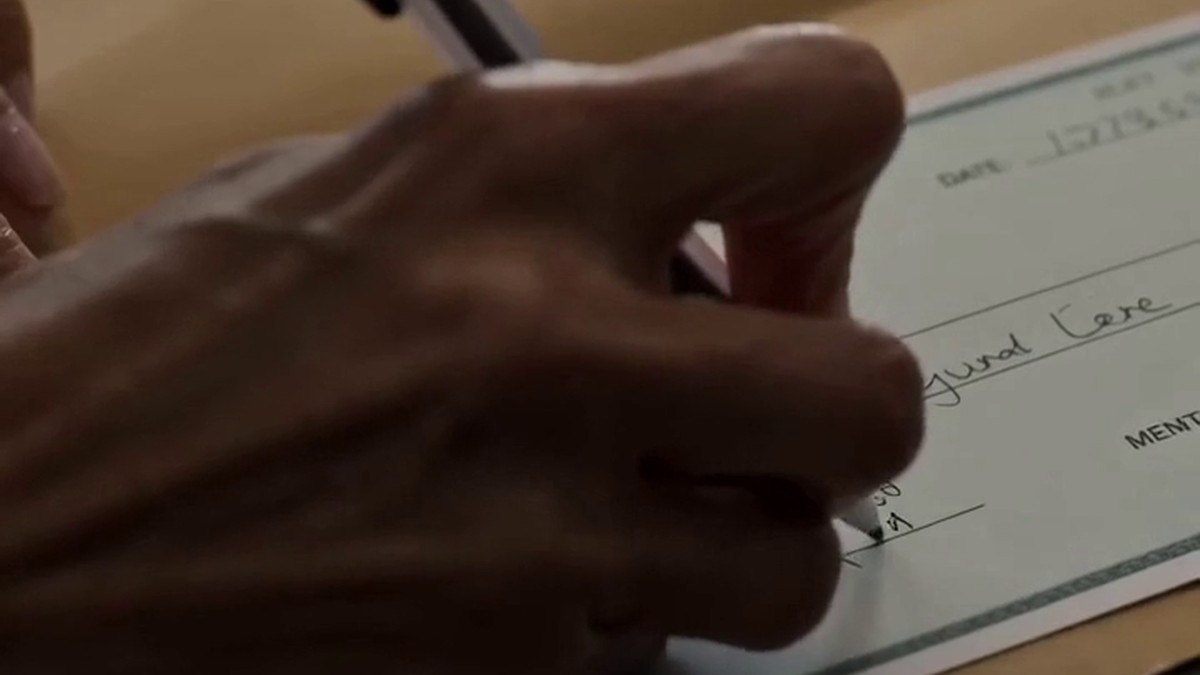
I wrote the check right there, with the folder open to the last page, where I’d already labeled the entry: *Final distress payment. Closing file.*
Not because she deserved it. Not because my mother asked. But because I had always known the fire was real, even when my sister stood too close to it on purpose.
I licked the envelope, pressed it sealed, and wrote Trina’s name across the front in blue ink.
Then I walked out to the mailbox on Tillman Street, slid the envelope inside, and lifted the red flag all the way up.
When I came back inside, Marcus had pulled the bakery box toward him and untied the pink string. He pressed a pastry into my hand, and the two of us sat there in the kitchen, saying nothing, which was something.